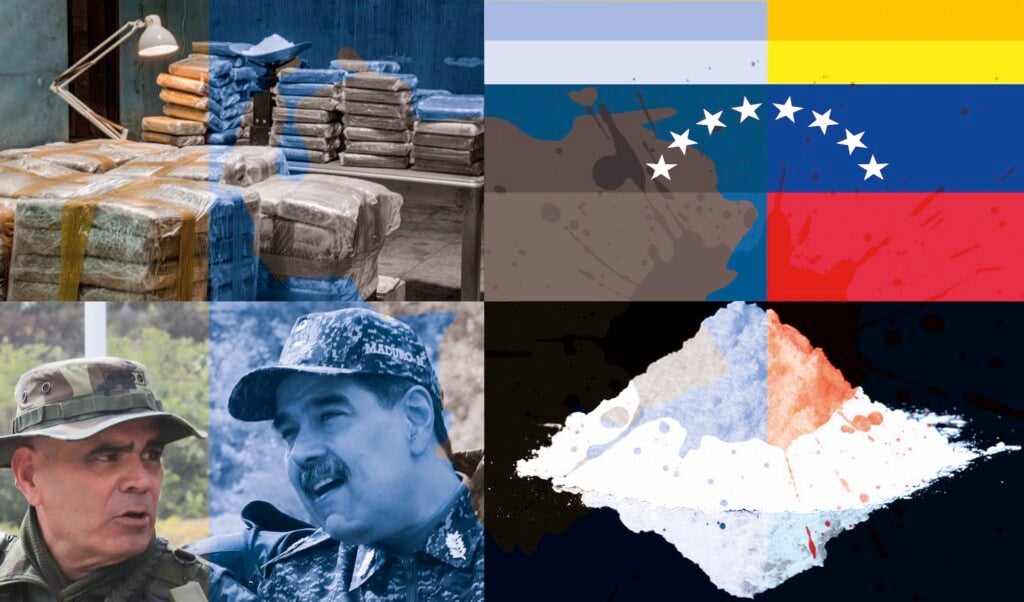
The decades-long erosion of democracy in Venezuela has culminated in a chilling diagnosis: The state itself has been co-opted. At the heart of this process is the Cartel of the Suns (CdS), an informal network of high-ranking Venezuelan military officers and political elites led by Nicolás Maduro that has transformed the illegitimate government into a criminal enterprise.
As argued by Juan Miguel Matheus in the Journal of Democracy, this represents the definitive “gangster state,” where political power and criminal operations are no longer distinct but fully fused. The very military institutions designed to protect the nation have been repurposed as a transnational criminal organization (TCO).
“Maduro is the mafia boss in this story. He has succeeded in merging political power with criminal power into a single apparatus. He colonized the Venezuelan state and has bent it to serve international organized crime, destroying his country’s democracy along the way,” says Matheus, a Venezuelan politician in exile and research fellow at the University of Texas School of Law.
Institutionalizing illicit governance
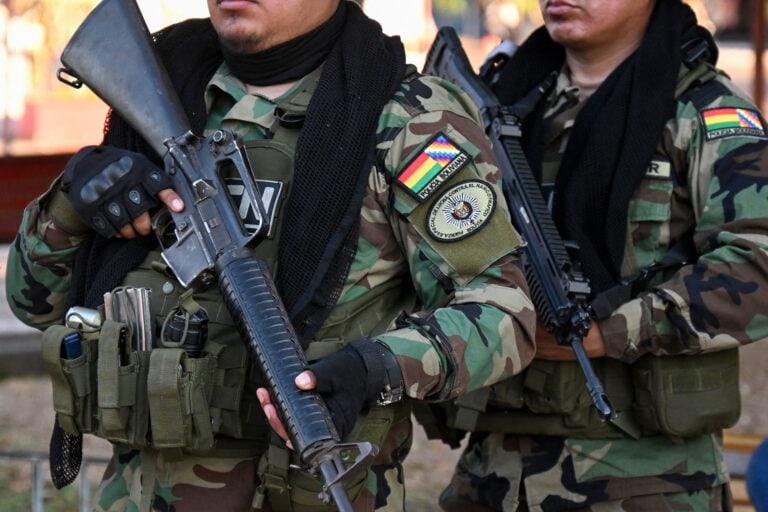
The origins of the CdS — named for the sun insignias on the uniforms of Venezuelan military generals — lie in historic military corruption, BBC Mundo reported. The institutional conditions for the network’s growth were first established under the administration of Hugo Chávez.
Today, Maduro and other top officials head this network, which leverages control over every critical logistical asset — ports, airfields, and border checkpoints — to facilitate global smuggling. This institutional control provides the regime with a vast revenue stream, which, according to various security analysts, is essential for maintaining political loyalty and funding the repressive apparatus. The illicit revenue generated by the network’s operations, which includes facilitating the distribution of as much as a quarter of the world’s cocaine supply, according to think tank Center for a Secure Free Society, is used to purchase the allegiance of the military elite, making their survival dependent on the regime’s continuation.
Regional response: Designating a terrorist threat
The CdS is not just an internal Venezuelan crisis; it is a transnational security threat that has prompted decisive action from regional governments.
A growing number of Latin American nations, including Argentina, the Dominican Republic, Ecuador, Paraguay, and Peru have formally designated the CdS as a terrorist organization, following the lead of the U.S. Treasury July designation. This move not only imposes sanctions but fundamentally rejects the legitimacy of the Venezuelan power structure.
Upon Argentina’s designation of the CdS in August, Security Minister Patricia Bullrich was explicit in her assessment of the regime’s leadership. “Maduro and all his entourage are narco-criminals,” Bullrich said via X, emphasizing that the action was taken to advance regional security efforts against the group and its ties to drug trafficking.
Confirmed in U.S. courts
The criminal structure of the CdS has been substantiated by key figures within the regime who have faced U.S. justice. In a landmark case, former Venezuelan military intelligence chief Hugo “El Pollo” Carvajal pled guilty in June 2025 in a New York federal court to narcotics conspiracy charges.
Crucially, Carvajal explicitly acknowledged his role in the structure of the CdS, confirming the involvement of the highest echelons of the military in massive, continental-scale drug-trafficking operations.
Weaponizing transnational criminality
The CdS does not operate in isolation. It relies on strategic alliances with other powerful TCOs, allowing it to export crime and instability across the hemisphere, including by providing material support to both the Mexican Sinaloa Cartel and the notorious Venezuelan mega-gang, the Tren de Aragua (TdA), also designated a terrorist organization by several nations of the region.
Critically, Venezuela under the Maduro regime also acts as a haven and operational base for foreign armed groups, including the Colombian National Liberation Army (ELN) and FARC dissidents. These groups control illicit border economies, causing regional instability and presenting cross-border threats.
The Maduro regime also collaborates with criminal groups engaged in violence and repression beyond Venezuela’s borders. This capability was demonstrated in the highly publicized 2024 assassination of exiled Lieutenant Ronald Ojeda Moreno in Santiago, Chile. Ojeda, a vocal political dissident, was kidnapped from his apartment by individuals posing as police and later found dismembered and buried in cement.
Chilean prosecutors, citing protected witnesses, alleged the assassination was politically motivated, orchestrated from Venezuela, and carried out with the involvement of the TdA. Furthermore, Chilean Attorney General Ángel Valencia stated that at least one witness testified that the high-ranking Venezuelan official Diosdado Cabello Rondón, Maduro’s so-called minister of Interior, Justice and Peace, ordered and financed the killing through TdA intermediaries.
“As if ordering and executing the torture and killing of Venezuelans through the Venezuelan armed forces and police inside Venezuela weren’t enough, Maduro is now resorting to this notorious international gang [TdA] to execute its transnational crimes,” Human Rights Foundation Chief Legal and Policy Officer Javier El-Hage said in an April 2025 statement.
The targeted murder of a dissident on foreign soil, executed with the logistical precision of a state intelligence operation but carried out by a major terrorist organization, underscores the CdS’s nature: A criminal enterprise within a captured state, utilizing transnational criminal networks to present profound threats to democratic stability across the continent.