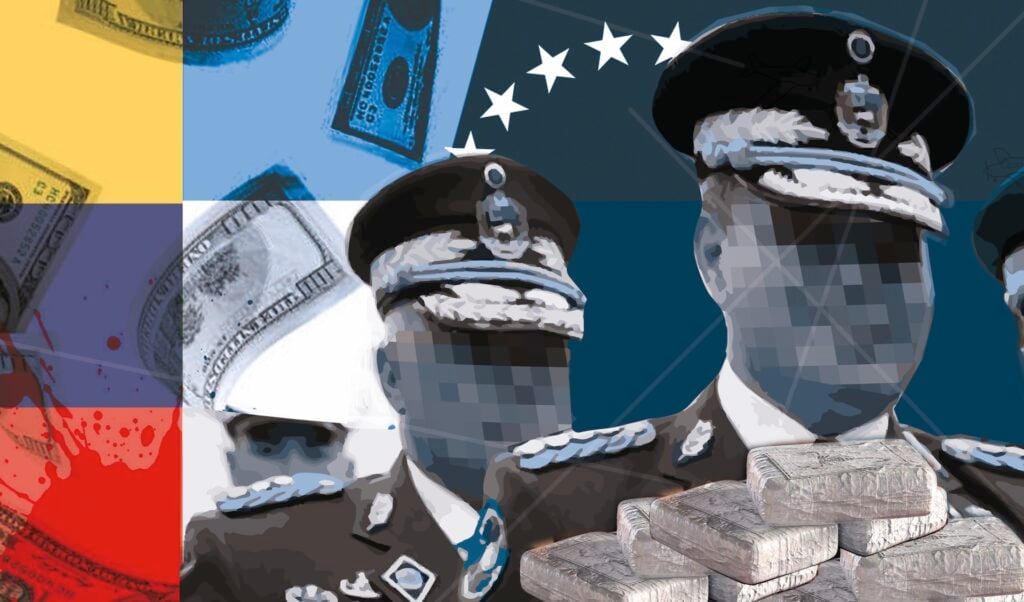
A comprehensive transnational journalistic investigation, spearheaded by the international investigative journalism organization Organized Crime and Corruption Reporting Project (OCCRP), in partnership with the Latin American Center of Investigative Journalism (CLIP) and various regional organizations, continues to highlight the profound involvement of the Nicolás Maduro regime and its military in the drug trade. The project, originally published in 2023, stemmed from a massive leak of documents from the Colombian Attorney General’s Office.
“The management of cocaine trafficking in Venezuela is not something new,” Euclides Tapia, a senior lecturer in International Relations at the University of Panama, told Diálogo in a late 2023 interview. “Since Maduro took control, he has been identified as the main person responsible for this illegal and money-laundering mechanism.”
The investigation incorporates testimonies of former officials of the Chavista regime, DEA agents, and former members of the Cartel of the Suns. These accounts detail the operations of the Cartel of the Suns, which is led by high commanders of the Venezuelan Armed Forces, and corroborates the allegations made by the U.S. justice system.
“It lacks a single, traditional leader but is controlled by the senior officers of the National Armed Forces. It maintains a low profile yet boasts powerful allies, including the Sinaloa Cartel and the ELN [National Liberation Army]. Its structure is hazy, sometimes dismissed as a legend, but it is real, capable of moving up to 350 tons of cocaine a year. Whether by rivers, farms, or airplanes, the Cartel of the Suns continues to traffic in Venezuela, a reality established by U.S. justice accusations and now underpinned by dozens of documents from the Colombian Attorney General’s Office,” Venezuelan investigative news site Armando.info reported in late 2023.
In 2020, the U.S. Justice Department indicted Venezuela’s Maduro and high-ranking officials of his regime for leading the Cartel of the Suns to traffic cocaine to the United States. The Colombian leak confirms their continued alliance with dissidents of the Revolutionary Armed Forces of Colombia (FARC), even following the demobilization of most of the guerrilla force.
A former DEA agent told OCCRP that, given the military’s strict hierarchy, high-ranking leaders and Maduro’s Defense Minister Vladimir Padrino López, who wield substantial control over territory alongside the Bolivarian Army and the National Guard, were directly involved.
The leaked documents revealed the involvement of more than 75 high-ranking regime officials and businessmen linked to the cartel. This group includes members of the Armed Forces, local and regional officials, and business figures who facilitate the protection and concealment of the Cartel of the Suns’ activities and assets.
A significant political development occurred in August 2024, when Diosdado Cabello Rondón, a key figure indicted by the United States for drug trafficking, was appointed the regime’s Minister of Interior, Justice and Peace, effectively placing an alleged cartel leader at the head of the country’s security and anti-narcotics apparatus.
Targets and tactics
The drug trafficking network established by the Venezuelan regime pursues four core operational objectives: to make periodic payments to military units; to establish secure corridors for the transport of narcotics; to utilize military vehicles to move drugs; and to control the trafficking infrastructure, particularly in ports and airports.
Over two decades, the Cartel of the Suns evolved from a disorganized trafficking network into a sophisticated system of patronage (clientelism). This mechanism is used to distribute drug-generated wealth to individuals Maduro deems critical for sustaining the regime’ stability.
The Venezuelan Army facilitates drug trafficking by land, sea, and air through several methods: sanctioning the passage and protection of shipments, manipulating radars for illegal flights, receiving payments to bypass searches, and authorizing the departure of shipments from facilities guarded by military and government agents.
“Maduro [through the Cartel of the Suns] is attempting to institutionalize cocaine trafficking, considerably increasing the capacity to increase the drug trade directly, which could prove even riskier,” Tapia said.
International trafficking
Trafficking from Colombia to Venezuela is rooted in coca leaf production in Catatumbo. According to the OCCRP report, most of the coca cultivation within the 42,000 hectares of this area bordering Zulia state is routed into Venezuela via the Catatumbo, Zulia, and Tarra rivers.
Once in Venezuela, the cartel sends the cocaine to ports and clandestine airstrips. These shipments are then trafficked to intermediate destinations — including the Dominican Republic, Trinidad and Tobago, Honduras, Suriname, and Guyana — and, in some cases, to final destinations such as the United States and Europe.
In recent years, according to the report, the cartel evolved from transporting narcotics to processing them. They have established a network of laboratories in Venezuela capable of transforming coca paste into powder cocaine, thereby yielding more substantial profits.
In a report, nongovernmental organization Transparencia Venezuela indicated that drug trafficking is the country’s primary illicit economy. Cartels, guerrilla groups, and other criminal organizations generated of an estimated $8.2 billion in 2024, a sum representing a significant portion of the country’s economic activity.
Cocaine production in Venezuela’s border region, characterized by poverty, isolation, and the dominance of armed groups, creates conditions ripe for the cartel’s expansion. This activity represents a major threat within a country mired in a severe economic crisis and governed by a corrupt regime, according to InSight Crime, an international organization dedicated to the study of organized crime in Latin America.
‘Immunity’
The Cartel of the Suns’ involvement is not limited to international and local drug trafficking. Its illicit portfolio extends to gasoline smuggling, illegal mining, logging, the illegal sales of regulated products, and arms and ammunition trafficking inside prisons.
“Their sense of immunity is fueled by internal and external backing from nations such as China and Russia, particularly the backing of the Russian Army,” Tapia said. “They believe that no one has the capability to remove Maduro or his power structure, which affords them a sense of absolute security.”
However, Tapia added, “a conviction by the International Criminal Court for human rights violations would leave him with few options for refuge: Cuba, China, Iran, North Korea, Nicaragua, or Russia. Otherwise, he would be at risk of arrest.”
Note: This article is a revised and updated version of a report originally published in November 2023.