
As customs controls become increasingly sophisticated, transnational criminal organizations (TCOs) are turning to ever more complex concealment methods. Among them is so-called liquid cocaine, produced by altering the drug’s physical properties and incorporating it into seemingly legitimate liquid or viscous substances, such as beverages, fruit juice and pulp, oils, shampoos, creams, and gels.
Once it reaches its destination, the cocaine must be recovered through chemical processes. The complexity of these operations does not make them unprofitable: High profits in destination markets can make the method economically viable even when some of the drug is lost during the recovery process.
“The first cases were detected by authorities around 2010-2011 and are part of the innovations drug traffickers introduce into their business as they seek to circumvent authorities’ controls,” Luis Fernando Trejos Rosero, a professor and researcher at Universidad del Norte in Barranquilla, Colombia, told Diálogo.
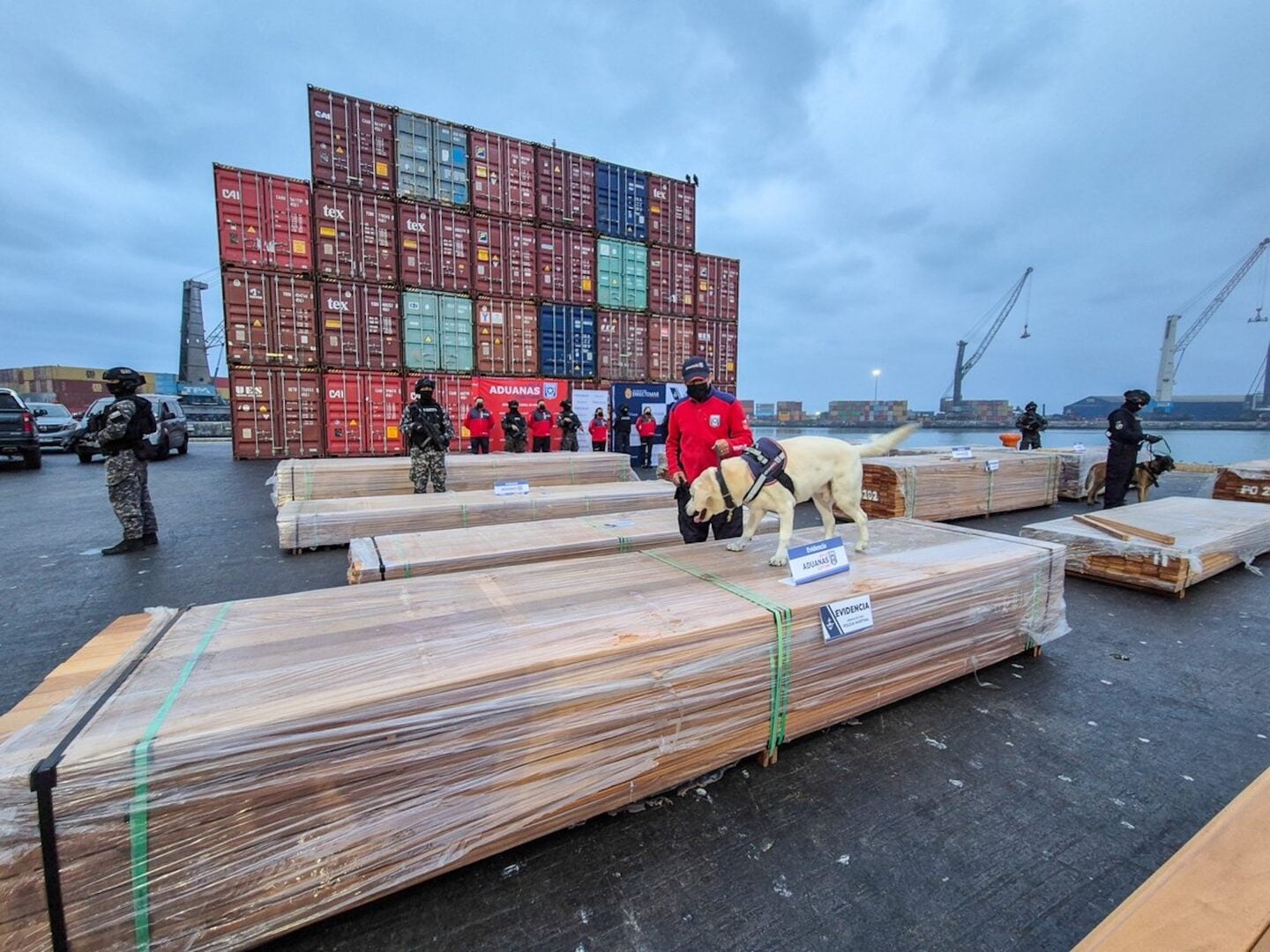
Although there are earlier documented cases of cocaine dissolved in or impregnated into other materials, the method has become more widespread and visible across the region, with increasingly sophisticated techniques. In some cases, cocaine is dissolved in a solution used to impregnate solid materials, such as wood, making it even more difficult to distinguish the drug from the legitimate goods concealing it.
In Chile, a six-month investigation in June 2026 uncovered 1,080 metric tons of wood impregnated with illicit substances at the ports of Arica, Valparaíso, and San Antonio. Authorities estimated that the shipments contained approximately 108 metric tons of drugs, primarily cocaine hydrochloride and ketamine.
“This is 100 percent intelligence work and investigative work. Nothing was found by chance,” Arica and Parinacota Regional Prosecutor Mario Carrera told Infobae.
The Chilean case illustrates how these techniques shift the challenge for security forces from simply detecting drugs to rapidly identifying high-risk shipments without slowing legitimate trade. The investigation, conducted jointly by the Arica and Parinacota Regional Prosecutor’s Office, the Chilean Navy’s Maritime Police, and the National Customs Service, combined intelligence and criminal analysis to identify the contaminated shipments.
Because comprehensive inspections require significant time and resources, interagency and international cooperation, criminal and financial intelligence, and chemical forensic capabilities are critical to identifying suspicious shipments and reconstructing the networks behind them.
Concealment techniques
The term liquid cocaine does not refer to a single technique, but rather to a family of methods in which the drug is dissolved in a substance or incorporated into a material until it becomes difficult to distinguish from the legitimate goods concealing it. The variety of products and materials used demonstrates how organized crime adapts concealment methods to the type of merchandise, route, and size of the shipment.
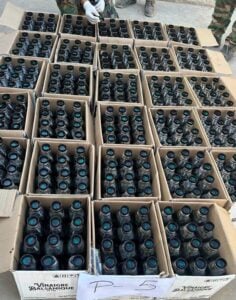
In July 2026, for example, Bolivian authorities seized 1,643 bottles bound for Luxembourg in which cocaine had been dissolved in balsamic vinegar. According to Oruro Departmental Prosecutor Aldo Morales, it was the first time authorities had detected the use of this substance to conceal liquid cocaine. The same approach extends to large international supply chains. In February 2025, Dutch Customs detected three containers from Brazil at the Port of Rotterdam carrying refrigerated drums of fruit juice. In several dozen of the drums, cocaine had been dissolved in liquid; laboratory analysis determined that the shipment represented 2,950 kilograms of cocaine.
Concealment can go beyond dissolving the drug and make cocaine part of the material itself. “I am aware of cases where sacks contained large quantities of plastic or rubber fragments, of which only a relatively small percentage was impregnated with cocaine,” Tony Saggers, an independent consultant and former head of Drugs Threat and Intelligence at the United Kingdom’s National Crime Agency, told Diálogo. “This creates an enormous inspection burden unless law enforcement can identify markings or other indicators showing where the cocaine is located or has specific intelligence. Even then, however, forensic analysis requires considerable work to grind down the material in which the drug is incorporated and carry out the extraction process,” he said.
Liquid cocaine can also be transported by so-called drug mules, with small quantities distributed among multiple couriers. This fragmentation reduces the risk to the network: A single seizure does not necessarily compromise its operations and makes it more difficult to connect individual cases and reconstruct the entire trafficking chain.
The chemical chain of drug trafficking
Liquid cocaine introduces a highly specialized chemical component into the drug trafficking chain, required both to transform the drug before shipment and to recover it in the destination country. Altering the substance therefore creates new logistical and investigative requirements throughout the route. Several laboratories linked to these activities have been discovered in Latin America.
In April 2026, Peruvian authorities destroyed 12 clandestine laboratories in the Valley of the Apurímac, Ene, and Mantaro Rivers (VRAEM) region and seized more than 1.6 metric tons of liquid cocaine sulfate, along with large quantities of chemicals. The operation was carried out jointly by the Peruvian Army and National Police.
The chemical component, however, does not end in the country of origin. “In the destination country, the organization that purchased the shipment must have the technical capabilities, human resources, and infrastructure necessary to extract the cocaine from the material used to conceal it,” Trejos said.
These capabilities can also be outsourced to people outside criminal organizations, making it more difficult to identify their links to the network. A Belgian court case in 2025 documented how a criminal group importing liquid cocaine from Latin America hired a chemist without initially revealing the nature of the activity.
Chemical transformation therefore shifts part of the risk from the country of production to the destination country. The recovery process requires laboratories and specialized expertise. The European Union Drugs Agency (EUDA) has documented the discovery in Europe of cocaine-processing laboratories, including sites used for the secondary extraction of cocaine chemically concealed in materials.
According to Saggers, in addition to Colombian chemists sent to carry out extraction, Dutch criminal networks have decades of experience operating clandestine laboratories for synthetic drug production, as well as the strategic location of the ports of Rotterdam and Antwerp, “through which the cocaine arrives and where it is delivered directly under their control.”
“In terms of laboratories, these tend to be informal structures, often set up in warehouses, containing the equipment and chemicals needed to recover the cocaine. The Dutch have decades of experience clandestinely operating these types of makeshift laboratories for drug production, which facilitates their adaptation for cocaine extraction,” Saggers said.
Detection challenges and possible responses
The evolution of liquid cocaine requires a multilayered response in which intelligence, inspection technologies, chemical analysis, and cooperation operate throughout the entire chain: before departure, during transportation, and at the destination. The objective is not only to detect the drug, but to use each layer of control to reconstruct the network that produces, transforms, and transports it.
The first layer is preventive intelligence, which must come into play before a shipment departs. Analysis of companies, commercial documentation, routes, volumes, and logistics operators can reveal anomalies and focus inspections on higher-risk shipments.
The second layer involves ports of origin and transit. According to a report by the Colombian Navy’s International Center for Research and Analysis against Maritime Drug Trafficking, X-ray and fluoroscopy remain fundamental tools for nonintrusive inspection but can have limitations in detecting cocaine incorporated into certain materials. More advanced technologies, such as multidetector computed tomography, provide more detailed three-dimensional characterization, although their use depends on adequate investment and infrastructure.
The third layer is chemical forensics. Chemical analyses, including mass spectrometry, can confirm the presence and composition of the drug. When these results form part of broader forensic profiling programs, they can help compare samples from different seizures, identify common characteristics, and, when combined with intelligence and logistics data, generate new investigative leads involving laboratories, chemists, precursor and solvent suppliers, intermediaries, and operators.
To turn this information into investigative results, countries must be able to compare and share it. A network that produces the drug in one country, transforms it in another, and transports it through a third jurisdiction leaves fragmented traces throughout the trafficking chain. Timely sharing of intelligence, logistics data, and forensic findings can begin to piece those elements together.
This transnational nature also underscores the value of regional cooperation mechanisms such as the Americas Counter Cartel Coalition. Created in March 2026 and expanded to 19 partner nations in August, the coalition seeks to strengthen the ability of countries across the hemisphere to act jointly against drug trafficking networks. During its August meeting in Panama, participating countries began establishing working groups aimed at developing joint operations.
Liquid cocaine illustrates why such coordination can be critical. Sharing information can turn a seizure from an isolated event into a starting point for identifying and dismantling other components of the network.
As Saggers noted, “a strong combination of intelligence, cooperation, and technology must be part of future efforts to counter this threat.” Faced with concealment methods designed specifically to exploit boundaries between countries, agencies, and control systems, the ability to connect those pieces can be just as important as detecting the drugs themselves.