
Although Guatemala remains one of Central America’s main cocaine transit countries, it is playing an increasingly strategic role in regional synthetic drug supply chains, reflecting the transformation of global drug trafficking. Its location along major regional and international trade routes has made it a link between Asian producers of chemical precursors, clandestine laboratories in Mexico, and the North American market.
According to Guatemala’s National Civil Police (PNC) Anti-Narcotics Analysis and Information Division (SGAIA), synthetic drug seizures increased in 2025 compared with the previous year. Methamphetamine seizures rose from 3.4 kilograms to 6.13 kilograms, while authorities also reported the seizure of 500 doses of fentanyl as they continued operations targeting networks involved in trafficking chemical precursors.
“Guatemala is being used as a transit country for the smuggling of chemicals and precursors destined for Mexico, where they are used to produce fentanyl,” Guatemalan journalist Julie López, who specializes in drug trafficking, told Diálogo. López also points to the presence of clandestine laboratories producing synthetic drugs. “Laboratories that mainly produce methamphetamine have been discovered in remote areas along the Mexican border and on the country’s southern coast.”
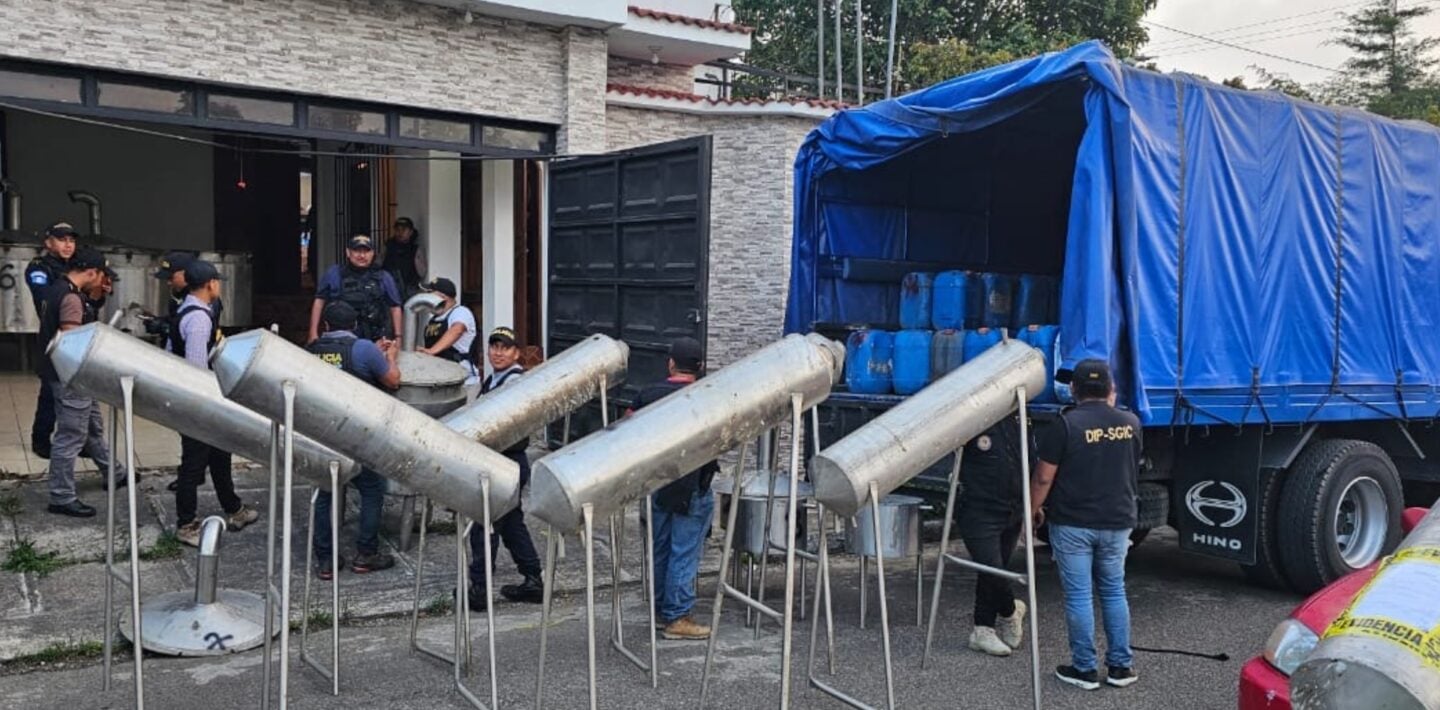
In May 2025, authorities dismantled the largest clandestine synthetic drug laboratory ever discovered in Guatemala, located in San José Pinula, on the outskirts of Guatemala City. Inside, investigators seized 132 containers holding chemical substances, including ketamine, along with materials used to manufacture synthetic drugs such as methamphetamine and tusi, the so-called “pink cocaine.”
Unlike cocaine and heroin, synthetic drugs do not depend on agricultural crops, giving criminal organizations greater logistical flexibility. Some finished products concentrate high value in relatively small shipments, although their production depends on complex international supply networks for chemical precursors. This transformation has coincided with a sharp decline in poppy cultivation, a crop that made Guatemala one of Latin America’s leading producers for decades, while also attracting new transnational criminal actors in addition to the Mexican cartels.
The Global Organized Crime Index 2025 points to the presence of Turkish criminal organizations involved both in trafficking cocaine to Europe and in the fentanyl trade alongside the Sinaloa Cartel, reflecting Guatemala’s growing importance within the logistical networks of transnational organized crime.
From smuggling routes to fentanyl precursors
The expansion of synthetic drugs in Guatemala has built upon long-established smuggling networks. Logistical corridors that for years were used to import counterfeit medicines and chemical products from China are now also being used to move chemical precursors destined for fentanyl and methamphetamine production.
In this process, the presence of the Mexican cartels has been decisive. The Sinaloa Cartel, which has operated in Guatemala for years, relies on a relatively decentralized structure supported by local groups. More recent has been the expansion of the Jalisco New Generation Cartel (CJNG).
“The CJNG, which arrived in Guatemala around 2021, followed the routes and areas of influence that had previously belonged to Los Zetas,” López said. “They partnered with a local group from Huehuetenango known as Los Huistas, longtime allies of the Sinaloa Cartel.”
One of the CJNG’s main routes begins in Honduras, crosses Guatemala’s Northern Transversal Strip to Huehuetenango on the Mexican border, and continues into Chiapas, demonstrating that the same corridors long used to transport cocaine are now also being used to move chemical precursors.
Guatemalan criminal groups are also playing an increasingly important role as intermediaries between Asian suppliers, Mexican cartels, and regional logistics operators. In May, authorities dismantled a local network that coordinated the importation of precursors from India destined for Mexican laboratories, using international courier companies, transportation firms, import-export businesses, and even the remittance system to conceal financial flows. In April, the U.S. Department of the Treasury also sanctioned Guatemalan businessman Jaime Augusto Barrientos Camaz, identifying him as a facilitator in the supply of chemical precursors to the Sinaloa Cartel.
Chinese criminal actors are also appearing with increasing frequency in this logistical chain. The case of Wenshen Xu, who was arrested in Guatemala in 2025 and later extradited to the United States, illustrates how the country has become part of the operational space used by Asian criminal organizations and Mexican cartels to coordinate logistical and financial networks linked to drug trafficking. Wenshen admitted organizing logistical operations for the CJNG, transporting cocaine from Colombia and laundering millions of dollars in proceeds from cocaine and fentanyl trafficking.
The Pacific corridor
Growing pressure from authorities on clandestine airstrips used for cocaine trafficking has increased the importance of the Pacific corridor for the cartels, which are increasingly shifting their operations toward the Pacific. According to El País, since early 2026 the Ecuador-Guatemala-Mexico corridor has emerged as one of the principal maritime routes for shipping cocaine to North America.
The Sinaloa Cartel and the CJNG rely on a sophisticated logistical network that includes cargo vessels, fishing boats, go-fast boats, and at-sea transshipments, reducing the risk of losing entire shipments if they are intercepted.
“The main advantage of maritime trafficking is that drugs can be hidden inside virtually any type of cargo or shipping container. Thousands of containers move every day, and it is impossible to inspect them all, making maritime trafficking far easier,” López explained.
Counterdrug operations confirm this trend. In January 2026, Guatemalan authorities seized nearly 5 metric tons of cocaine concealed inside seven shipping containers loaded with flour from South America and bound for Mexico, the country’s largest cocaine seizure in 12 years. In the following months, the Guatemalan and Mexican navies intercepted several vessels between Puerto San José and Puerto Chiapas, all linked to the same maritime corridor connecting Ecuador’s Pacific coast with Mexico.
A challenge for regional security
The convergence of cocaine trafficking, chemical precursors, synthetic drugs, and maritime logistics has turned Guatemala into a strategic node in the transnational criminal supply chain, making trafficking networks increasingly flexible and resilient.
The next transformation could be even more significant. “The greatest evolution of drug trafficking in Guatemala has to do with coca cultivation. In recent years, coca crops have been identified mainly in the country’s north-central region and in the department of Petén,” López said.
Although these crops do not yet represent production comparable to that of the Andean countries, their emergence could indicate that criminal organizations are seeking to incorporate additional stages of the cocaine production chain within Central America.
In this context, territorial control is becoming increasingly strategic. Competition among the Sinaloa Cartel, the CJNG, and other criminal groups along the Guatemala-Mexico border — which has already displaced civilians in several border communities — underscores the importance of controlling strategic corridors to ensure the movement of drugs, chemical precursors, weapons, and financial resources. At the same time, the shift of trafficking routes toward the Pacific expands these organizations’ operational reach and makes them even more difficult to counter.
Operations carried out throughout 2026 show that cooperation among Guatemala, the United States, and other regional partners has already strengthened the capacity to intercept major cocaine shipments. As criminal organizations become increasingly adaptable, the challenge will be to integrate intelligence sharing with maritime surveillance, risk analysis of cargo and chemical precursors, financial investigations, and closer coordination among security forces, customs authorities, and regional partners to identify and dismantle the logistical networks that sustain drug trafficking.