
Designated by the United States as a Foreign Terrorist Organization (FTO) in February 2025, the Jalisco New Generation Cartel (CJNG) has continued to project its influence beyond Mexico’s borders, even after its longtime leader, Nemesio Oseguera Cervantes, alias El Mencho, was killed on February 22, 2026, in an operation by Mexican Army Special Forces (SEDENA) in Tapalpa, Jalisco state.
The cartel’s ability to keep its networks operational following Oseguera’s death reflects a decentralized structure, with leadership and criminal activities spread across different groups and territories. This reduces its reliance on any single leader and allows the organization to continue operating under pressure.
Recent actions by U.S. authorities illustrate how this structure operates. On August 5, the U.S. Department of Justice announced new charges against five senior CJNG leaders, while the State Department offered more than $100 million in rewards for information leading to the arrest or conviction of eight fugitives linked to the cartel. The cases reveal a transnational criminal network involved in activities ranging from drug and weapons trafficking to money laundering and fraud, with responsibilities and risks distributed among different actors.
The cases also reflect an interagency effort: Investigations involved several U.S. federal agencies, including the DEA, FBI, Homeland Security Investigations (HSI), and Internal Revenue Service Criminal Investigation (IRS-CI).
Another example comes from the indictments against brothers Ramón and Rafael Álvarez Ayala, aliases R1 and R2. On August 26, the Department of Justice charged the two men, considered CJNG regional commanders in the Mexican state of Michoacán, with trafficking cocaine and methamphetamine bound for the United States and firearms-related offenses. The case illustrates how territorial control in Mexico can provide a foundation for connecting the cartel’s local activities with international drug-trafficking routes.
“The CJNG is no longer a Mexican cartel; it is a transnational criminal enterprise that, like an octopus, changes color, texture, and shape in an instant,” Abraham Serrano Ortega, a Mexican geostrategy and intelligence specialist, told Diálogo. According to Ortega, the CJNG operates under a franchise model that allows it to extend its presence to some 40 countries without having to deploy significant numbers of its own members.
Under this model, Latin America plays a strategic role because of its routes, ports, and alliances with local criminal organizations, which facilitate the movement of drugs, weapons, and capital. The transnational nature of the network makes a coordinated regional response increasingly necessary, based on intelligence sharing, joint operations, tracking financial flows, and closer judicial cooperation.
An organization built around specialized functions

The recent indictments offer insight into how the CJNG combines centralized leadership that sets objectives and coordinates its various components with a decentralized operational structure built around specialized functions. “We are witnessing the definitive mutation of crime into a narcoterrorist holding company,” Ortega said.
According to the U.S. Department of Justice, Juan Carlos Valencia González, alias El Pelón or El 03, El Mencho’s stepson, allegedly assumed leadership of the cartel following his death, ensuring continuity at the top. Valencia is accused of involvement in the production, transportation, and distribution of large quantities of cocaine and methamphetamine destined for the United States, as well as organizing multiple acts of violence. Valencia had already been sanctioned by the Treasury Department on July 23, along with more than 50 individuals and companies considered part of the CJNG’s financial network, in what Treasury described as its largest-ever action against the cartel. The investigation identified a money-laundering system based on international transfers, shell companies, and real estate activities.
Among those charged on August 5, Julio César Montero Pinzón and Carlos Andrés Rivera Varela led the so-called Grupo Elite, an armed wing responsible for protecting the cartel’s interests, controlling strategic areas, and attacking public officials and rival groups. The group also operated training camps and had more than 1,000 people under its command.
Other members played key roles across the organization: Hugo Gonzalo Mendoza Gaytán oversaw weapons procurement, training, and recruitment; Ricardo Ruiz Velasco coordinated drug trafficking, corruption, weapons, and coercive activities; and Julio Alberto Castillo Rodríguez handled logistics, chemical precursor procurement, revenue collection, and the transportation of drug shipments bound for the United States.
The network also includes a financial component that, according to the Department of Justice, was overseen by Montero Pinzón and Griselda Margarita Arredondo Pinzón, who are accused of participating in an international timeshare fraud scheme. The proceeds were allegedly funneled back into the cartel’s operations. “The same money generated through fraud and other illicit activities around the world finances the purchase of weapons, drugs such as fentanyl and other narcotics, and the use of force in support of terrorism,” Ortega said.
The local alliances strategy
These resources also allow the CJNG to expand its operations beyond Mexico through local partners that provide access to territory, infrastructure, routes, and markets without requiring the cartel to deploy large numbers of personnel and resources directly to each country. “They are fluid joint ventures, not hierarchical gang alliances,” Ortega explained. In Latin America, these partnerships range from logistics and access to port infrastructure to drug supply and distribution. In return, local organizations gain resources, weapons, chemical precursors, capital, and access to international markets.
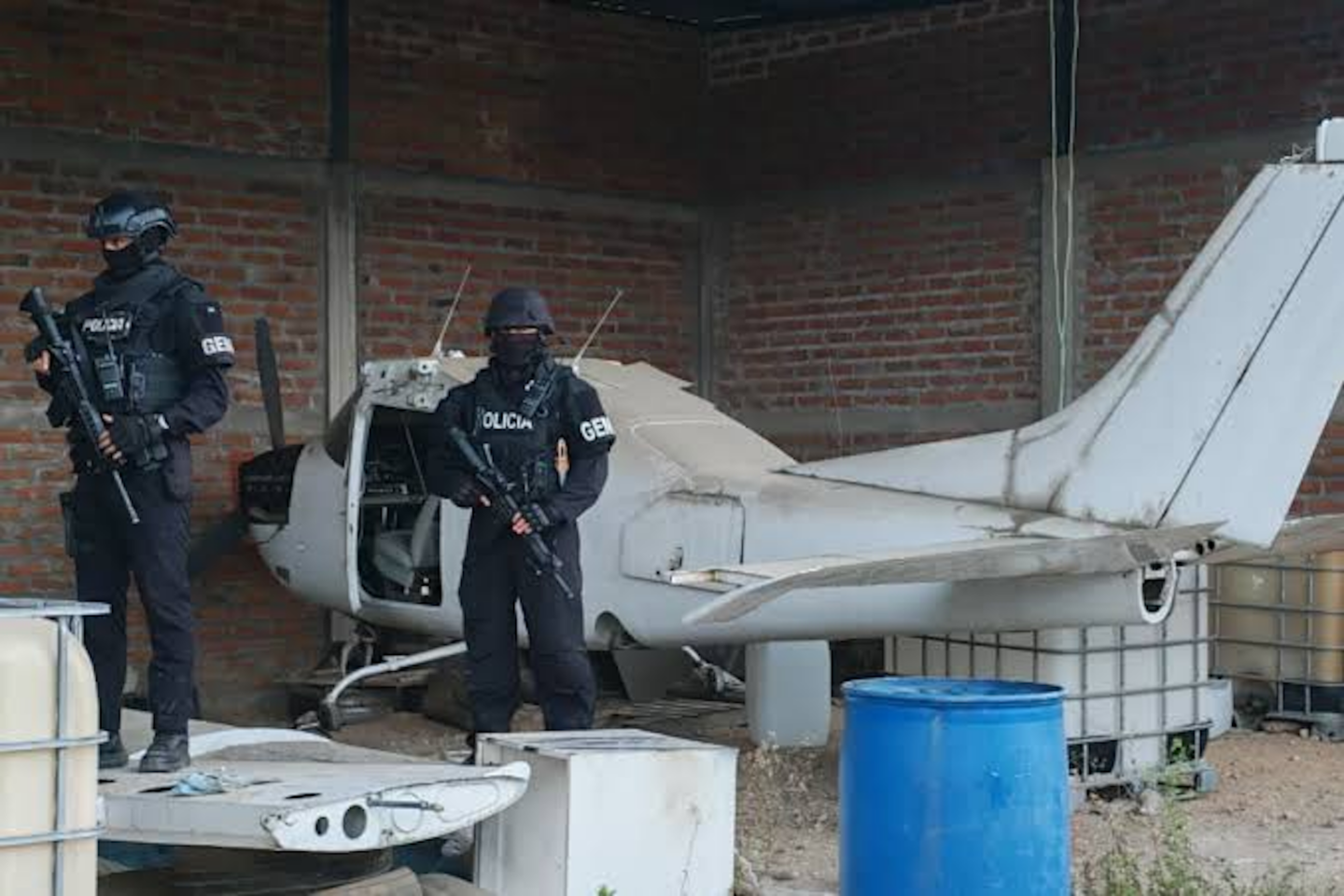
Ecuador is one of the most significant examples. On August 26, Ecuadorian authorities, with support from the DEA and U.S. Southern Command (SOUTHCOM), carried out simultaneous operations Jericó and Factoría in several provinces against structures linked to Los Choneros and Los Lobos, the latter a criminal organization associated with the CJNG. The operations resulted in arrests and the seizure of drugs, weapons, money, vehicles, and communications equipment, while also disrupting infrastructure used for clandestine air trafficking. According to the DEA, the organizations under investigation moved cocaine from Ecuador through Central America and Mexico to other international markets. Among those arrested were two Mexican nationals whom Ecuadorian Interior Minister John Reimberg linked to the CJNG.
The operation took place within the context of broader regional cooperation against cartel networks. Ecuador is a member of the Americas Counter Cartel Coalition (A3C), an initiative that brings together 19 countries across the hemisphere to strengthen coordination against transnational organized crime. At its second meeting, held in Panama in August, defense and security officials advanced efforts to identify areas for joint action, including intelligence sharing and efforts to combat the financial and logistical structures that allow these organizations to operate across borders.
“It is a territorial subcontracting alliance. The CJNG provides weapons, precursors, and logistics, while local groups guarantee access to ports. It’s a criminal franchise,” Ortega said.
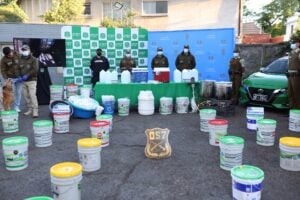
In Panama, journalistic investigations have linked the Bagdad criminal group to the CJNG and to logistical support for cocaine shipments moving from Ecuador and Colombia toward Mexico. In Colombia, the cartel operates through emissaries who purchase cocaine, while in Chile, prosecutors linked the CJNG to a clandestine methamphetamine laboratory discovered in January 2025 in the O’Higgins region and operated by two Mexican nationals. More than 844 kilograms of drugs and chemical precursors were seized. Investigations in Paraguay, Argentina, and Brazil have also revealed the presence of members, operators, or networks linked to the organization.
The network, however, is not limited to drug trafficking. It extends into criminal sectors capable of generating profits, supplying raw materials, or facilitating the movement of capital. According to nongovernmental organization Environmental Investigation Agency (EIA), the cartel is involved in the illegal trafficking of mercury from Mexico to gold-mining regions in South America, including Bolivia, Peru, and Colombia.
This diversification expands opportunities for collaboration with other transnational criminal organizations. The Venezuelan group Tren de Aragua, whose presence has been documented in 11 Mexican states, occasionally collaborates with the CJNG and other Mexican criminal organizations. According to security analyses cited by regional media, cartels use the group as criminal manpower and to control migrant routes, while Tren de Aragua benefits from their local protection and power.
The CJNG’s connections also extend beyond the hemisphere. Regarding its relationship with Italy’s ’Ndrangheta, Ortega said, “It is a wholesale-market and money-laundering alliance. The CJNG delivers pure cocaine and methamphetamine to Europe via Spain and Belgium, and the ’Ndrangheta launders the proceeds through restaurants and construction.” With the Albanian mafia, by contrast, the alliance is based on what Ortega calls “last-mile distribution.” “The Albanians control distribution in the United Kingdom and the Balkans and have the heroin route. The CJNG uses that network to place fentanyl without exposing its own structure,” Ortega added.
A coordinated response against the CJNG network
The increasingly transnational nature of the CJNG now demands an equally coordinated response. Latin American countries already cooperate through security forces, intelligence sharing, and joint operations, but experts say these efforts must evolve into a permanent regional strategy capable of continuously tracking the criminal network across borders. When authorities strike a single node without disrupting its connections, the cartel can replace an intermediary, move personnel and capital, or alter its routes, exploiting differences in laws, judicial systems, and investigative capabilities.
As such, Ortega said, cooperation must go beyond law enforcement operations to include systematic tracking of financial flows and greater harmonization of legal tools. “Classifying material support for the CJNG and other nonstate actors as terrorism throughout the region” would make it possible to “enable asset forfeiture and expedited extradition of the corporation, not just the hitman,” he said.
The objective, therefore, is not simply to target individual members, but to prevent the CJNG from quickly reconstituting its operations elsewhere. To accomplish this, existing capabilities must be connected through a regional system capable of simultaneously tracking the people, capital, infrastructure, and routes that make up the criminal network. Only a coordinated, multilayered response can reduce the cartel’s ability to exploit differences among countries and evade pressure in one jurisdiction simply by shifting its activities to another.