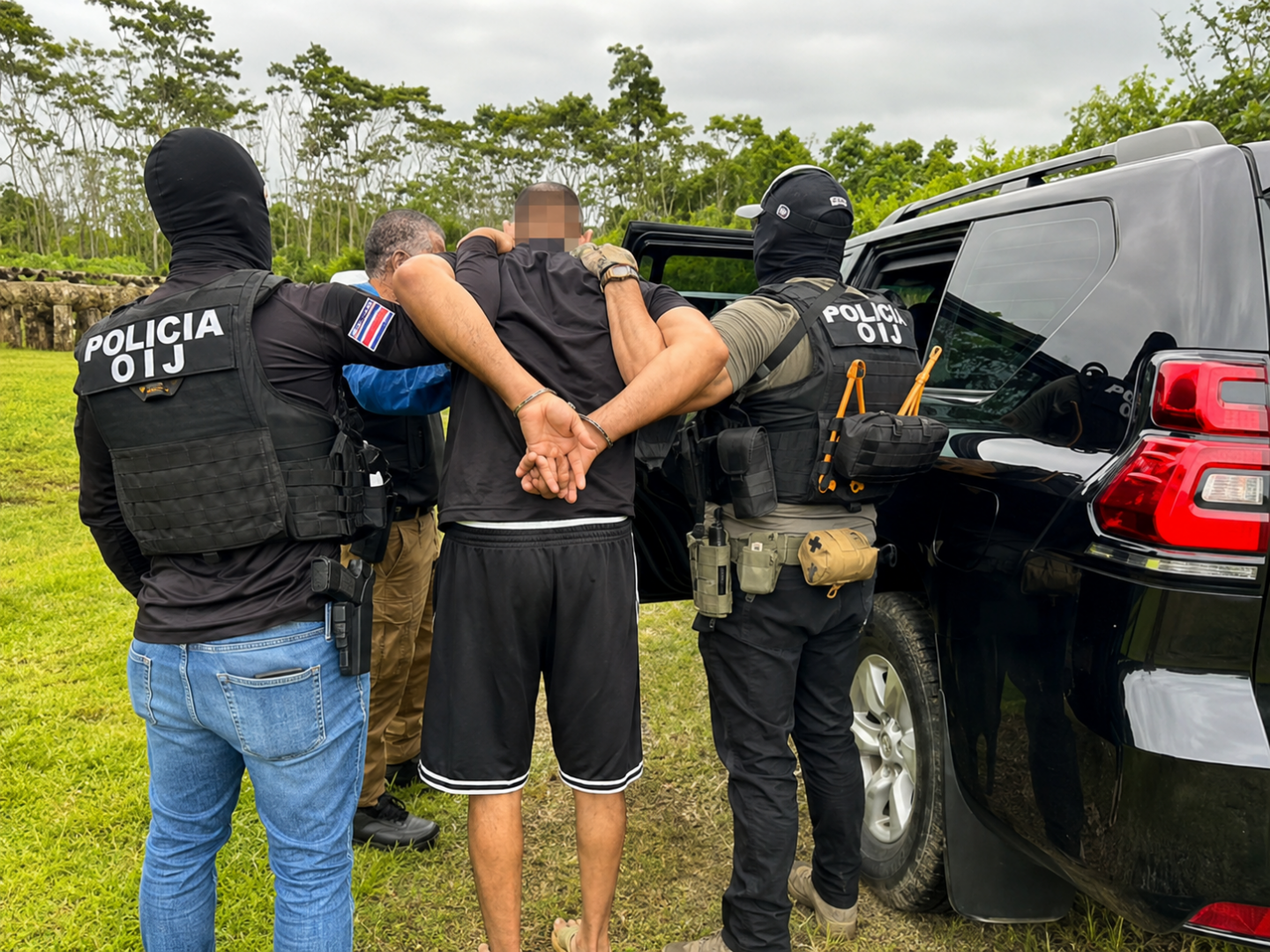

The capture of Alejandro Arias Monge, alias Diablo, considered Costa Rica’s most wanted fugitive, exposed the growing firepower and technological capabilities of criminal organizations, British broadcaster BBC News reported. The operation ended a decade on the run after a nearly 50-minute firefight that left eight agents wounded, Infobae reported.
Security forces carried out the operation on July 24, 2026, in Sarapiquí, near the border with Nicaragua, seizing assault rifles, handguns, more than 2,700 rounds of ammunition, and drones that the organization used to monitor the area and anticipate police movements, the same outlet reported. The arsenal and equipment illustrate how criminal organizations are incorporating high-powered weapons and commercially available technology to protect their operations and compete for territorial control.
Traditional smuggling no longer the only source of supply
“The illicit arms market in Central America is evolving toward a more diversified, flexible model that is increasingly difficult to control,” Karen Jiménez, director of the School of Police Sciences at Costa Rica’s State Distance University, told Diálogo. “It no longer depends solely on traditional smuggling or weapons theft, but combines stolen weapons, legally acquired weapons diverted into criminal hands, imported individual parts, domestic assembly, artisanal manufacturing, and 3D printing.”
This diversification is taking place amid growing armed violence. According to the Peace and Democracy Foundation’s report Armed Violence in Costa Rica: Findings from a Decade, 2014–2024, more than 77 percent of homicides recorded during that period were committed with firearms, making it the most violent decade in the country’s recent history.
“The case of Costa Rica reveals a very troubling transformation: The country went from armed violence associated with isolated incidents or common crime to violence linked to criminal economies, territorial disputes, and organized crime,” Jiménez said. “Firearms have become the primary instrument of lethal criminal violence.”
Seizures point to the widespread circulation of firearms
During the first half of 2026, Costa Rican authorities seized some 1,100 handguns and revolvers. The volume of seizures reflects the widespread circulation of firearms in the country and the challenge this poses for security forces.
“Costa Rica shows that the illicit arms market can no longer be understood solely as a seizure problem,” Jiménez stressed. “It is a criminal supply network fueled by legal weaknesses, traceability gaps, regional circulation, and growing demand from organized crime groups.”
Counternarcotics operations offer another view of the same criminal ecosystem. On June 18, the Drug Control Police concluded 23 raids in Puntarenas and Alajuela, seizing more than 500 kilograms of drugs, eight firearms, and nine vehicles, daily CR Hoy reported. The investigation dismantled an organization that, according to authorities, had expanded from street-level drug dealing into international maritime drug trafficking. The discovery of weapons alongside drugs, vehicles, and other equipment shows how firearms form part of the capabilities that sustain the operations of these criminal organizations.
National strategies and international cooperation
The Costa Rican case is part of a regional challenge in which criminal organizations exploit land borders, ports, airports, courier services, and commercial supply chains to move complete firearms or their components. Honduras’ Public Prosecutor’s Office reported on July 10 that the Technical Criminal Investigation Agency seized long guns, ammunition, and grenades at an urban bus workshop in Puerto Cortés, allegedly destined for a criminal organization operating in the country’s northern region. In Guatemala, a series of raids targeting groups involved in extortion and vehicle theft resulted in the arrest of 29 suspects and the seizure of firearms. The Ministry of the Interior ordered ballistic testing of the rifles and handguns to determine whether they had been used in homicides or attacks.
The evolving threat is pushing countries to integrate prevention, investigation, tracing, and information sharing. Costa Rica, El Salvador, Guatemala, Honduras, Panama, Belize, and the Dominican Republic are part of the Central American Roadmap to Prevent the Illicit Trafficking and Proliferation of Firearms, Ammunition, and Explosives, adopted in 2025 with the support of the Organization of American States, the United Nations Regional Centre for Peace, Disarmament and Development in Latin America and the Caribbean, and the Central American Integration System (SICA).
As part of these efforts, El Salvador moved in July 2026 toward the final phase of its National Plan against Illicit Arms Trafficking, with support from the SICA General Secretariat, the OAS, and the United Nations Regional Centre. The process seeks to establish priorities, institutional responsibilities, and mechanisms for coordination and information sharing to curb the proliferation of firearms, ammunition, and explosives, SICA said.
International cooperation is also part of efforts to combat the organizations that obtain these weapons. The capture of alias Diablo, which received support from the U.S. Department of State and the Drug Enforcement Administration (DEA), demonstrated how Central American security forces can dismantle high-threat criminal organizations by combining intelligence, coordination, specialized operations, and support from strategic partners. DEA prepared and sponsored a reward solicitation managed by the Department of State for information on Diablo. DEA also monitored the tip line and email 24/7 for over a year and supported Costa Rican authorities with investigative and intelligence requests leading up to the operation and capture.
The growing range of supply methods — from the diversion of legally acquired firearms to the importation of components, domestic assembly, artisanal manufacturing, and 3D printing — is broadening the challenge facing security forces. Interdiction at borders and ports remains necessary, but must be complemented by investigations, weapons tracing, ballistic analysis, and information sharing to identify not only the firearms themselves, but also the networks that supply and use them.
The use of drones by organizations such as alias Diablo’s also confirms that criminal groups are adapting commercially available technologies to monitor territory and anticipate police operations. This evolution presents new tactical and intelligence challenges.
Regional mechanisms under development seek to strengthen the response to an illicit market that does not stop at national borders through the tracing of seized firearms, the exchange of ballistic information, and coordination among institutions and countries. The Diablo case illustrates both the level of threat these organizations can pose and the importance of combining intelligence, operational capabilities, and cooperation to dismantle them.