
As authorities step up pressure, criminal networks operating along the nearly 1,300-kilometer border between Brazil and Paraguay are diversifying a model traditionally centered on producing cigarettes and marijuana in Paraguay and moving them into the Brazilian market. Increasingly flexible structures are emerging alongside this model, allowing criminal networks to adapt production, logistics, and distribution according to the level of risk. Although the Friendship Bridge between Foz do Iguaçu and Ciudad del Este remains a major crossing point, criminal organizations are diversifying the goods they traffic and shifting some activities, such as the production of counterfeit cigarettes, into Brazil. This dispersal reduces the volume moving through traditional crossing points and limits exposure to inspections and seizures, spreading risk across the criminal supply chain.
“Organized crime operates according to a profit-driven logic, adapting routes and methods faster than the state’s bureaucratic machinery can respond,” Roberto Uchôa, a public security and firearms control specialist and member of the Executive Board of the Brazilian Forum on Public Safety, told Diálogo.
One example of this adaptation is the smuggling of weight-loss medications containing semaglutide and tirzepatide. In the first half of 2026, Brazil’s Federal Revenue Service seized more than 76,000 units in Foz do Iguaçu, compared with about 24,000 during all of 2025. These small, high-value products offer higher profit margins and simpler logistics than cigarettes or drugs. In Paraguay, several tirzepatide-based medications are registered with the National Directorate of Health Surveillance (DINAVISA), but those Paraguayan versions are not registered for sale in Brazil. Traffickers exploit routes and logistics networks already used to move other illicit goods from Paraguay into Brazil. Authorities and experts are also investigating the possible involvement of organizations such as the First Capital Command (PCC) and Red Command (CV), although Brazil’s Federal Police has yet to conclusively link this market to a specific organization.
“The modus operandi has changed. Products such as electronic cigarettes and weight-loss pens are smaller and have very high added value,” Cláudio Roberto Caetano Marques, an auditor with Brazil’s Federal Revenue Service in Foz do Iguaçu, told Folha de São Paulo.
This ability to adapt also complicates the response by security forces. Seizing a commodity or blocking a route can temporarily disrupt an illicit activity, but it can also prompt criminal organizations to switch products, routes, or production sites. As a result, effective operations increasingly depend on cooperation between Brazilian and Paraguayan authorities to identify not only individual shipments but also the structures connecting supply, production, transportation, distribution, and money laundering.

Marijuana: A more flexible supply chain
Paraguay is one of South America’s leading marijuana producers, and Brazil is its main market. A report by the Colombian Navy’s International Center for Research and Analysis Against Maritime Drug Trafficking (CIMCON) estimates that Paraguay produced more than 30,000 metric tons of cannabis in 2024, with nearly 80 percent destined for the Brazilian market.
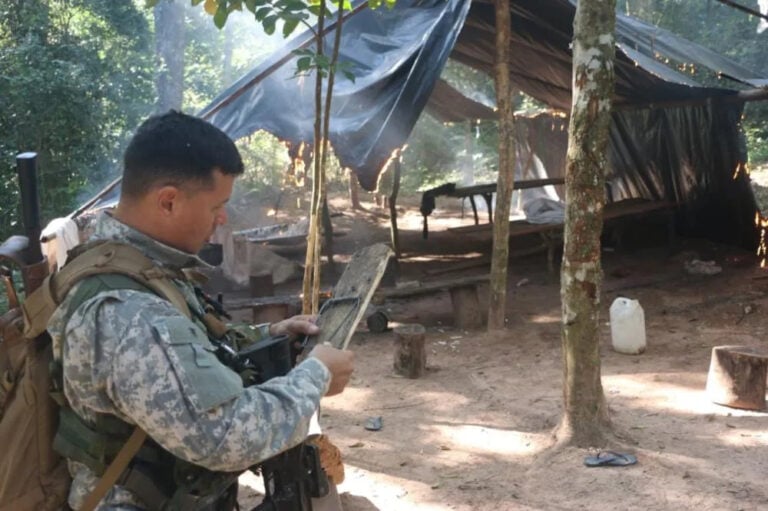
Seizures also illustrate the scale of the market. During two phases of Operation New Alliance completed in August, Brazil’s Federal Police and Paraguay’s National Anti-Drug Secretariat (SENAD) eradicated 378 hectares of crops and destroyed 115 clandestine camps in the country’s main production areas, including Amambay, where authorities documented the presence of Brazilian criminal organizations such as the PCC and CV. The two phases also eliminated an estimated 1,139 metric tons of marijuana. The operations combined technical and scientific capabilities from both countries to collect and analyze plant and soil samples.
“This represents a structural technical and methodological advance. Transnational cooperation among forensic experts makes it possible to georeference and chemically characterize substances, scientifically mapping the origins and agronomic dynamics of illicit activities,” Uchôa said. “From a procedural standpoint, this robust forensic evidence […] provides adequate evidentiary support for prosecution, making solid convictions possible in the courts of both jurisdictions.”
At the same time, authorities have detected greater diversification in the production chain, including the manufacture of more concentrated, higher-value derivatives.
In February, SENAD uncovered a criminal operation in Capitán Bado, Amambay, with interconnected cultivation areas, irrigation systems, generators, and processing equipment, pointing to a shift from agricultural production toward a more sophisticated processing chain. In addition to cultivating cannabis, the organization processed it into dry hash and ice, more concentrated derivatives that command higher prices in Brazil. By reducing the volume of the product, criminal networks can limit potential losses in the event of a seizure while increasing the return on each successful crossing.
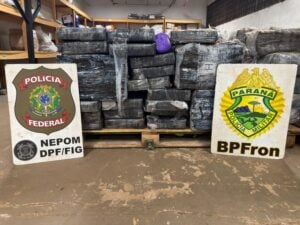
Diversification also extends to logistics, with criminal networks using an increasingly varied mix of routes and transportation methods. In September, the Federal Police seized more than 520 kilograms of marijuana in Foz do Iguaçu after the drugs were transported from Paraguay by boat and unloaded on the Brazilian side of the river. Two days later, another operation intercepted 303 kg following a similar landing. Overland transportation continues to rely on concealment methods involving cars, trucks, and buses. In August, for example, Paraguayan authorities seized more than 300 kg of high-THC marijuana, known as premium marijuana, concealed in a false compartment in a truck bound for Brazil.
Moving production across the border
The same adaptability is evident in the cigarette market, where pressure on traditional smuggling routes is prompting criminal organizations to change not only their routes but also where they produce their goods. Data from Brazil’s Federal Revenue Service show a sharp decline in cigarette seizures along the Foz do Iguaçu border, from 122.69 million packs in 2020 to 64.79 million in 2025.
According to experts, part of the decline reflects the relocation of production into Brazil. The shift reflects criminal organizations’ calculations of risk: Moving large volumes from Paraguay requires trucks, boats, warehouses, and numerous intermediaries, multiplying the points at which they can be detected by security forces. Producing cigarettes in Brazil eliminates at least part of the most vulnerable segment — the border crossing — while moving production closer to major consumer markets.
According to a survey by Brazilian research firm Ipec commissioned by the National Forum Against Piracy and Illegality (FNCP), 41 clandestine cigarette factories were shut down in Brazil between 2022 and May 2026, with a significant concentration in the southeast, particularly in São Paulo state. Some produced counterfeit versions of Paraguayan brands. As this activity becomes more entrenched inside Brazil, it can generate other forms of criminality beyond smuggling, including labor exploitation, money laundering, and the infiltration of local economies.
In July 2025, the Brazilian Federal Police’s Operation Chrysós dismantled a transnational network accused of financing and operating a clandestine factory in Ourinhos, São Paulo state. Fourteen Paraguayan nationals worked at the site after being lured to Brazil with promises of employment. In May 2026, Brazil’s Labor Court convicted a man of international human trafficking and subjecting workers to conditions analogous to slavery. In August, the Federal Police launched a second phase of Operation Chrysós targeting the organization accused of financing and maintaining the clandestine cigarette production operation.
From border control to intelligence
Faced with highly adaptable criminal networks, Brazilian and Paraguayan authorities are strengthening and expanding existing cooperation mechanisms, moving beyond physical border control toward more sustained information and intelligence sharing. In May, Brazil’s Federal Highway Police and Paraguay’s National Police signed a memorandum of understanding covering information sharing, joint technical training, and the planning of integrated operations against arms and drug trafficking, smuggling, and cargo theft. That same month, the two countries also agreed to strengthen cooperation against money laundering and illicit financial transactions and to advance the integration of migration control systems.
This approach is also strengthening border cooperation mechanisms established in previous decades. The Tripartite Command, established in 1996 by Argentina, Brazil, and Paraguay to coordinate police cooperation in the Tri-Border Area — Foz do Iguaçu, Ciudad del Este, and Puerto Iguazú — and the Brazil-Paraguay Bipartite Command in Guaíra, focused on another section of the bilateral border, are evolving from information sharing toward more operational coordination, including shared intelligence, target identification, and joint actions.
In September, the Tripartite Command coordinated Operation Nexo, carrying out simultaneous controls in all three cities. In August, cooperation between the two mechanisms led to the identification and transfer to Brazil of a Brazilian national wanted for homicide and criminal organization offenses. Paraguayan authorities located the suspect while he was attempting to obtain documents.
These developments reflect a broader shift in the approach to cooperation: Rather than viewing the border simply as a control point, authorities are increasingly treating it as a node within a distributed criminal system. If criminal organizations can relocate production, alter routes, or switch products, the elements holding the supply chain together are the people who organize it, the infrastructure that sustains it, and the capital that finances it.
According to Uchôa, cooperation should therefore focus increasingly on “tracking atypical financial flows, countering cybercrime, and seizing property and assets.” “The decisive action is to dismantle the money laundering infrastructure, depriving these criminal networks of their ability to reinvest, corrupt, and reproduce,” he said.
The challenge for Brazil and Paraguay is to turn interagency information sharing into a permanent capability to reconstruct criminal supply chains across jurisdictions, connecting operational intelligence, customs data, financial information, and judicial investigations to target not only trafficking itself but also the structures that make it possible.