
Transnational criminal organizations increasingly operate across borders, combining drug trafficking and other illicit economies with financial, logistical, and corruption networks that allow them to expand their reach. Faced with a threat that exceeds the response capabilities of any single country, regional cooperation has become a central component of security efforts across the hemisphere.
That approach gained new momentum in March 2026 with the creation of the Americas Counter Cartel Coalition (ACCC), designed to strengthen coordination among participating countries in confronting transnational criminal organizations. Since then, participating nations have advanced operational coordination and information sharing to address threats that cross national borders.
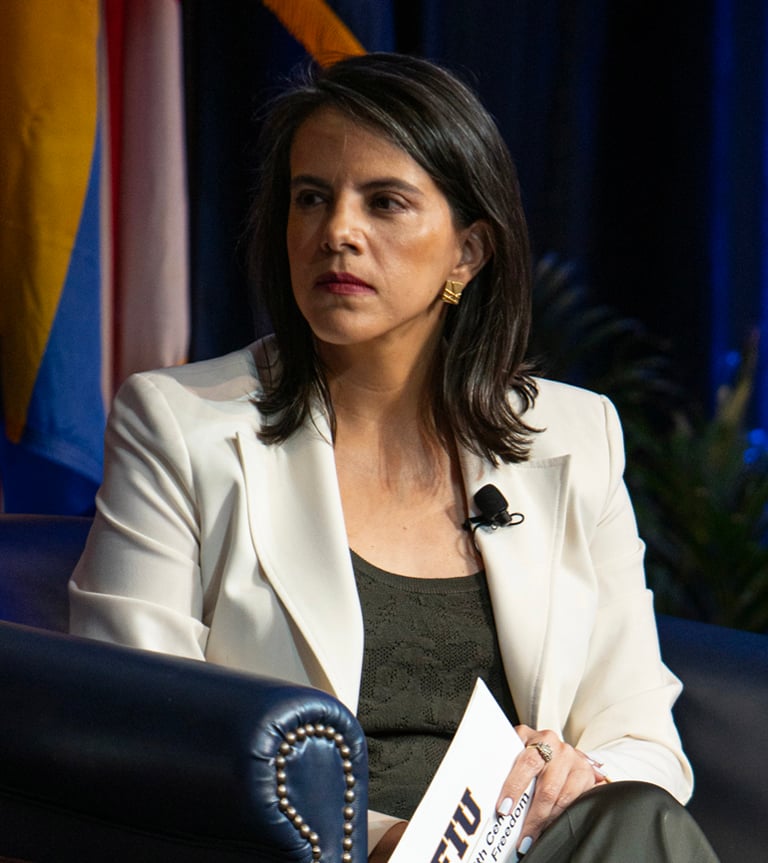
Against this backdrop, Diálogo interviewed María Paula Romo, former minister of Government of Ecuador (2018-2020) and director of Executive Education at Florida International University’s (FIU) Adam Smith Center for Economic Freedom, during FIU’s Hemispheric Security Conference, held in Miami May 5-8, 2026. The conversation took place during the ACCC’s early stages, before several of the operational advances the coalition would later develop.
Romo discussed the evolution of transnational organized crime and the capabilities needed to confront it, from stronger institutions and integrity mechanisms to financial intelligence and sustained regional cooperation. For Romo, when criminal organizations operate across multiple countries, the response must also be organized and transnational.
Diálogo: For decades, Latin America and the Caribbean have experienced some of the world’s highest levels of violence, despite sustained increases in security spending and institutional reforms. What does this persistence reveal about the limitations of current security models, and where do you see the most promising paths forward?
María Paula Romo, former minister of Government of Ecuador and director of Executive Education at FIU’s Adam Smith Center for Economic Freedom: This is probably the question that keeps those of us who study or deal with security issues up at night, as well as governments, particularly because security has now become citizens’ top concern. For decades, violence ranked among the leading concerns, but economic issues, jobs, and unemployment always topped the list. Today, security has moved into first place, not because the other indicators have improved, but because security conditions have deteriorated. Why is this happening in Latin America?
Let me offer one statistic that helps illustrate the disparity. Latin America accounts for about 9 percent of the world’s population but 33 percent of its homicides. Violent crime is more common and poses a greater threat to the population than anywhere else. Other factors, such as whether people live in urban or rural areas or their income level, also become less significant in the face of violence, which is a common factor across our countries.
There are many possible explanations. Impunity, lack of oversight, and informality are extremely important factors. We could examine specific indicators, but if I had to choose one, I would point to institutional weakness that leads to impunity.
Diálogo: Organized crime has expanded its influence beyond territorial control into local economies and even governance. What capabilities should states prioritize to restore authority and legitimacy without compromising the principles of democratic governance?
Romo: What you are describing is extremely important, and it represents a shift we need to recognize. Decades ago, criminal organizations fought against the state and targeted, in a military sense, justice officials and security forces: police officers, military personnel, and judges. Today, with their enormous economic power and deep penetration into local economies, we see these criminal organizations co-opting the state, including security forces, through campaign financing and the infiltration of institutions, police forces, militaries, and the judiciary. This is part of our daily reality.
That changes both the landscape and the approach. It is no longer simply a matter of the state fighting an outside actor, but of the state trying to prevent that outside actor from infiltrating its own ranks and identifying where that infiltration has already occurred, because we must assume that it has. The evidence can be seen across our countries. That is why integrity policies, internal controls, and permanent vetting mechanisms must be a priority. I believe that is an extremely important factor.
Diálogo: Surveys such as Latinobarómetro and the AmericasBarometer continue to show very low levels of trust in key institutions such as the police and the justice system. How does this trust deficit affect the fight against organized crime, and what approaches have proven most effective in rebuilding institutional legitimacy?
Romo: This is another key question when it comes to security, and probably the most difficult to address and the one that will take the longest. Some high-profile actions against organized crime, criminal structures, and illicit economies can produce more immediate results. But building public trust, given the gap that exists between citizens and criminal justice institutions, as well as other forms of justice, is much more difficult. Delays, lack of timely action, and the inability to deliver effective responses are at the heart of our institutional crisis and the erosion of trust in our democracies. The key is finding ways to ensure that people receive answers.
What I am about to suggest may have only a marginal impact, but I believe new technologies, such as artificial intelligence solutions for the most basic aspects of the administration of justice, could help reduce backlogs and provide faster solutions, particularly for the most common, lower-level legal disputes. It is not without controversy.
At the end of the day, this is about justifying the very existence of the state. In classical theory, the modern state exists to perform two fundamental functions: to mediate disputes between private parties and to provide security as the holder of the legitimate monopoly on the use of force. Those two functions, which explain the very reason for the state’s existence, are now being called into question in Latin America. When someone faces a dispute, whether personal or on a larger scale involving a criminal organization, and the state is unable to provide justice, control, and order, criminal organizations step into that space. They finance their daily operations through small-scale extortion because they are the ones controlling the territory. That is why these challenges cannot be viewed solely as security issues. If we fail to address them, what is at stake is the very purpose of the state and the existence of states as we know them.
Diálogo: Beyond strengthening national capabilities, we are confronting criminal organizations that operate across multiple countries and jurisdictions. In practice, what makes regional security cooperation truly effective, and what conditions are necessary to sustain it over time?
Romo: As you said, crime is organized and transnational, so the response must be organized and transnational. It makes no sense to confront a criminal industry that increasingly operates according to that model with isolated, domestic, and polarized responses.
In my experience, one solution is for cooperation to be specialized and embedded within law enforcement and security institutions, which are hierarchical and permanent. Cooperation among police forces, militaries, and judicial institutions provides continuity beyond political processes, ideological differences, and polarization. One key to effective cooperation is to keep it focused at the operational and technical levels, deepen it, and concentrate as much effort as possible there, because that is where continuity can be maintained across our countries.
Diálogo: Other international actors also play an important role in regional security cooperation, including the United States, for which strengthening institutional resilience in the region is a priority. Where do you believe this cooperation can provide the greatest value in confronting criminal organizations that operate across borders and financial systems?
Romo: This is a particularly interesting moment to look at security because the United States has placed the rest of the hemisphere, and Latin American countries in particular, at the center of its security strategies for perhaps the first time in decades. Latin America has not received this much attention from the United States in a long time, nor has it been viewed to this extent as an issue connected not only to hemispheric security but also to U.S. national security.
The key is for U.S. cooperation with countries in the region to focus on intelligence, particularly financial intelligence and efforts to combat illicit financial flows. The United States has a fundamental role to play because it is a major hub for business and financial transactions and because of the amount of information it can access compared with our local systems. For me, the real shift will come when we achieve cooperation that is not limited to one operation or another, but is sustained through criminal intelligence, financial intelligence, and efforts to pursue and seize criminal assets.
Diálogo: Finally, looking at the regional security landscape as a whole, what do you consider essential to building a more integrated, effective, and forward-looking response to these transnational threats?
Romo: Cooperation, as we have discussed, strong institutions, and serious integrity policies. We also need a clearer and more realistic approach to security. Precisely because security has become such a widespread concern, it has also become the subject of publicity campaigns, and none of the problems our countries face will be solved with a photo, a video, or a social media post. These are deep-rooted problems that require substantive, structured, medium- and long-term responses. Communications strategies cannot substitute for them.