In Nicolás Maduro’s Venezuela, a new criminal ecosystem has emerged as the Venezuelan autocrat has effectively co-opted the most powerful criminal groups and major foreign guerrilla groups, forging a pervasive network of interests that transcends national borders.
The core of this state-linked criminality is the Cartel of the Suns (CdS) — a network of high-ranking Venezuelan military and regime officials led by Maduro. The accusations made by the United States and multiple regional partners, including the terrorist designations in 2025 against the CdS and the Tren de Aragua (TdA), reflect a profound change in the structure of organized crime in the country.
From bonanza to violence: Chávez’s legacy
The rise of organized crime in Venezuela is not a recent phenomenon. During Hugo Chávez’s tenure, the flood of oil revenue, coupled with rampant corruption and the dismantling of state institutions, laid the groundwork for violent crime explosion that ranked the country among the world’s most dangerous.
In December 2014, the Venezuelan Violence Observatory warned that Venezuela had the second-highest homicide rate on the planet. This institutional chaos allowed criminal gangs to proliferate throughout the country. A 2015 study by the Venezuelan Observatory of Organized Crime identified 28 “megagangs” with the capacity to operate on a large scale.
Bolívar state became one of the most violent territories, where criminal organizations fought fiercely for control of mining areas. In 2016, Ciudad Guayana, its capital, ranked 11th among the 50 most violent cities in the world, according to Mexican organization Seguridad, Justicia y Paz (Security, Justice, and Peace). However, the dynamics of violence have shifted in recent years.
From massacre to coexistence: The new criminal symbiosis
Mercedes de Freitas, director of nongovernmental organization Transparencia Venezuela, describes a dramatic transformation in the relationship between state and armed groups. “Currently, there are no reports of the large massacres of yesteryear, in which armed gangs, guerrilla groups, and the Venezuelan military forces were involved. Now we are seeing a ‘coexistence’ between irregular armed groups and state forces,” she told Diálogo.
De Freitas points out that criminal leaders have become local figures of reference, wielding more power than elected mayors and maintaining a “really very strange relationship with the state.”
This symbiosis is not limited to Bolívar. In Táchira, for example, food distributors are victims of an entrenched extortion scheme, known locally as the “Bernal system” — a reference to Governor Freddy Bernal — that involves both guerrilla groups and Venezuelan military personnel. In this system, bribes paid to an operator in San Cristóbal ensure that transporters are not harassed by the authorities.
Repression, and criminal consolidation
The People’s Liberation Operations (OLP) — a controversial regime anti-crime initiative involving massive security sweeps in low-income neighborhoods — were determining factors in the consolidation of criminal power around the ruling party. Between 2015 and 2017, at least 505 people died during the OLP, according to figures compiled by the Attorney General’s Office and later presented to international bodies, in operations involving police and military forces. Shortly after the publication of this data, Attorney General Luisa Ortega Díaz was dismissed and forced to flee the country.
Organizations such as Human Rights Watch estimate that the deaths during the OLP number in the thousands. Following two years of these operations, repressive authority was transferred to the Venezuelan National Police’s Special Action Force (FAES), which is now defunct. After a decade of lethal state violence, only criminal structures with explicit links to the highest echelons of power have been allowed to survive and operate, thereby guaranteeing them impunity.
Guerrillas and transnational crime: The border as a zone of influence
Among the organizations that have thrived under this new order are the Colombian guerrilla groups National Liberation Army (ELN) and dissidents of the Revolutionary Armed Forces of Colombia (FARC), with a strong presence in the border states. Both have received public support from the Caracas regime. In 2019, Maduro said that FARC leaders Iván Márquez and Jesús Santrich were “welcome in Venezuela” despite being wanted by Colombia, Reuters then reported.
The history of the TdA, Venezuela’s most notorious criminal gang, illustrates the complexity of the phenomenon. According to the regime, the organization was dismantled in September 2023 following the military intervention at the Tocorón prison.
However, Commissioner Iván Simonovis (a former high-level security official turned prominent opposition figure) maintains that the gang, led by Héctor Guerrero Flores, alias Niño Guerrero, continues to operate with force and international reach, thanks to the support of the regime. Although Guerrero is formally wanted by the authorities, Simonovis asserts that he moves freely throughout the country, protected by Maduro’s apparatus.
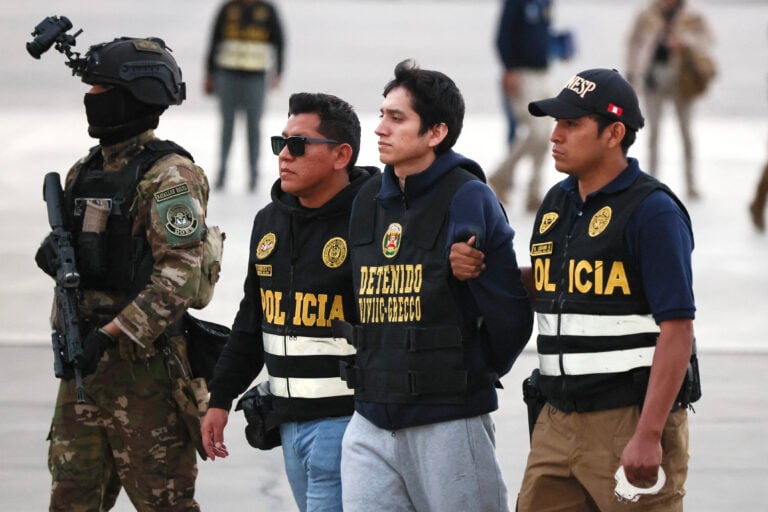
Simonovis told Diálogo that the TdA carries out activities with which Venezuelan authoritarianism does not want to be directly associated. One example is the kidnapping and murder in Chile of retired Lieutenant Ronald Ojeda in February 2024.
Following the intervention in Tocorón, no member of the TdA leadership has been captured in Venezuela. On the contrary, the regime has attempted to obstruct investigations into the gang’s international activities. The recent request for the extradition to Colombia of Larry Amaury Álvarez, alias Larry Changa, an original founder and leader of the TdA who was arrested in July 2024, is an example of the dictatorship’s efforts to control the narrative and protect its allies.
The rising international condemnation of Venezuelan-based TCOs reached a peak this year: The United States, Argentina, Ecuador, Paraguay, and Peru are among the countries that have designated the TdA and the CdS as terrorist organizations.
Venezuela, a “criminal state”
The centralization of criminal power around the regime has transformed the country into what the former president of Venezuela’s National Commission against Illicit Drug Use, Carlos Tablante, calls a “criminal state.”
“They occupied a series of spaces, of criminal control activities that weakened the rule of law, to create a situation in which any citizen, in order to resolve any issue with the ruling party, has to interact with a structure increasingly compromised by criminal activity,” Tablante told Diálogo.
International drug trafficking, arms dealing, precious metals, and human trafficking are key activities in this network. But according to Tablante, the epicenter of the Maduro regime’s criminal activity is the state-owned Petróleos de Venezuela (PDVSA), which provides the resources to sustain the regime.
Corruption and illicit income: the global cost of the regime
The expansive effect of corruption under the Venezuelan regime is undeniable. Transparencia Venezuela has documented 178 court cases in 30 countries during the Chávez and Maduro eras.
Beyond oil revenues, the organization estimates that illicit income derived from Venezuela’s involvement in the cocaine industry is estimated to be in the billions of dollars, with some estimates exceeding $8 billion, with the CdS playing a key role.
Maduro’s Venezuela, far from eradicating crime, has centralized it and turned it into a key instrument of power, with consequences that cascade across its borders and threaten the stability of the entire region.