In Venezuela, organized crime has ceased to operate on the fringes of power and has instead merged with it. The convergence of illicit networks, sectors of the autocratic state, and military officers has transformed the country into a critical hub for transnational operations, directly threatening the security of the entire region.
“These ties, which began during the Hugo Chávez regime, consolidated a network of cooperation that mixed ideology, political interests, and illicit economies,” Jorge Serrano, security and intelligence advisor to the Peruvian Congress, told Diálogo. “The relationship with the FARC [Revolutionary Armed Forces of Colombia] allowed the dictatorship to expand its influence beyond its borders, generating financial and logistical benefits that strengthened its power structure.”
With the arrival of Nicolás Maduro, this convergence became institutionalized. Structures such as the Tren de Aragua (TdA) emerged, and the Cartel of the Suns (CdS) became centrally commanded, integrating state functions with criminal activities. The regime has incorporated drug trafficking, gold mining, and oil smuggling as tools for international negotiation with actors such as Iran, Russia, and Turkey, often with the participation of Hezbollah, Serrano explains.
Criminal architecture
Reports from the U.S. Department of the Treasury’s Office of Foreign Assets Control (OFAC), and the Department of Justice document the involvement of senior Venezuelan military officials in drug, gold, and human trafficking. In 2020, U.S. authorities accused Maduro, his so-called Defense Minister Padrino López, and other senior officials with narco-terrorism, accusing them of leading the CdS and conspiring to traffic cocaine to the United States.
According to InSight Crime, an organization dedicated to the study of organized crime in Latin America and the Caribbean, the CdS dates back to the early 1990s, when it first emerged as a network of corrupt military officers involved in drug trafficking. Today, this network is rooted within the Bolivarian Armed Forces, where it uses state resources to facilitate illicit activities, from drug trafficking to gasoline smuggling and illegal mining. Its architecture involves various military branches, police forces, and civilian officials.
In July 2025, OFAC designated the CdS as a Specially Designated Global Terrorist for its role in international drug trafficking and money laundering. According to the U.S. Treasury Department, the Maduro-led group provides material support to criminal organizations such as the TdA and the Sinaloa Cartel, both of which were designated as Foreign Terrorist Organizations by the U.S. State Department, a move that was followed by several nations in the region.
According to Serrano, the structure “not only participates in drug trafficking, but also coordinates and finances subsidiary networks dedicated to smuggling and money laundering,” he said. “The Cartel of the Suns not only maintains links with terrorist organizations; it has become the operational hub of transnational crime linked to Venezuelan totalitarianism.”
Regional expansion
The expansion of the TdA beyond Venezuela has consolidated this organization as a transnational threat present throughout Latin America and the Caribbean, including Chile, Colombia, Ecuador, Mexico, Panama, Peru, and Trinidad and Tobago, where it finds new victims and recruits, nongovermental organization Transparencia Venezuela said in a report.
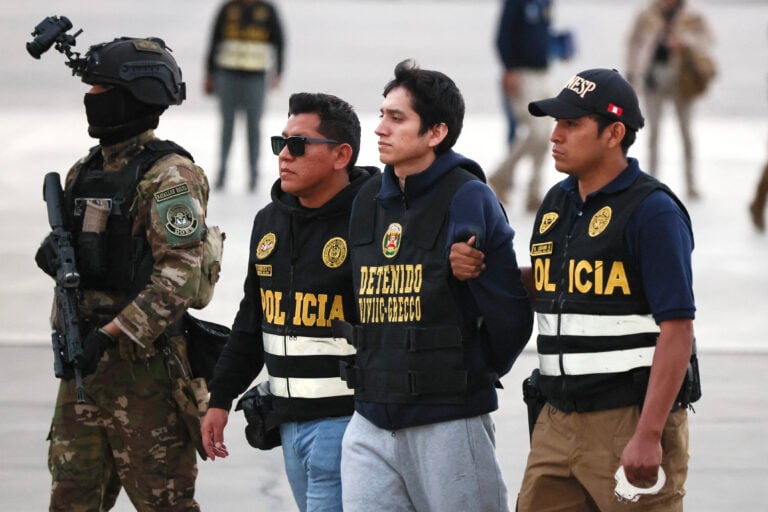
Originating in the Tocorón prison, the TdA is involved in drug trafficking, human trafficking, and extortion, operating with paramilitary structures and international financial networks, Peruvian investigative news site Ojo Público reported. Its rise coincides with the collapse of Venezuelan institutions, serving as evidence of state tolerance or outright complicity.
Transparencia Venezuela notes that the group has infiltrated regional economies through money laundering and illicit business mechanisms. In Chile, for instance, criminal members use migrants to acquire property and transportation. In Peru, they resort to small shipments and cryptocurrencies, while in other countries they use “gota a gota” loans (quick loans without collateral, but with high interest rates) and sports-related transactions.
In Brazil, the TdA maintains links with the First Capital Command (PCC). In Mexico, it has established an alliance with the Cartel de la Empresa, a branch of the Juárez Cartel, taking advantage of its logistical and financial capacity to expand its influence, Transparencia Venezuela contends.
“The threat posed by the Maduro regime has become a structural risk for the region,” Serrano says. “The Cartel of the Suns, led from within the apparatus of power, and the Tren de Aragua, its enforcement arm, operate alongside the armed forces and political networks. This fusion of dictatorship and organized crime makes Venezuela a player that goes beyond traditional criminality.”
Unlike in past decades, when drug cartels were the main concern, Serrano adds, today “the current danger lies in a political-criminal structure with international support.”
Illegal gold and financing power
The Venezuelan dictatorship exploits or allows the exploitation of illegal gold mines to enrich the regime and armed groups. The rise in the price of gold has fueled this uncontrolled mining, strengthening both criminal organizations and Colombian guerrillas and elites linked to political power, International Crisis Group indicated.
In a report, Freedom House indicates that the convergence of criminal and official interests turns illegal resource extraction into a mechanism for sustaining the dictatorship, with effects that transcend Venezuela’s borders. These operations also consolidate alliances with countries such as Iran and Russia, facilitating the export and laundering of gold. In mining areas, armed groups recruit members of indigenous communities and exercise territorial control through violence.
Hezbollah and extra-regional projection
The Atlantic Council report, The Maduro-Hezbollah Nexus: How Iran-Backed Networks Prop Up the Venezuelan Regime, documents Hezbollah’s active presence in Venezuela. The Lebanese group has turned the country into a hub for transnational crime and terrorism, engaging in drug trafficking, money laundering, and logistical cooperation with Iran.
The study details how Hezbollah operates through compartmentalized family structures — clans — integrated into illicit economy and state bureaucracy. In addition, the dictatorship protects a logistical air bridge between Caracas, Damascus, and Tehran, used to transport resources and personnel.
A report by the U.S. research organization RAND indicates that the permissiveness of the Chávez and Maduro regimes allowed the establishment of cells dedicated to drug trafficking, smuggling, money laundering, and document forgery. Venezuela, the report states, has become a regional operational center for Hezbollah with a direct impact on hemispheric security.
Hemispheric cooperation and containment
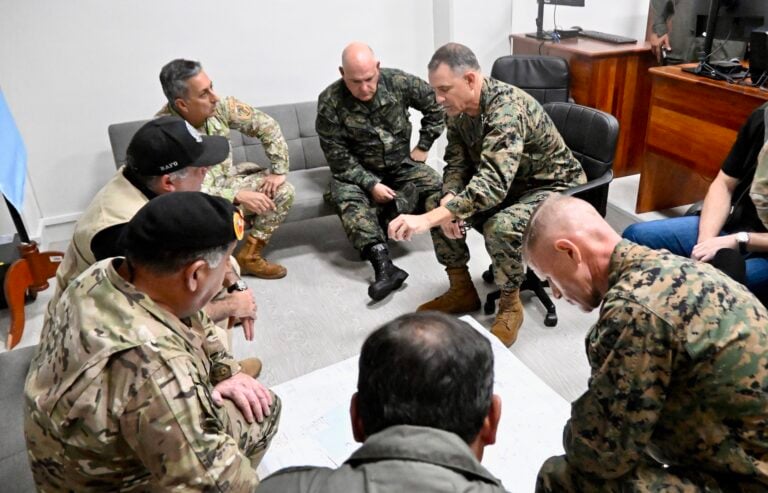
“The United States’ strategy in the Caribbean is moving in the right direction, in the face of an autocracy that combines organized crime, ideology, and alliances with hostile actors,” Serrano said. He believes that “cooperative defense actions, military presence, and coordination with democratic governments are necessary steps to contain the expansion of the Venezuelan regime and its criminal networks.”
In his view, the stage of negotiations, sanctions, and diplomatic measures is now behind. “The soft-handed strategy no longer correlates with the reality in Venezuela,” he concludes. “The most effective response requires active deterrence and sustained hemispheric cooperation to prevent Venezuela from consolidating its position as the epicenter of transnational crime.”