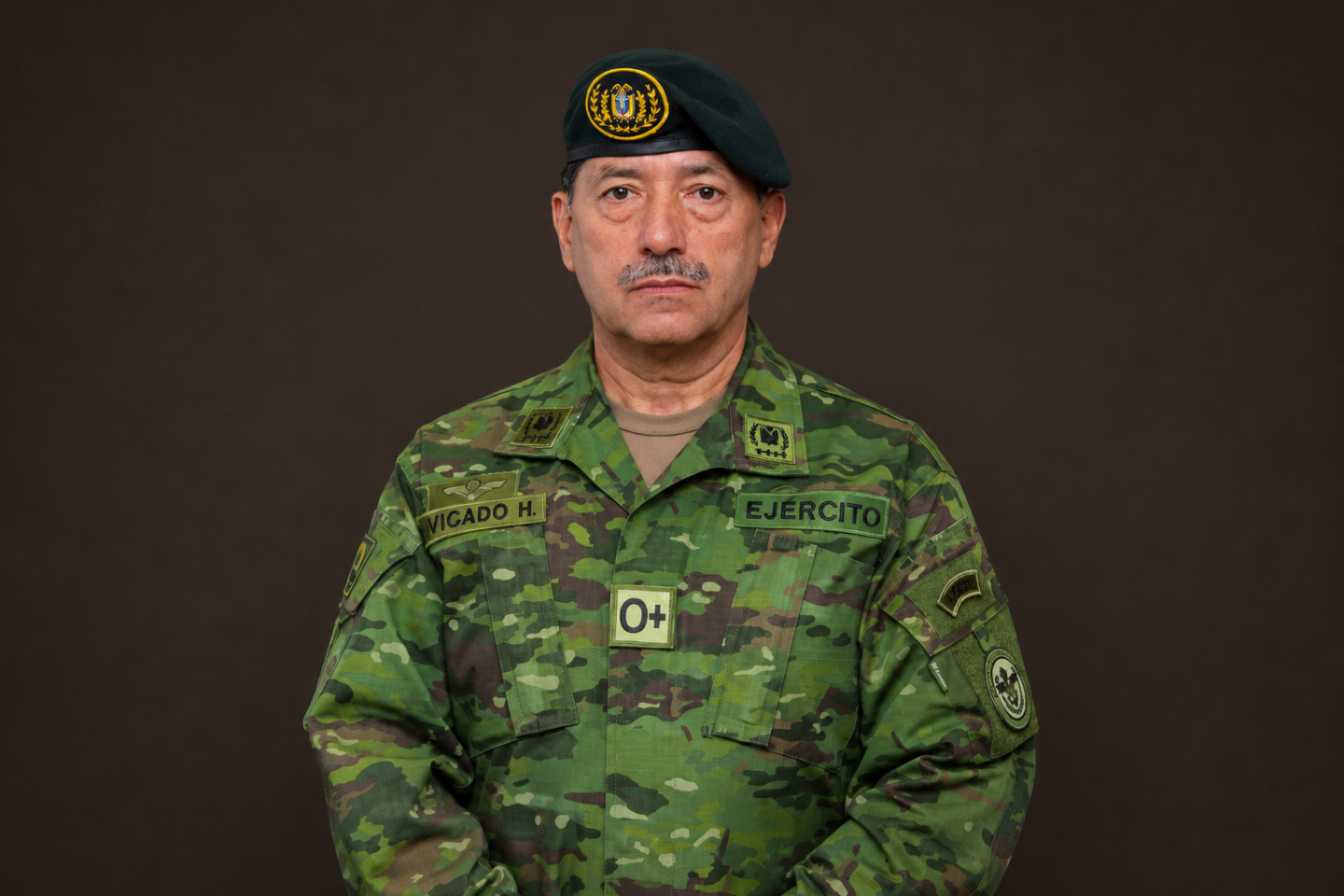

At the third meeting of the Americas Counter-Cartel Coalition, held October 26–27, 2026, in Santo Domingo, Dominican Republic, Ecuador shared its operational experience combating transnational organized crime and drug trafficking networks that operate across the region’s borders.
Army General Henry Santiago Delgado Salvador, chief of the Ecuadorian Armed Forces Joint Command, has played a central role in leading military operations against these threats and strengthening cooperation with the United States and other regional partners.
During the meeting, Gen. Delgado spoke with Diálogo about advances in the Coalition’s operational coordination, intelligence sharing, and technological cooperation, as well as the results of recent operations targeting maritime fuel supply networks used by drug traffickers in the Pacific. He also discussed lessons learned by the Ecuadorian Armed Forces during the country’s internal armed conflict and their relevance to other Coalition members.
Diálogo: General, what are your impressions of this third Coalition meeting here in Santo Domingo?
Army General Henry Santiago Delgado Salvador, chief of the Ecuadorian Armed Forces Joint Command: I believe it is very important to continue working on planning, organization, establishing protocols, and the coordination needed to fulfill the mission set by the Coalition, the Regional Coordination Centers, and each of the countries that are part of the Shield of the Americas.
Diálogo: General, when we spoke during the second meeting in Panama, you said it was impossible for any one country to confront criminal organizations operating across national borders on its own. Since then, the Coalition has made progress toward greater operational coordination. From Ecuador’s perspective, what needs to happen now for that cooperation to translate into sustained, simultaneous pressure on criminal networks across different countries?
Gen. Delgado: As I mentioned previously, the United States and Ecuador have already been working together on different types of operations. However, as planning has progressed, virtually all the support Ecuador needs to carry out its operations is now taking shape.
This has allowed us to maintain constant pressure on these threats, particularly drug trafficking, organized armed groups, organized criminal groups, illegal mining, and other related crimes.
Diálogo: In August, you joined officials from Ecuador, Colombia, U.S. Southern Command (SOUTHCOM), and Joint Task Force–Western Hemisphere (JTF-WHEM) at a meeting in San Lorenzo to advance a joint operational strategy against criminal networks. What lessons did that meeting offer about coordinating intelligence, planning, and operations among forces from different countries while respecting each nation’s sovereignty and authorities?
Gen. Delgado: Coordination focused primarily on identifying and assessing the threats we face along Ecuador’s northern border with Colombia.
Specifically, efforts focused on Esmeraldas province, particularly the Mataje and San Lorenzo areas, because of the presence of the illegal armed group known as the Oliver Sinisterra Front.
This group operates in Colombia’s Nariño department, where it is involved in drug cultivation and production. Its members also cross into Ecuador to engage in illegal mining and drug trafficking, using land, river, and maritime routes.
That is why coordination with Colombia was so important, particularly in determining how we would conduct operations against this threat.
Diálogo: How are the Armed Forces integrating intelligence and their land, air, and maritime capabilities to develop a more comprehensive picture of these networks? How can the Coalition extend that visibility across multiple countries?
Gen. Delgado: The Coalition will expand these capabilities, first and foremost, through U.S. technological cooperation in areas where drug trafficking routes originating in Colombia and crossing Ecuador have been identified.
We have identified three main routes that ultimately lead to the coast and the ports. With this technological support, we can gather intelligence and conduct surveillance and reconnaissance, which in turn allows us to plan operations, primarily against drug trafficking.
Diálogo: Recent operations in the Pacific have underscored the importance of identifying not only drug trafficking routes and shipments, but also refueling vessels and other components of the drug trafficking supply chain. What has Ecuador learned about the importance of targeting these support networks, and how can intelligence sharing within the Coalition help maintain pressure on them?
Gen. Delgado: First, the important thing is sharing information and intelligence. That is what allowed us to identify the targets and determine exactly how they operated.
In this case, we are talking about approximately 11 vessels linked to the Los Choneros organized criminal group. Their primary illicit activity involved trafficking fuel and establishing offshore refueling stations, essentially floating gas stations.
These stations allowed boats, apparently operating as fishing vessels, to reach these locations alongside so-called go-fast boats, refuel, and continue along the northern or southern drug trafficking routes.
When operations against these vessels were planned and carried out, we also uncovered other aspects of how these networks operated. Some vessels were towing nine or 10 smaller boats, known as pangas, apparently used for fishing, but among them were also these go-fast boats.
Based on this planning, established procedures, and coordination with the United States, ships were deployed along both the northern and southern routes.
The results have been very positive because destroying these vessels has effectively prevented the refueling stations from being reestablished at those locations and disrupted the boats’ ability to continue trafficking drugs.
However, these operations have also had other effects. What is happening now? According to our intelligence assessments, these organizations are currently in a holding pattern, or what we might call standby mode. We believe they are stockpiling drugs at storage sites while assessing the situation before eventually resuming their illicit activities.
That is why one of the Coalition campaign plan’s objectives is so important: maintaining sustained pressure on these threats.
Diálogo: Ecuador has become one of the countries with the most extensive recent experience deploying its Armed Forces against criminal organizations. What capabilities, experience, and lessons can Ecuador contribute to other Coalition members as the initiative moves toward a more operational phase?
Gen. Delgado: We have been engaged in this internal armed conflict for nearly three years, and we have gained considerable experience understanding the behavior of organized armed groups, organized criminal groups, and other illegal armed groups, as well as the illicit activities they carry out.
We have also identified the relationships between these groups in Ecuador and Colombia, their direct ties to various Mexican cartels, and even their connections to criminal organizations on other continents.
Drawing on this experience, we share lessons learned from our internal armed conflict during these meetings so that each country can strengthen its operational capabilities, planning, and legal framework, enabling it to act effectively against these threats.
This last point cannot be overlooked. It is a recommendation we make to countries that still face certain legal obstacles. They need to pay attention to this issue because, further down the road, it could become much more difficult for them to begin conducting operations against these threats.
It is therefore important that they review their legal frameworks so they can act now and prevent these criminal organizations from developing greater levels of coordination, organization, training, equipment, and operational capabilities, as has unfortunately happened in Ecuador, where we now find ourselves having to confront these threats.