
Ecuador faces increasingly structured criminal organizations, with ties that extend beyond its borders and illicit activities ranging from drug trafficking and illegal mining to arms trafficking and money laundering. In response to this threat, the Ecuadorian Armed Forces are strengthening their operational capabilities and deepening cooperation with the United States and other countries in the hemisphere.
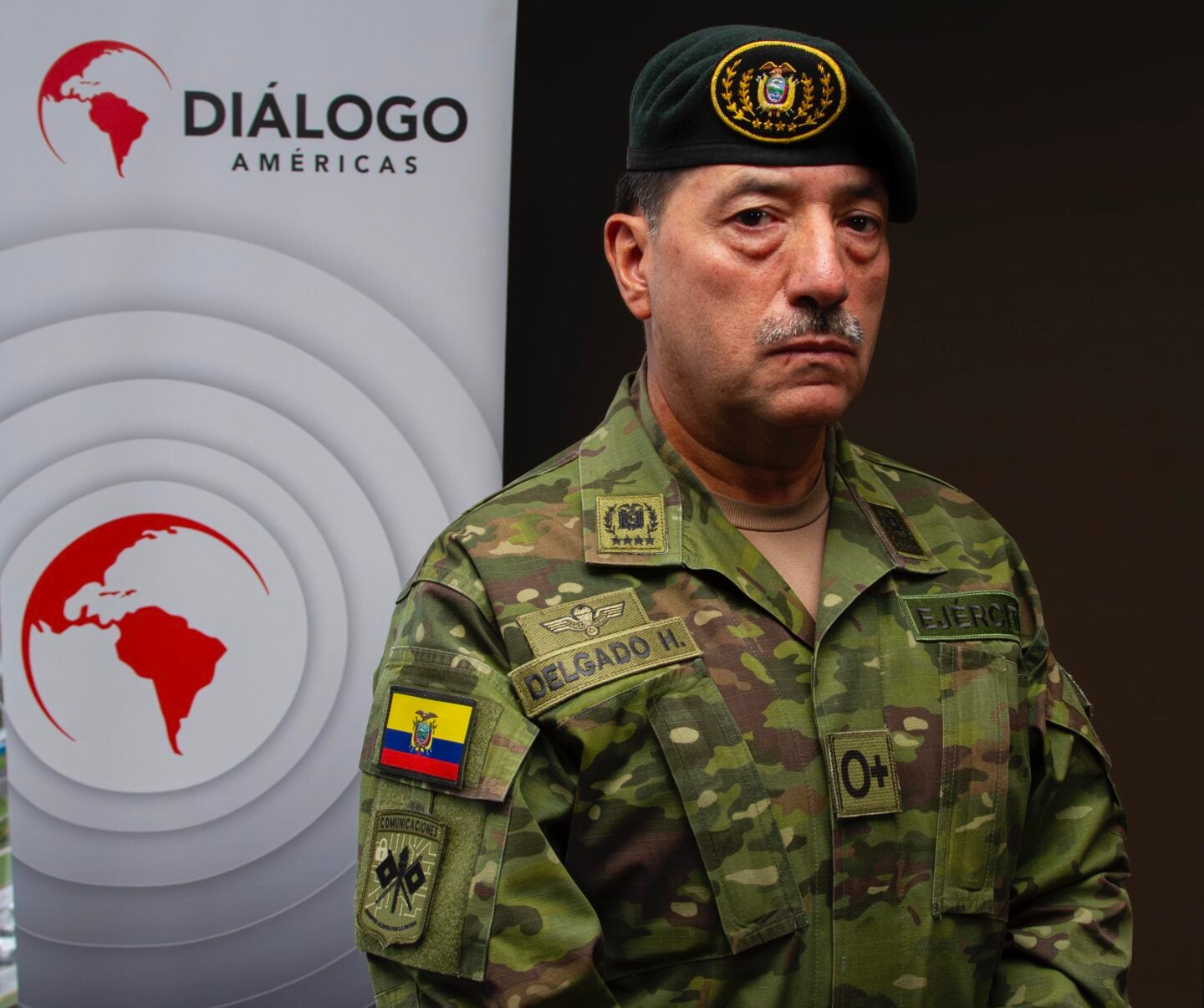
Leading these efforts is Army General Henry Santiago Delgado Salvador, chief of the Ecuadorian Armed Forces Joint Command since September 2025. With more than three decades of service, Gen. Delgado has held positions including commanding general of the Army and undersecretary of National Defense, and has also served as military attaché in the United States and Ecuador’s representative to the Inter-American Defense Board.
During his participation in the second meeting of the Americas Counter Cartel Coalition, held in Panama, August 11-12, 2026, Diálogo spoke with Gen. Delgado about the evolution of transnational organized crime, regional cooperation, and the capabilities Ecuador considers priorities in confronting these threats.
Diálogo: General, transnational organized crime operates through networks that extend across borders. Based on Ecuador’s experience, how have these connections evolved, and what challenges do they pose for the Armed Forces?
Army General Henry Santiago Delgado Salvador, chief of the Ecuadorian Armed Forces Joint Command: It’s important to understand that when we talk about transnational organized crime, it’s impossible for a single country to confront these types of threats. There are relationships and connections among different actors, not only in the Americas but also on other continents, led by mafias. We have talked about the Italian mafia, the Albanian mafia, the Russian mafia, and their ties to cartels here in the Americas, particularly the Jalisco New Generation Cartel. In this way, Mexican cartels are connected to illegal armed groups in Colombia and, through them, to organized armed groups in Ecuador. However, today we can even see a direct relationship between these cartels in Mexico and armed groups in Ecuador.
Diálogo: The Ecuadorian Armed Forces have accumulated extensive experience operating against these types of organizations. How has the organized crime threat evolved in the country, and what new criminal dynamics are you seeing?
Gen. Delgado: It is true that in the 1980s and 1990s we had already begun experiencing these problems with illegal armed groups coming from Colombia into Ecuador, but today the situation is completely different. We are talking about criminal gangs that gradually became more structured, organized, armed, and trained, with the objective of using drug trafficking — which is at the core of the problem — to gain structure, strength, and capabilities and attempt to control certain territories as a result of payment for narcotics.
Payment for narcotics leads to microtrafficking. They are paid with a certain amount of drugs, the business begins, and from there comes the struggle for territory among these organized armed groups in order to sustain their illicit activities through drug trafficking.
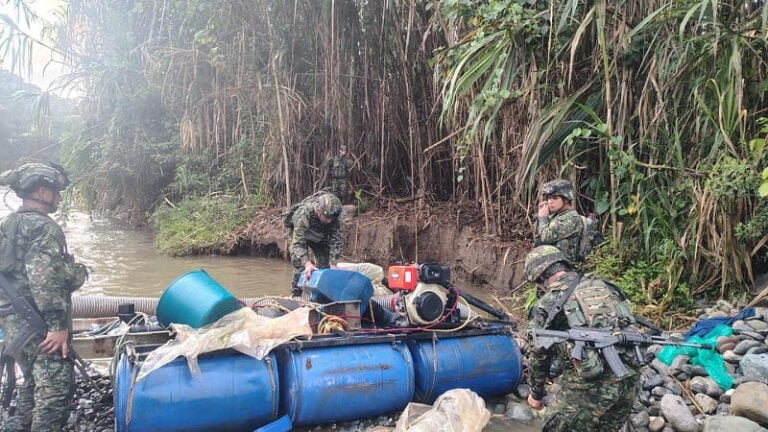
From there, we have seen various related crimes emerge because today these illegal armed groups from Colombia, including those that have established relationships with our own groups, are diversifying their illicit economies. One of these activities is illegal mining. Why? Because it is extremely profitable. An ounce of gold reached values of more than $4,000 and $5,000, comparable to the value of a kilogram of drugs, so it became very profitable. There is also the ease with which they can move gold from one country to another because it is not inspected in the same way as drugs. On the other hand, for them, it is preferable to have gold, to have gold bars stashed away, than to have cash hidden away and deteriorating. For them, it’s much more profitable.
This also gives rise to money laundering; the smuggling of weapons, ammunition, and explosives; and fuel smuggling. All of these become related crimes. Add human trafficking to that. Then they move out to sea, where we even see “floating gas stations,” refueling points at sea intended to facilitate drug-trafficking routes.
Diálogo: As criminal organizations continue to develop their own capabilities, how important is it for the hemisphere’s security and defense forces to stay one step ahead?
Gen. Delgado: At the meeting, I told all the countries: It’s impossible to conceive that our countries’ armed forces — prepared, trained, capable, and equipped, in other words, ready to engage in any type of combat — are not organized at the level of the Americas, while these criminal gangs and groups, or transnational organized crime, as the term itself says, are organized.
That is inconceivable, particularly considering that these are common threats. Today, the impact of these threats is greater in certain countries, as is the case with ours, than in others. However, we can see that every country needs to start preparing. It is preferable that today, in these meetings we are holding as part of the Shield of the Americas, we organize ourselves to combat them immediately and prevent them from acquiring greater capabilities across the Americas.
Diálogo: Criminal organizations have evolved and diversified their activities, and technology is playing an increasingly important role both for them and for security and defense forces. How can partner nations better leverage technology and information sharing to respond to this evolution?
Gen. Delgado: This is extremely important, considering that these groups possibly have even larger budgets than many of our countries’ armed forces and, logically, they have adopted cutting-edge technology to commit their crimes.
This demonstrates the importance of countries such as the United States — whose initiative I applaud, as well as the effort it has been making to bring all the countries together — supporting us, within the framework of international cooperation, with technology that many of our countries currently lack to identify these threats. It’s very important to understand that surprise and opportunity are key to successfully accomplishing our missions.
That support, not only from the United States but from every country that possesses certain technologies and shares them — whether through information or intelligence, or even through physical capabilities in different jurisdictions or areas of operations — is extremely important.
Diálogo: Ecuador occupies a strategic position between the Andean region and the eastern Pacific, making it both a key hub for legitimate trade and a target for criminal networks. What role do maritime cooperation and information sharing with partner nations play in protecting these areas and strengthening regional security?
Gen. Delgado: It is fundamental, considering that this is one of the main drug-trafficking routes. Remember that because of the production that exists in Nariño and Putumayo, on the Colombian side, as well as in Peru, the second-largest drug-producing country, we are effectively situated between these two countries.
They seek to use these routes, primarily over land. We have identified approximately four specific routes they use to transport drugs, all of which lead toward the coastline, the ports, and access to the sea through different methods: either by contaminating shipping containers or by using speedboats along routes south and north of the Galápagos, with the aim of reaching Central America and, in this case, Mexico, and even crossing into the Atlantic toward Europe.
This cooperation is fundamental because it also requires technology and the necessary maritime-air surveillance and detection capabilities, with technology that makes it possible to determine exactly which vessel is transporting drugs. They also have their own methods, tactics, techniques, and procedures. These drug traffickers blend in with fishermen; when the fishermen head out, those boats go out as well.
But that is where technological capabilities come in, in this case with maritime patrol aircraft, unmanned aerial vehicles (UAVs), and drones, to determine which boat is actually transporting drugs, trace the route it is taking, and even determine when action can be taken.
That is also why the use of coast guard forces is so important, along with ships capable of remaining at sea for more than 30 or 40 days and equipped with interceptor boats to immediately intercept vessels involved in drug trafficking.
Diálogo: Looking ahead, what capabilities do you consider priorities to continue developing with the United States and other partners in the hemisphere to strengthen the regional response to transnational organized crime?
Gen. Delgado: Intelligence. Sharing information is important and fundamental — gathering information based on the capabilities the United States has, sharing it, and enabling us to plan operations against these types of threats.
Airspace coverage is also important so that we can use drones or UAVs with all the capabilities we discussed previously to determine, including through thermal imaging, the location and concentration of people, drug routes, and small, medium, and large storage sites.
Mobility is another capability that is required: air mobility, ground mobility, and maritime mobility, so that we can effectively block the entire drug-trafficking process through our country and out to sea.