China’s escalating interest in acquiring Colombia’s critical minerals, essential for advanced technologies and defense industries, raises significant security concerns. Beijing’s growing influence in securing these vital resources, especially following Colombia’s recent entry into the Belt and Road Initiative, risks creating vulnerabilities in global supply chains and potentially provide geopolitical leverage, posing challenges to regional stability.
In addition to exploiting the country’s natural resources, with serious social and environmental repercussions, Beijing is fueling the internal armed conflict in Colombia. Its interest in critical minerals such as coltan has encouraged illegal mining for export, involving local armed groups such as dissidents from the Revolutionary Armed Forces of Colombia (FARC) and the National Liberation Army (ELN).
According to the Colombian National Mining Agency, there are 17 groups of minerals considered strategic in Colombia, but only 2.9 percent of the territory has legal mining activity.
In 2025, Colombian authorities confiscated nearly 49 tons of coltan and tin, illegally mined by FARC dissidents in the departments of Guainía and Vichada, on the border with Venezuela and Brazil. The shipment was estimated at $1.2 million.
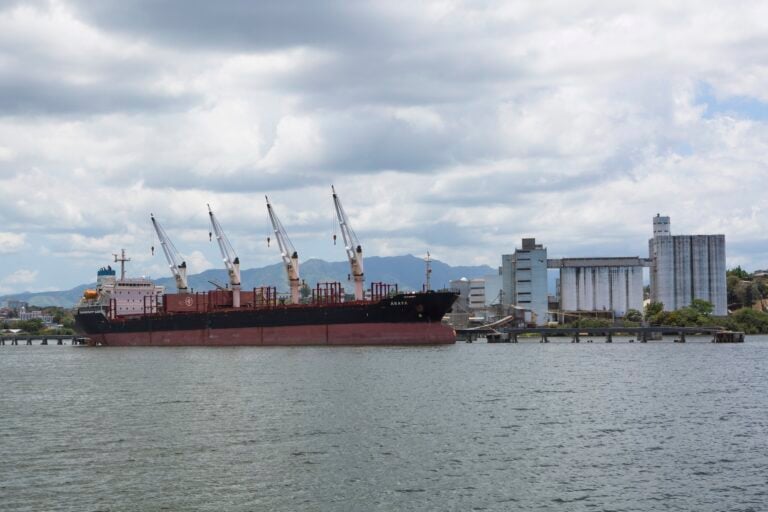
“The shipment was intended to be sold on the international market, with China as its final destination via the Port of Cartagena in northern Colombia,” Colombian Police Brigadier General José Roa, director of the Carabineros and Environmental Protection, said in a statement.
Coltan is a mixture of minerals from which niobium and tantalum are extracted, which are strategic for China’s technological and military plans. In addition to being a key component in advanced electronics, it is used for defense equipment such as missiles, military drones, and satellite components.
“However, Colombia is not only losing physical control over coltan, but also the possibility of incorporating it into a national development strategy. In addition, the financial autonomy of armed groups is strengthened, consolidating illegal logistics networks and forms of social and territorial control,” Mauricio Guzmán Rojas, a Colombian risk and security expert, told Diálogo.
According to an Insight Crime report, coltan reaches China through falsified documentation and opaque supply chains. One method involves small processing plants with limited oversight acquiring unrefined coltan and reselling it via online platforms in China.
“It has been documented that a high percentage of these shipments appear to be destined for Hong Kong, which could be linked to the strategic use of free trade zones with less customs control, fewer regulatory barriers, and the existence of commercial networks specializing in the exchange of rare metals,” Rojas said.
The gold interest
China’s investments in the Buriticá gold mine, located in the department of Antioquia, have also proved to be a problem for the local population.
In 2020, the Chinese state-owned company Zijin Mining Group finalized its $1 billion acquisition of Canadian company Continental Gold’s project. This deal granted Zijin a 14-year concession over nearly 1,900 hectares, an area already notorious for social instability driven by illegal mining. Armed groups, including the Clan del Golfo came to control portions of these illegal mining operations. Zijin now claims it has lost control of around 60 percent of its tunnels to illegal miners.
According to Global Arbitration Review, a news site specializing in investment arbitration, “the mine has been affected by violence due to clashes between Zijin workers and illegal miners in the area.” While Zijin has sued the Colombian government in international arbitration for failing to protect its investment, claiming $500 million in compensation, some argue that the company underestimated the serious security problems and the deep entrenchment of illegal armed groups and mining operations in the region, suggesting a lack of due diligence on the part of the Chinese company.
Other issues include allegations that Zijin has failed to adequately address the needs of local communities and traditional miners who have worked the land for generations and are seeking formal recognition of their rights. According to critics, problems with community relations intensified after Zijin took over the project.
There are also allegations, denied by Zijin, that the company dumped toxic sludge into the tunnels while informal miners were on site.
On the other hand, concerns about serious environmental degradation exist in all Chinese mining projects and have had serious consequences. The use of mercury by illegal miners to extract gold, such as in Buriticá, has contaminated local aquifers and puts the health of surrounding communities at risk.
“In addition, deforestation and soil erosion caused by mining operations have threatened the biodiversity of one of the most species-rich regions in the Andes,” says Rojas.
However, China remains keenly interested in Colombian gold. According to official figures from the Colombian Mining Information System (SIMCO), gold exports to China and Hong Kong showed a consistent growth pattern between 2020 and 2024. In 2020, Colombia exported 0.3 tons to mainland China and 6.3 tons to Hong Kong. In 2021, these figures rose to 1.2 tons for China and 14.8 tons for Hong Kong. No new data has been made available since 2022.
“However, some gold export operations to Hong Kong and China may appear to be linked to undervaluation or triangulation practices, which fuel asset laundering networks,” says Rojas.
Other Chinese investments in critical minerals
In May 2025, a Chinese consortium led by JCHX Mining Management Co. purchased the remaining 50 percent of the Alacrán mining project for $128 million.
The project located in Puerto Libertador, in northern Córdoba, was owned by Canada’s Cordoba Minerals Corp., a subsidiary of Ivanhoe Electric. Estimates suggest the deposit, set to begin operations in 2026 after exploration, could reach an annual production capacity of about 450 tons of copper, along with silver and gold.
According to a report by the Colombian Center for Research and Popular Education for Peace, the Alacrán project’s mining exploration operations have devastated the surrounding environment, threatening the survival of local communities.
“Large amounts of mercury have been dumped, impacting the tributary and eroding its slopes. This has contributed to deforestation and exposed local residents to high doses of contaminated water, violating their fundamental rights and their right to a healthy environment,” the report states.
There are also ongoing lawsuits accusing the mine of violating the rights of indigenous communities and traditional miners.
In addition, according to Reuters, the February 2025 purchase by Chinese company MMG Ltd of Anglo Americas’ ferronickel facilities in Brazil could prompt China to also take an interest in buying the Cerro Matoso mine in Colombia, located in Córdoba.
“China’s exploitation of critical minerals remains a critical issue because it not only contributes to deforestation and forced displacement, but by being channeled through illegal networks, it strengthens illicit economies that directly challenge sovereignty, institutional order, and the integrity of the royalty and mining system in Colombia,” Rojas concluded.