

Multinational exercise CENTAM Guardian 2026, co-sponsored by U.S. Southern Command (SOUTHCOM) and El Salvador’s Ministry of Defense, will convene Central American armed forces in mid-April. The exercise underscores that interoperability is not merely a military concept, but a strategic imperative linking national security, humanitarian assistance, and disaster response into a unified regional framework.
The 2026 iteration builds on lessons from previous editions, deepening coordination among regional partners. The exercise demonstrates that partnership remains the region’s most effective deterrent against emerging threats. Through this large-scale convergence of forces, participants demonstrate an enduring commitment to regional security, ensuring the Americas remains resilient in the face of evolving challenges.
“CENTAM Guardian marks a milestone in the evolution of security doctrine in the region. In criminology and strategic studies, this is defined as the shift from national security, focused on borders and armed enemies, to multidimensional security,” Salvadoran criminologist and national security expert Dr. Ricardo Sosa told Diálogo. “Comprehensive security understands that a poorly managed disaster creates the raw material for gangs. From a strategic intelligence perspective, it is assumed that enemies of the state will take advantage of the chaos of disaster to operate.”
CENTAM Guardian serves as a yearly platform for participating nations to evaluate the capacity of their institutions to manage complex crises by integrating the armed forces with civil protection and humanitarian actors. This interagency approach aligns decision-making, enhances operational capabilities, and deepens alliances to counter transnational threats more effectively.
Strategic planning and regional cooperation
Planning for CENTAM Guardian 2026 began nearly a year ago, allowing military and security leaders and humanitarian assistance teams to synchronize efforts, standardize rescue protocols, optimize operational capabilities, and refine logistics for rapid aid delivery. This year’s exercise will feature the participation of Belize, Costa Rica, the Dominican Republic, El Salvador, Honduras, Guatemala, and the United States, with some 1,100 civilian and military personnel expected to gather. These collaborative efforts also strengthen military units in deterring and countering regional and international threats by closing the gaps that hostile actors typically exploit.
The Salvadoran Armed Forces (FAES) have emerged as a regional leader, showcasing tactical experience acquired through territorial control operations, emergency assistance, humanitarian logistics, and decades of U.S. military training. A statement from the institution noted that this structural approach is embedded in their training from day one, allowing personnel to move seamlessly between public security missions and citizen protection.
“The versatility of the FAES serves as a comprehensive security mechanism that transforms disaster response into a stabilization operation, preventing a power vacuum,” Sosa said. “It maintains state presence, preventing criminal structures from taking advantage of the chaos to regain territorial control or gain social legitimacy, ensuring that supplies reach those affected without being looted, diverted, or extorted along the way.”
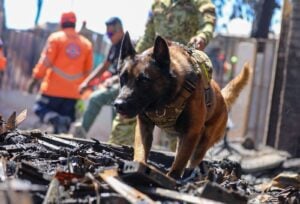
A recent testament to this capability occurred February 13, when a massive fire broke out in the historic district of San Salvador. The FAES provided immediate support to rescue teams, deploying canine units, establishing security perimeters, and assisting in debris removal.
Resilience in a disaster-prone region
Central American nations annually face large-scale environmental disasters, including hurricanes, earthquakes, floods, and landslides. In this environment, CENTAM Guardian strengthens the bonds between partner nations and consolidates mechanisms required to meet shared challenges.
“Soldiers across the military need to be ready to be adaptive to any environment as well as to be adaptive to operations across the world,” said U.S. Army First Lieutenant Darcey Starling, who served as a U.S platoon leader for an event during the 2025 edition in Guatemala. “Whether it’s for readiness or actual conflict, we need to be ready to work with anyone to be able accomplish any mission.”
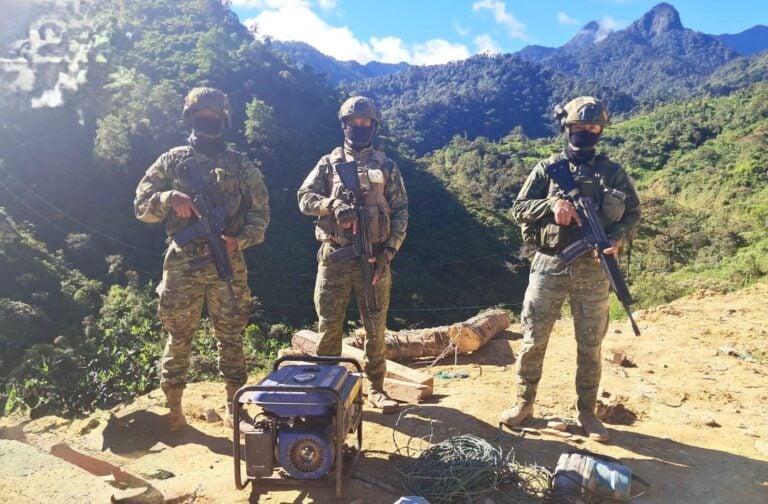
In 2025, the exercise mobilized more than 900 military and civilian personnel from six countries. Participants engaged in jungle patrols, squadron attacks, fast rope descents, and drone-supervised air operations. These activities enhanced participants’ ability to respond to a broad spectrum of threats, from narco-terrorism and irregular migration to natural disasters.
A model of comprehensive security
“Humanitarian crises or natural disasters cause a temporary breakdown in formal social control by institutions such as the police, the prosecutor’s office, and customs, among others,” Sosa said. “Exercises such as CENTAM Guardian train armies to respond quickly, not only for humanitarian reasons, but also for sovereignty. Humanitarian assistance becomes a tool to deny organized crime political and social space.”
CENTAM Guardian stands as an innovative model focused on developing agile, responsive forces capable of navigating dynamic security challenges. According to past participants, this level of training does more than enhance operational readiness; it bolsters regional resilience and long-term security.
In a region where the next emergency could be a hurricane, an earthquake, or a complex security threat, the ability to integrate diverse missions ensures a coordinated and effective response. By mastering the intersection of security and humanitarian action, partner nations ensure they can face the challenges of the future with greater determination, demonstrating that unity is the most reliable shield for protecting stability and sovereignty across the region.