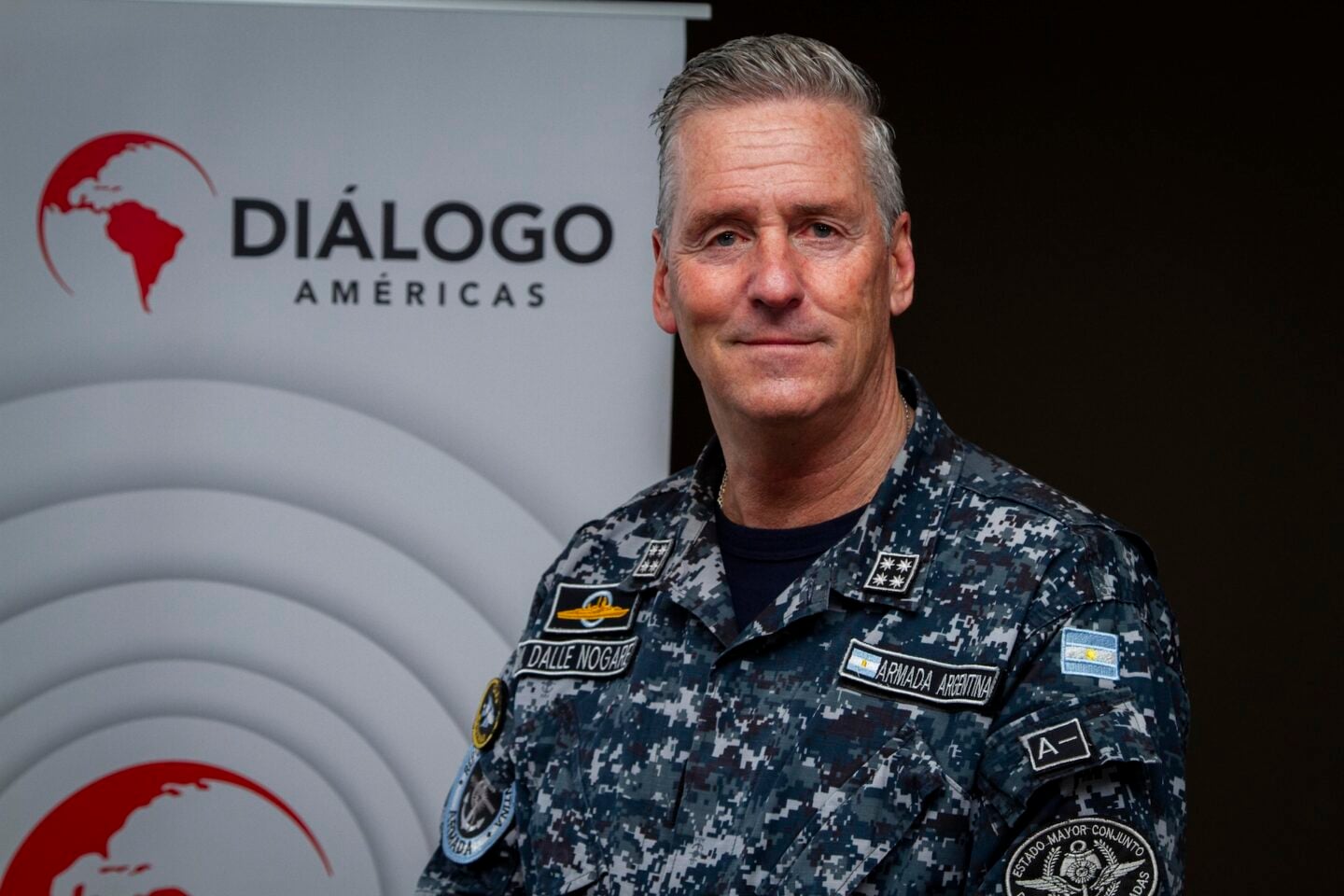

More than three decades of military service have taken Argentine Navy Admiral Marcelo Alejandro Dalle Nogare from command of Argentine Navy units and international naval operations to the highest levels of joint leadership. That trajectory, which includes experience in intelligence, combined operations, and international cooperation, has reinforced a conviction that shapes his view of transnational threats: No country can confront them alone.
As chief of the Argentine Armed Forces Joint Staff, Adm. Dalle Nogare promotes greater integration among the services, intelligence sharing, the adoption of new technologies, and cooperation with partner nations. His career includes participation in naval operations during the Gulf War, command of naval units and the Southern Naval Area, service as defense attaché in South Africa, and senior positions in intelligence and joint leadership.
During the second meeting of the Americas Counter-Cartel Coalition, held in Panama City in August, Diálogo spoke with Adm. Dalle Nogare about Argentina’s role in confronting transnational threats, the importance of combined exercises, technological challenges, and opportunities to deepen cooperation with the United States and other partners across the hemisphere.
Diálogo: Argentina is actively participating in the Americas Counter-Cartel Coalition on several fronts. What value does an initiative like this have in confronting transnational organizations that operate across multiple borders, and how can it strengthen cooperation among the armed forces?
Navy Admiral Marcelo Dalle Nogare, chief of the Argentine Armed Forces Joint Staff: This is something that is just getting started. I just came from greeting the people who were working on exercise PANAMAX 2026, and I was telling them that I had the opportunity to participate in PANAMAX 2003. Over time, you see how initiatives that start small end up becoming something big.
I think the same thing will happen with this. It is just getting started as a U.S. Southern Command (SOUTHCOM) initiative, and to me it is extremely important. Under our current government, we consider ourselves strategic partners of the U.S. government, and we have an excellent relationship with its Armed Forces; we always have. We intend to take a leading role in this effort, and we believe this hemispheric security initiative is excellent.
I would point to a phrase that is used here: “Local Action, Regional Impact, and Hemispheric Defense.” I believe everything starts with a local initiative. It has been emphasized throughout that this initiative cannot infringe on the legal limitations of each participating state. There are 19 states. By achieving control at the local level and extending it regionally, we will achieve greater regional and hemispheric security, which is ultimately what we want to accomplish with this entire agreement.
This is just beginning. I think we have high expectations. SOUTHCOM is receptive to our needs and our limitations. In Argentina’s specific case, that is why the minister of Security and the minister of Defense are here [at the Panama’s conference]. As in many countries in the Americas, the roles of the security forces, of which we have four, and the Armed Forces, of which we have three, are very clearly defined, essentially within and beyond our borders.
So, we can continue coordinating activities to achieve local, regional, and hemispheric security, which is the ultimate goal.
Diálogo: One of the pillars of this new coalition is strengthening information sharing among member nations. From your perspective, what role do intelligence and trust among partners play in anticipating and dismantling criminal networks?
Adm. Dalle Nogare: The first thing, and it is fundamental, is mutual trust. In our particular case, we have that with all our neighbors.
We regularly conduct exercises with Chile, Brazil, Bolivia, Paraguay, and Peru, whether naval exercises or combined and joint exercises, some more closely related to security issues and others to emergency response. And intelligence is vital. The armed forces were traditionally focused, and remain focused, on military intelligence beyond our borders.
Domestic intelligence, particularly anything related to cartels or criminal organizations, is handled by the security forces. Argentina has made a major change in this area with the creation of the Joint Staff’s Directorate General of Intelligence, headed by Rear Admiral Pablo Javier Barbich, who is here with me. He now heads the intelligence directorates of the three branches of the Armed Forces.
We have an excellent relationship with both neighboring countries and SOUTHCOM to exchange intelligence and views, as well as to reequip ourselves and bring our intelligence capabilities closer to the level of those used by these organizations.
Diálogo: In 2026, Argentina led the combined exercise Atlantic Dagger, the first exercise of its kind held in the country. What capabilities do exercises like this develop, and why are they important for strengthening cooperation and interoperability among participating forces?
Adm. Dalle Nogare: I’m going to go back a little. The Joint Staff has a joint operational commander, which is something not every country has. All the joint commands fall under that commander.
I believe our Joint Staff is somewhat more advanced than those of many countries in the region because all the joint commands conducting air, land, and maritime operations fall under us, the Joint Staff. And among those commands, we have the Joint Special Operations Command.
Although each branch of the Armed Forces — the Army, Navy, and Air Force — has its own special operations forces, this Joint Command integrates all their requirements. We try to standardize everything related to equipment, from something as basic as a parachute to a vest or helmet and make the forces increasingly interoperable with one another.
Within this framework, the Joint Special Operations Command, which participated in PANAMAX 2026, conducted Atlantic Dagger. It is the first major exercise of its kind, focused entirely on special operations forces. It included components involving the Army, Navy, and Air Force, and everything was then integrated into a major exercise held in Córdoba.
It is the first in a series of exercises we are going to conduct. Thanks to the professionalism and capabilities of our joint special operations commander, Argentina led the exercise, and it is not common for the United States to hand over command of an exercise.
We are already planning the next one, which I estimate will take place in two years. Most importantly, it was a combined exercise in which different countries worked together alongside the special operations forces of all our Armed Forces.
Diálogo: What does it mean for the Argentine Armed Forces to assume command of complex multinational exercises such as PANAMAX?
Adm. Dalle Nogare: First, as a member of the Armed Forces, it is a source of pride because entrusting us with command of an exercise as complex as a special operations exercise demonstrates recognition of our professionalism and capabilities. We are restoring capabilities, modernizing, and moving toward new technologies, and having our ability to command these types of exercises recognized is extremely important to us.
I would say that every Argentine should be proud that we are able to command this exercise. Special operations exercises can be conducted anywhere and offer great mobility. Just as we conducted Atlantic Dagger in Córdoba or PANAMAX here in Panama City, these exercises can be rapidly transferred to any part of the world where an international force may require us.
And from what the Joint Operations commander has told me, we are at an excellent level, not only professionally but also in terms of the integration of equipment, communications, and organizational capabilities with SOUTHCOM forces.
Diálogo: Transnational criminal organizations have adopted new technologies and diversified their sources of financing. What do you consider the main challenges these organizations pose today to the armed forces of the hemisphere?
Adm. Dalle Nogare: For the armed forces of the hemisphere, integration and cooperation are fundamental, as is beginning to standardize information transmission systems in the maritime and air domains, as well as land-based intelligence information.
As I said before, much of this information goes through the security forces, while much of our maritime and air information comes through our Joint Aerospace Command and Joint Maritime Command. I believe something very important in an initial stage is integrating the security forces with the armed forces.
Another very important issue discussed at these meetings is the entire legal framework. There is a chain: being able to detect an anomaly, detect a terrorist organization or transnational organization; being able to intervene and capture [those involved]; being able to detain them; and finally being able to hold them, which is where the penitentiary system comes in.
If any link in that chain fails, the whole effort loses its purpose. If the legal component fails — and that is where we are experiencing difficulties in more than one country — there is no point in investing in the rest. This is a very comprehensive issue, and it will affect all of us.
Essentially, when we come to these conferences, we see that the scenarios are not the same in Central America, the Pacific, the Atlantic, southern South America, or northern South America. Then there is our own complex region, which encompasses Bolivia, Paraguay, Chile, Argentina, Uruguay, and Brazil.
Each area has a different problem. What we are looking at — and there will be another meeting in November — is establishing information-sharing nodes in each of these areas so we can integrate our security forces, our armed forces, and, above all, our intelligence capabilities.
Diálogo: During the Western Hemisphere Chiefs of Defense Conference in February, you said that “security is multidimensional.” How does that view influence the way the region’s armed forces should cooperate to confront threats such as transnational organized crime?
Adm. Dalle Nogare: Today, the threats we know as transnational threats, or threats posed by organizations, are all transnational. They move throughout South America: When pressure is applied in one place, they emerge somewhere else.
Today, these are not just criminal organizations linked to drug trafficking. They have also moved into human trafficking, smuggling, and the theft of minerals and fuel. It is very complex, and that is why the armed forces first have to work jointly. That is why the Joint Staff chiefs are here rather than the chiefs of each individual service.
Within each country, we also have to work in a multidimensional way with border agencies, security organizations, the legal sector, immigration authorities, and the banking sector to monitor and track transactions. It is a very complex issue.
The forces are the ones with greater operational capacity and more capabilities. In the specific case of our country, for example, along the land border, we provide logistical support to the security forces because, by law, we cannot participate directly in confronting these types of threats within our territory.
The situation is very different in the maritime and air domains. Through the Joint Aerospace Command and Joint Maritime Command, we have radar coverage across all of northern Argentina, we have a reasonable degree of control over aircraft entering the country, and the same applies to our maritime domain out to our 200-nautical-mile exclusive economic zone.
We complement this with maritime operations known as Mare Nostrum, which we conduct together with the Prefecture [Argentine Naval Prefecture]. The Navy and Prefecture have separate responsibilities, and we are constantly monitoring our waters out to 200 nautical miles, in addition to the surveillance we conduct through electronic means.
Diálogo: What role does technology play in this protection and surveillance effort, particularly in an area as complex as the maritime domain in the southern part of the hemisphere?
Adm. Dalle Nogare: Technology is extremely important today. And within technology, there is also everything related to cyber defense. We also have the Joint Cyber Defense Command, which is vital today.
In the future, our capabilities will become much more technologically advanced. Some are already saying that in 20 or 30 years everything will be automated and that there will even be robots on the battlefield. Everything is becoming highly technological.
This requires a different kind of training and different kinds of people in the Armed Forces and, without question, significant investment, although in the future this could result in lower defense expenditures.
What I see today is a very fine line between security and defense. We can say that in the hemisphere we do not face major state-based threats like those we are seeing in Europe, but we do face major threats from transnational and criminal organizations that find fertile ground here to export much of what is produced in South America to the rest of the world.
We have to remain alert to that, which may require, in the future, a reassessment or reconsideration of our defense and security laws.
Diálogo: In what areas do you believe Argentina can expand cooperation with the United States and other partners in the hemisphere to strengthen security, increase capabilities, and confront these transnational threats?
Adm. Dalle Nogare: What we are proposing, and what we have proposed to SOUTHCOM, is to intensify everything related to airspace control through the Joint Aerospace Command and also strengthen maritime control.
Although we maintain control of our maritime space, our primary relative threat is everything related to illegal fishing beyond the 200-nautical-mile limit. Illegal fishing also involves a range of crimes or illicit activities that take place aboard vessels, and we have to try to keep those activities under control.
One of the things we have offered, as something different, is a control center for the entire South Atlantic, focused primarily on maritime control.
We are also thinking about something that, although we are not analyzing it right now, involves deployment or projection toward Antarctica. And given where we are right now, if the Panama Canal were at some point to experience some type of disruption or anomaly, all the traffic passing through the Strait of Magellan, which is controlled by Chile, as well as through the southern passages that we monitor jointly with Chile through different types of patrols, would become critically important.