
As transnational criminal organizations (TCOs) become increasingly sophisticated, Guatemala continues to strengthen its special operations capabilities through sustained cooperation with U.S. special operations forces.
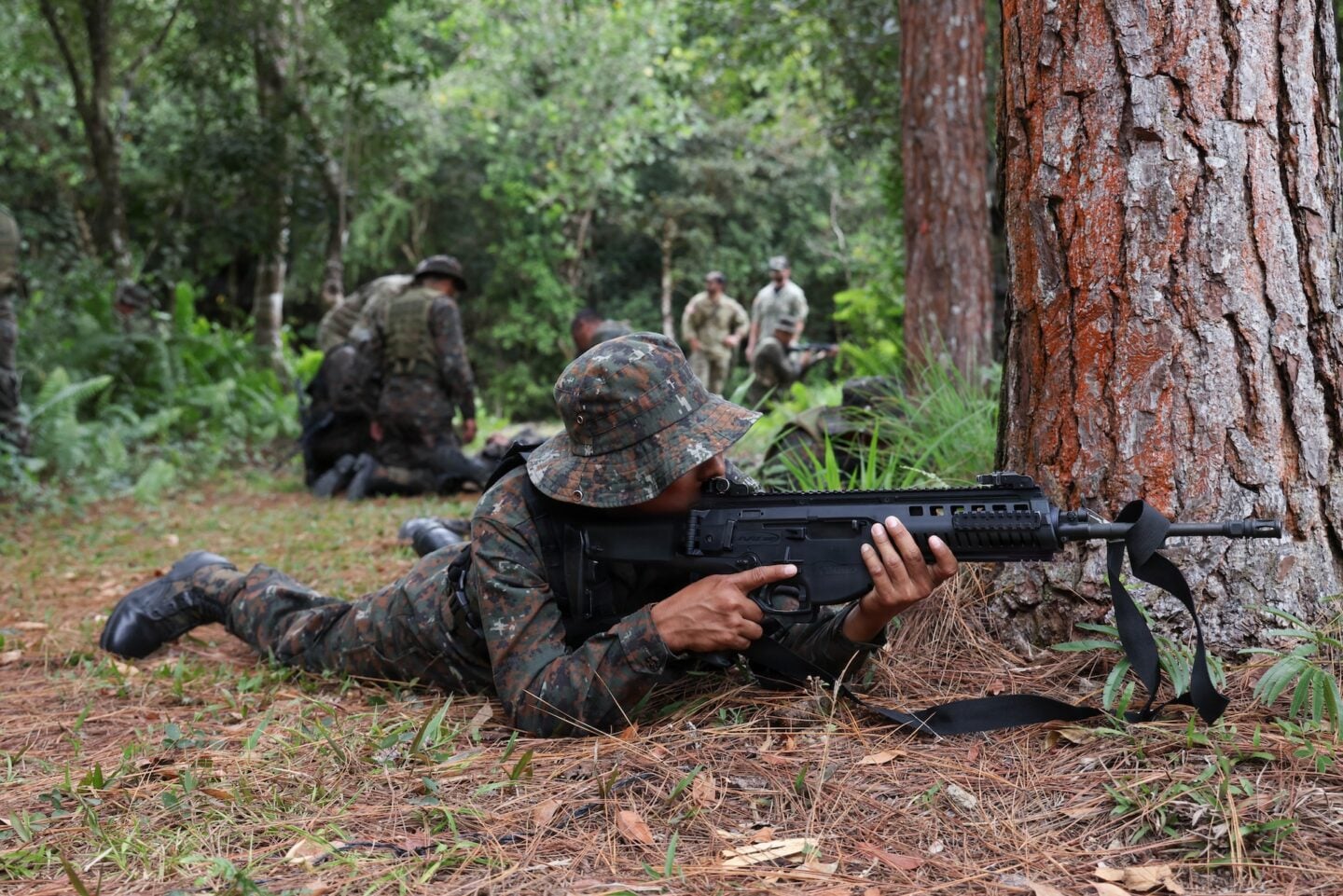
That strategic partnership was demonstrated during a March 2026 exercise in Poptún, Petén Department, where U.S. Army Green Berets assigned to the 7th Special Forces Group (Airborne) trained alongside personnel from the Guatemalan Army’s Naval Special Forces Command (COFEN) and Kaibil soldiers from the Interdiction and Rescue Brigade. The training focused on small-unit tactics, reconnaissance, communications, and coordinated maneuver in complex terrain.
Another example came in June, when a Guatemalan Army Special Forces detachment participated in a rotation at the Joint Readiness Training Center (JRTC) at Fort Polk, Louisiana, alongside members of the Arkansas National Guard.
“They attended a jungle warfare reinforcement course as part of our broader counternarcotics efforts. The contingent consisted of 42 Kaibiles, including five junior officers,” Guatemalan President Bernardo Arévalo told the press.
During the rotation, participants operated against an opposing force in one of the U.S. Army’s most demanding training environments. They conducted reconnaissance and scouting missions, detainee operations, and offensive maneuvers. The event marked the first training of its kind in the 24-year partnership between Guatemala and the Arkansas National Guard.
Arévalo said the training is designed to enhance the Army’s operational readiness to secure the country’s complex border regions. Guatemala shares an approximately 960-kilometer border with Mexico. Among the areas most vulnerable to TCO activity are Huehuetenango and San Marcos, which border the Mexican state of Chiapas, as well as Petén, which borders the states of Tabasco and Campeche.
Petén, Guatemala’s largest department, is characterized by dense jungle and a network of rivers, roads, and remote areas that can be exploited by transnational criminal organizations to move personnel, weapons, narcotics, and illicit goods.
Intelligence integration and operational planning
“Jungle warfare training is tailored to the operational dynamics of TCOs, which use jungle terrain to conceal their activities because of its difficult access and dense natural cover,” Military Police Major Nathalia Mollinedo Díaz, the Guatemalan Army spokesperson, told Diálogo. “To counter these threats, the Guatemalan Army incorporates technological capabilities such as helicopters and unmanned aerial systems in areas of dense vegetation.”
According to Maj. Mollinedo, integrating technological assets is critical during the planning phase of military operations. In operations of this nature, helicopters and drones provide the command staff with real-time information on activity within the operational area.
“That allows us to achieve up to 90 percent situational awareness, significantly reducing the risk for reconnaissance units,” she said.
Developing leadership and operational resilience
Beyond technology, the bilateral training places a strong emphasis on resilience and leadership at the small-unit level under challenging conditions.
During an interdiction scenario in the June training focused on locating clandestine airstrips in a jungle environment, participants encountered a simulated ambush and lost access to their technological equipment.
“The strategy is to rely on basic tools such as compasses and maps to complete the mission,” a Kaibil officer who participated in the June exercise and requested anonymity told Diálogo.
The scenario required participants to maintain orientation, communications, and maneuver capabilities without relying exclusively on electronic systems.
For Maj. Mollinedo, the training also strengthened leadership among officers and noncommissioned leaders, as instructors introduced new strategies and modern communications systems.
“This has enabled us to transmit orders clearly, promptly, and effectively, even in isolated areas. It increases tactical autonomy and improves decision-making at the small-unit level,” she said.
Interoperability and regional security
The value of the training extends beyond individual tactical skills, strengthening Guatemala’s institutional capacity to protect strategic areas and operate alongside partner forces.
Following the bilateral training, Maj. Mollinedo said Guatemalan Army personnel are better prepared to conduct these types of operations and reinforce security in strategic areas.
Retired Honduran Armed Forces General Luis Maldonado Galeas, a defense and security expert, shared that assessment. He told Diálogo that the combined training between Guatemalan and U.S. military personnel has a positive impact on regional security, particularly in the land domain.
According to Gen. Maldonado Galeas, “the training will help identify three critical elements: drug trafficking routes through Guatemala’s jungle regions; areas controlled by drug cartels that serve as sanctuaries; and populations that either collaborate with or oppose transnational criminal organizations.”
He added that establishing electronic surveillance systems and tactical mobility routes will strengthen the fight against criminal organizations and ultimately enhance interoperability between the two forces through compatible technologies.
Institutional cooperation in security and defense
Security and defense cooperation between Guatemala and the United States was further reinforced by the early June visit of U.S. Marine Corps General Francis L. Donovan, commander of U.S. Southern Command (SOUTHCOM).
During meetings with President Arévalo and senior Guatemalan officials, both sides discussed expanding bilateral defense cooperation and reaffirmed their commitment to combating TCO activity through the Americas Counter Cartel Coalition.
According to Diario de Centro América, Arévalo described the visit as a great honor for Guatemala, adding that “discussing the terms of our security cooperation is itself an example of the strategic closeness between our two countries.”
The president also noted that the Guatemalan Army has expanded its presence along the borders with Honduras and El Salvador, building on efforts launched under Operation Ring of Fire and later extended to other border areas.
Gen. Maldonado Galeas warned that sustained pressure on criminal routes in Guatemala must be accompanied by increased surveillance and timely intelligence sharing among neighboring countries to prevent TCOs from shifting their activities to other border regions, including the Merendón mountain range.
“The bilateral training supported by the United States has enabled military personnel to reduce risks during engagements with transnational criminal organizations, minimize friendly casualties, and increase operational effectiveness in complex environments,” Maj. Mollinedo concluded.
The training conducted in Poptún and Fort Polk strengthened the capabilities of Guatemala’s special operations forces at both the tactical and operational levels. By combining specialized training, interoperability, and common procedures, these activities better prepare Guatemala and the United States to respond together to the evolving threat posed by transnational criminal organizations.