

Weeks after two powerful earthquakes struck Venezuela on June 24, the international response has moved beyond the race to find survivors. The priorities now include sustaining displaced families, restoring essential services, assessing damaged buildings and infrastructure, expanding health care, and maintaining the logistics networks that allow assistance to reach affected communities.
As those needs evolve, U.S. assistance is also moving from the initial emergency response toward sustained humanitarian and recovery support. The logistics, transportation, engineering, communications, and humanitarian capabilities deployed in the aftermath of the earthquakes helped establish critical access and supply networks, while continued U.S. assistance is supporting food, health care, water and sanitation, shelter, protection, and other needs as the recovery progresses. As of July 8, the United States had committed more than $386 million to the earthquake response, according to the U.S. Department of State.
“The Venezuelan government must exercise leadership, both to address the emergency and to determine what will be needed in the subsequent phases,” Ángel Rangel, former director of Venezuela’s Civil Protection Agency, told Diálogo. “Every brigade or mission from any country needs a national counterpart to guide it and tell it where it is most needed.”
From emergency response to sustained assistance
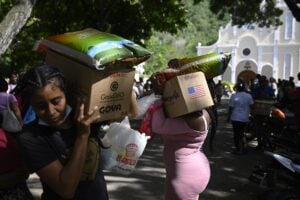
The U.S. government response, led by the Department of State through a Disaster Assistance Response Team (DART), mobilized civilian and military capabilities to support relief operations following the earthquakes. U.S. Southern Command (SOUTHCOM), operating in support of the department, established a Humanitarian Assistance Coordination Center at Simón Bolívar International Airport to organize U.S. military assistance and help direct capabilities where they were most needed.
Those capabilities supported the initial push to find survivors, treat the injured, reopen transportation routes, and establish access to damaged communities. As the operation moves forward, however, the challenges are changing. The current phase requires longer-term decisions about which buildings can be reoccupied, which infrastructure must be repaired or demolished, where displaced families will live, and how health, water, sanitation, and food services will be sustained.
“For the U.S. to be able to help, the government must establish its disaster management plans and, based on that, tell those offering aid what needs to be done,” Rangel said.
In La Guaira, one of the hardest-hit states, Governor José Alejandro Terán reported in early July that at least 750 buildings had been affected, including 180 that had collapsed and about 400 with partial damage. Assessments were continuing, meaning the full requirements for demolition, repair, and reconstruction had yet to be determined.
From emergency access to sustained support
U.S. assistance during the first phase helped reopen and sustain key entry points for international aid, including Simón Bolívar International Airport and the Port of La Guaira. Those operations, along with air, sea, and ground transportation networks, established the logistical foundation for the current relief effort.
Brigadier General (Ret.) Antonio Rivero of the Bolivarian Army, who previously led Venezuela’s Civil Protection Agency, said the restoration of critical infrastructure became a priority as the search for survivors wound down.
“Once the rescue phase was complete, three priorities were established: the restoration of critical infrastructure such as the airport, hospitals, and roads; the reconstruction of homes; and the maintenance of security,” Brig. Gen. Rivero told Diálogo.
The challenge now is not merely bringing aid into the country, but moving it from ports, airports, and warehouses to shelters, clinics, and communities while national and local authorities continue to assess changing needs.
The World Food Programme (WFP), which had more than 3,000 metric tons of food inside Venezuela when the earthquakes struck, expanded distributions in La Guaira and other affected areas. The organization also used its logistics capacity to transport supplies for humanitarian partners, provide storage, and improve connectivity where roads and services had been damaged.
WFP initially planned to reach 500,000 earthquake-affected people during the first three months of the response, with the possibility of assisting as many as 1 million if sufficient funding became available. Its established presence in Venezuela and the prepositioning of additional relief supplies at the United Nations Humanitarian Response Depot in Panama allowed it to expand operations without building a distribution system from the ground up.
This existing humanitarian network also provides a channel for U.S.-funded assistance. According to the Department of State, more than 400 metric tons of emergency supplies from U.S. warehouses had been delivered to support tens of thousands of people by early July.
Public-private partnerships extend the supply line
The flow of assistance has also expanded through cooperation among the U.S. government, humanitarian organizations, and private companies.
Amazon and the humanitarian aviation organization Airlink established an airlift between Miami International Airport and Caracas. Under the arrangement announced in July, Amazon agreed to cover aircraft and fuel costs for seven weekly cargo flights, while Airlink coordinated the movement of humanitarian supplies donated by nonprofit organizations.
The operation connects relief organizations in the United States with distribution networks already working inside Venezuela. Rather than creating a separate delivery structure, the airlift supports established humanitarian channels, including logistics and distribution mechanisms involving WFP and other partners.
That model allows private transportation capacity to reinforce a broader, nationally coordinated response. It also helps sustain the movement of food, medical supplies, hygiene items, water equipment, and shelter materials after the surge of military and government flights associated with the initial emergency begins to decline.
The U.S. Department of the Treasury also issued authorization for transactions related to earthquake-relief activities, reducing restrictions that could otherwise complicate the financing, transportation, and delivery of humanitarian assistance.
Health and displacement needs grow
The end of urban search-and-rescue operations has not reduced the pressure on emergency services. Instead, health requirements are shifting from trauma care toward primary care, maternal and infant services, disease prevention, mental health, safe water, and sanitation.
The International Federation of Red Cross and Red Crescent Societies (IFRC), working through the Venezuelan Red Cross, dispatched an emergency field hospital to La Guaira with support from the Spanish Red Cross. The facility has the capacity to provide primary health services to as many as 30,000 people and can support maternal and infant care, vaccination, nutritional and epidemiological surveillance, and mental-health and psychosocial services.
It complements a Venezuelan Red Cross field hospital that began treating trauma patients during the initial emergency and later shifted increasingly toward primary care and psychosocial support. Mobile clinics are also being used to reach communities where access to health facilities remains difficult.
The Venezuelan Red Cross, supported by the IFRC, has distributed hygiene kits, cleaning supplies, sleeping materials, water filters, and containers to families living in temporary shelters. The organization initially launched an appeal for 50 million Swiss francs to assist 300,000 people.
At the wider humanitarian level, the United Nations requested an additional $298 million to address the needs of 1.3 million earthquake-affected people over six months. Those requirements extend beyond emergency food and shelter to health, water, sanitation, protection, education, and early recovery.
US support continues into recovery
As Venezuela moves into a longer recovery phase, the nature of the response will continue to change. Restoring infrastructure, maintaining essential services, supporting displaced families, and addressing health and humanitarian needs will require sustained resources long after the initial emergency operations have ended.
The capabilities mobilized during the first weeks of the response helped establish critical transportation routes, logistics networks, communications, and channels for humanitarian assistance. Continued U.S. support — delivered directly and through international, nongovernmental, and private-sector partners — can build on that foundation as needs shift from immediate lifesaving operations toward recovery.
Aircraft, ships, trucks, warehouses, and relief supplies can greatly expand the reach of a national response when they are integrated into locally defined priorities. Venezuelan authorities will play the central role in guiding decisions on damaged communities, public services, housing, and reconstruction, while international partners continue to provide specialized capabilities and resources.
The scale of the earthquakes has demonstrated that humanitarian needs do not end when search-and-rescue teams complete their missions. As Venezuela faces the longer process of restoring critical services and supporting affected communities, the United States continues to provide assistance and resources to help meet evolving needs throughout the recovery and future phases of the response.