

Trinidad and Tobago’s strategic location — close to the Venezuelan coast and lying along major transnational crime routes — has contributed to strengthening the longstanding collaborative security partnership between the island nation and the United States. This increased partnership aims to contain the critical flow of drugs, weapons, and irregular migrants originating from Venezuelan territory. However, the move has triggered a harsh, retaliatory reaction from Caracas, which opted to suspend energy agreements with the island, raising regional tensions.
Energy fallout
The diplomatic crisis peaked in late 2025. On October 27, Venezuela’s Nicolás Maduro announced the suspension of an extensive energy agreement with Trinidad and Tobago, covering joint gas projects. This drastic move followed accusations from Caracas that Port of Spain was displaying a “hostile attitude” and aligning itself with the U.S. strategy, Argentine daily La Nación reported.
Euclides Tapia, a professor of International Relations at the University of Panama, view this break as part of a persistent trend. He notes that for years, “Venezuelan policy toward Caribbean microstates has sought to influence their governments through the supply of gas.” He told Diálogo that the suspension was not merely diplomatic; it was a direct retaliation for Trinidad and Tobago’s rapprochement with Washington.
The diplomatic deterioration was further underlined on October 28, when the Maduro-controlled Venezuelan National Assembly declared Trinidad and Tobago’s Prime Minister Kamla Persad-Bissenar persona non grata in direct response to the increase in security cooperation between Port of Spain and Washington.
Tapia stresses that for the Maduro regime, any distancing by these Caribbean countries reduces its capacity for influence. He warns that the suspension of gas agreements demonstrated how “Caracas was evaluating measures that could affect the Trinidadian economy,” adding that for Port of Spain, “coordination with the United States represents greater strategic benefits.”
Transnational crime and strategic security cooperation

Trinidad and Tobago’s geopolitical reality warrants international assistance to maximize the effectiveness of combating organized crime, whose capabilities often exceed the island’s national resources. This shared commitment to regional stability is the foundation of the long-standing cooperation with the United States, formalized under the Caribbean Basin Security Initiative (CBSI). This partnership focuses intensely on maritime interdiction, coastal surveillance, and port security.
Venezuelan regime officials, including Delcy Rodríguez, openly criticized the deepening collaboration, accusing the governments of Trinidad and Tobago and Guyana of supporting alleged U.S. plans to pressure Venezuela, Infobae reported.
Trinidad and Tobago is a key point in the transit routes for narcotics from South America, particularly regarding networks operating from Venezuela. The United Nations Office on Drugs and Crime identifies the maritime routes of the Southern Caribbean as critical segments within transnational organized crime chains.
Nongovernmental organization Transparencia Venezuela warns of the pressure this illicit flow exerts on the island’s limited interdiction systems. It also points out that large volumes of drugs continued to transit through Venezuelan territory in 2025, despite the lack of public information due to the regime opacity.
The Center for Strategic and International Studies (CSIS) highlights that these corridors connect criminal organizations with global logistics networks, contributing to significant increases in homicides, corruption, money laundering, and gang conflicts throughout the Caribbean. Tapia emphasizes that “the involvement of Venezuelan structures in drug trafficking networks has been documented for years. This is not a speculative statement.”
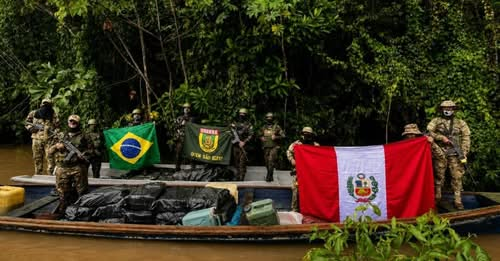
The island’s security efforts have yielded international results. For instance, in June 2025, a joint operation involving the Trinidad and Tobago Police Service (TTPS), the DEA, and the European Union’s Seaport Cooperation Project (SEACOP) resulted in the seizure of 1,660 kilograms of cocaine in Portuguese waters, Trinidad and Tobago Newsday reported.
Institutional strengthening and regional outlook
The cooperation with the United States is continuous and multi-faceted, marked by high-level engagements and a sharp increase in joint military exercises during the final months of 2025.
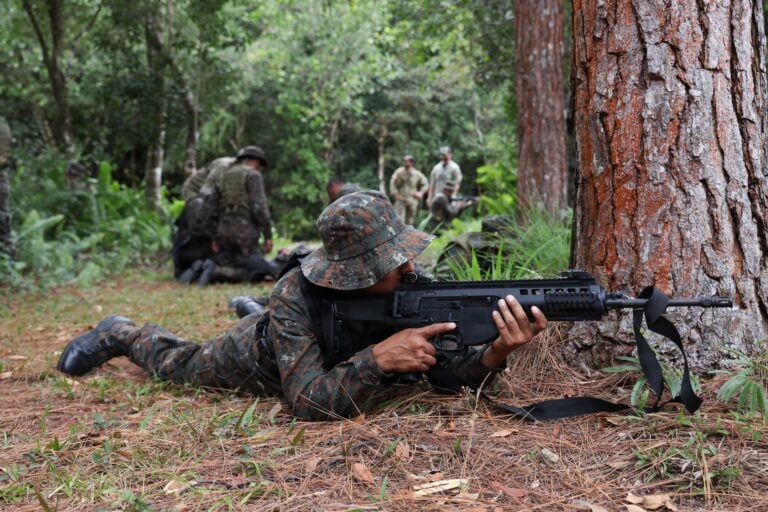
The heightened military-to-military cooperation began in late October 2025, when the U.S. guided-missile destroyer USS Gravely docked in Port of Spain for four days of joint training with the Trinidad and Tobago Defence Force (TTDF) and the 22nd Marine Expeditionary Unit (MEU). This was immediately followed by a second phase of intense drills with the 22nd MEU from November 16 to November 21, focused on urban and coastal operations.
Demonstrating the strategic priority of the alliance, on November 25, U.S. Air Force General Dan Caine, chairman of the U.S. Joint Chiefs of Staff, visited Port of Spain to meet with Prime Minister Persad-Bissessar. The visit focused on strengthening bilateral security ties, countering illicit trafficking, and reinforcing regional stability.
This intense late-year activity followed other engagements, such as U.S. Southern Command- (SOUTHCOM) sponsored exercise Tradewinds 2025. Co-hosted by Trinidad and Tobago in late April, the multinational exercise involved thousands of military and security personnel from over 20 nations, featuring extensive training in maritime security, ground operations, and disaster response, in addition to technical exchanges, including one that involved the TTPS and agents from the U.S. Department of Immigration and Customs Enforcement (ICE) focused on illegal arms trafficking and evidence recovery, ICE indicated.
Beyond direct security partnership, the island nation hosted the Cooperation Program between Latin America, the Caribbean, and the European Union on Drug Policy (COPOLAD III) meeting in April 2025, bringing together 14 countries from Latin American, the Caribbean, and Europe to strengthen drug policies. Furthermore, in 2024, experts on maritime drug trafficking gathered on the island nation during a forum organized by the Inter-American Drug Abuse Control Commission and the Inter-American Defense Board (IADB), to discuss best practices for interdiction.
According to Tapia, the recent deterioration in relations with Caracas has prompted other island states to carefully examine the cost of their financial and energy dependency on Venezuela. He explains that several Caribbean governments view their relationship with the United States as an essential part of their security architecture to reduce pressures arising from Venezuelan foreign policy.
The analyst concludes that revising energy agreements could reduce Venezuela’s sphere of influence in the region. Simultaneously, promoting international cooperation, especially with the United States, allows Caribbean countries to diversify their economic options and strengthen institutional capacities, effectively mitigating dependence on a single, volatile actor.