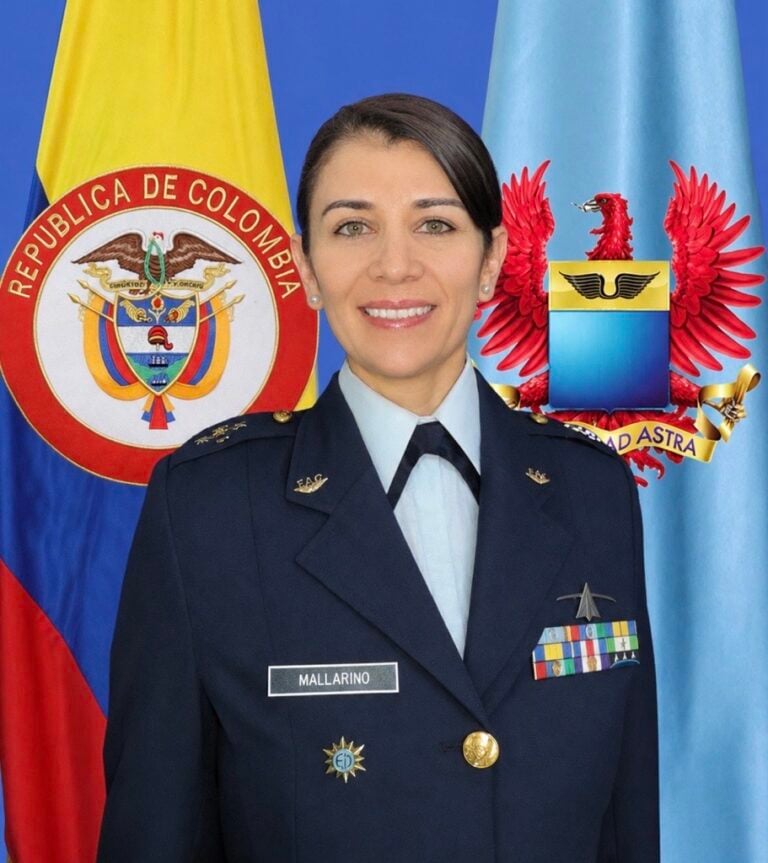

As Colombia consolidates its capabilities in the space domain, Colombian Aerospace Force Colonel Eliana Mallarino has been among the officers driving that process. As director of Space Capabilities of the Space Operations Command, she works to integrate space assets in support of security and defense operations, from monitoring illicit activities to responding to natural disasters. Throughout her career, she has also served as a space advisor to the Office of the Vice President of Colombia and has led international cooperation initiatives aimed at strengthening the country’s space capabilities alongside partners such as U.S Space Command (SPACECOM).
During the 2026 Space Conference of the Americas, held in April at the headquarters of U.S. Southern Command (SOUTHCOM) in Miami, Col. Mallarino spoke with Diálogo about the role of space in regional security, international cooperation, and the development of capabilities to address shared threats.
Diálogo: What are your main impressions of the 2026 Space Conference of the Americas?
Colombian Aerospace Force Colonel Eliana Mallarino, director of Space Capabilities of the Space Operations Command: In my view, the Space Conference of the Americas provides an opportunity to align concepts, projects, and initiatives from across the continent. This year, countries of Africa were also invited, which is very important because outer space is not a domain that can be developed individually; it requires cooperation.
The conference has been excellently organized. Above all, meeting in person with counterparts from different countries allows each nation to identify its strengths and opportunities for cooperation so that we can work together.
Ultimately, this is an effort with a clear mission that will undoubtedly benefit all participating countries.
Diálogo: During the conference, speakers emphasized how significantly the space domain has evolved over the past five years. Since you began working in this field, what has been your greatest lesson?
Col. Mallarino: There have been many. I began working on space issues in 2019 without knowing anything about the domain. I believe my greatest lesson has been understanding how, as a military force, we support the objectives of the state while also carrying a much greater responsibility for national security and defense, which is at the core of our mission.
When the Colombian Aerospace Force first began developing its space capabilities, we focused heavily on supporting those state objectives and on promoting the creation of a Colombian space agency, a project that we continue to support and hope will eventually become a reality.
Colombia still does not have that governance structure or civil institutional framework. Beyond understanding the space domain itself, the major lesson has therefore been learning how military, civilian, and commercial responsibilities come together within a single domain. I have learned a great deal, but one thing is certain: everything has changed over the past five years.
Diálogo: Through the FACSAT program, Colombia has strengthened its cooperation with U.S. Space Command. What progress has been made in using space capabilities to combat transnational organized crime?
Col. Mallarino: FACSAT is the program that brought space assets to the Force. It is not an effort developed solely by the Space Operations Command. It is also led by the Aeronautical Education Command through its Directorate of Science, Technology, and Innovation, because the operational component identifies a need and they develop the solution.
It is important to understand what the FACSAT program is, what its scope is, and how far it extends. We have had FACSAT-1 and FACSAT-2 Chiribiquete, and we are currently developing the FACSAT-3 project.
These assets have provided significant opportunities for cooperation and learning, from understanding how a nation develops a space capability to determining how that capability can be employed operationally through the products it generates. At the same time, I would not want to limit the discussion to FACSAT, because there are other capabilities that are not directly associated with a satellite.
For example, there are space situational awareness and space domain awareness. This knowledge allows our operators to understand what is happening in the space domain and how we can work with other nations to generate early warnings and identify risks in space.
Several areas within the Force also converge when it comes to transnational organized crime. The Space Operations Command has capabilities for satellite control, threat analysis, and the generation of products through international cooperation. But the Intelligence Command also plays a key role.
The Intelligence Command has access to other sources of information, including remotely piloted aircraft, crewed aircraft, and various commercial satellite constellations. Together, these resources provide imagery and other products that can be used to identify activities associated with organized crime.
Optical imagery, for example, supports judicial proceedings and can help identify activities that may not directly reveal a crime but do show related indicators. When we observe a deforested area in Colombia, we know that some form of illegal activity is likely taking place. In addition to being a crime in itself, deforestation is often linked to other forms of transnational crime.
In short, space capabilities provide tools for identifying illegal fishing, illegal mining, and deforestation.
But their use is not limited to national security and defense. We also have an important role in supporting responses to natural disasters, volcanic activity, and wildfires. Many of these products come from our own capabilities or from international cooperation. They are then analyzed and delivered to institutions that can use them directly to support operations or respond to emergencies.
Diálogo: The Colombian Aerospace Force’s space capabilities now support multiple government institutions. How is that work coordinated among the different agencies?
Col. Mallarino: Yes, and not only within our military role. Through the Intelligence Command, there is a National Geospatial Information Center responsible for providing the coordination you mentioned.
One area is specifically dedicated to national security and defense, where products are delivered in support of high-value targets. Another provides information for disaster response, the analysis of environmental crimes, and other issues that also support the Attorney General’s Office in judicial proceedings.
Many capabilities with different responsibilities come together within the Force. In the area we are discussing, they converge through space-based products and the use of the space domain. All of these products support operational planning and execution.
Diálogo: How are space capabilities translated into useful intelligence to strengthen border security?
Col. Mallarino: The products and imagery can support border security by identifying changes in activity in specific areas, increases in population, and other patterns that can be analyzed.
I do want to emphasize, however, that Space Operations delivers the products, while intelligence specialists conduct the analysis. A single image can be used for many different purposes.
The same image might be used for precision agriculture to identify what a crop needs, to detect illicit activities such as illegal mining, or to analyze population movements related to border security.
In addition, many illicit activities converge precisely in border areas because those are where the corridors used to move people, goods, and illegal products are located. Space capabilities provide tools for surveillance, but the operational analysis is primarily the responsibility of the intelligence community.
Diálogo: How does cooperation with the United States and other regional partners contribute to the development of Colombia’s human capital and space capabilities?
Col. Mallarino: One very important subject discussed during this conference is the development of space centers of excellence. It is a project that has not yet materialized, but the goal is for all of us to speak the same language. That means training together and aligning our doctrines.
From Colombia’s perspective, and this is something I also mentioned during one of the panels, we do not need to wait for the building or infrastructure to be completed before achieving early, incremental successes.
We have a very specific academic offering in space-related subjects, divided into two levels. The first is designed to build general knowledge. As we mentioned earlier, five years ago none of us fully understood what it meant to be an Aerospace Force. Now that we are one, one of our command’s missions is to build awareness at every level, from the most junior soldier to the most senior general, about the importance of the space domain.
To accomplish this, we offer two courses. The first is the Colombian Space Development Course, which provides general knowledge in a highly accessible way. The second is an advanced space course, for which the first course is a prerequisite.
We also offer specialized training in Cali, where our Space Operations Center is located, specifically for space operators. These courses have already been added to the catalog so that allied countries can access them through the United States and the U.S.-Colombia Action Plan on Regional Security (USCAP).
We also offer them through the System of Cooperation among the American Air Forces (SICOFAA), and we currently have international students enrolled in the Colombian Space Development Course.
We have also received training through the National Space Security Institute (NSSI). Its personnel have traveled to Colombia to provide both general instruction and a course specifically designed for senior leaders and commanders, with the goal of explaining why the space domain is important.
Another area of cooperation has been Joint Commercial Operations (JCO), a tool through which we work jointly and access information using the EDA [Enhanced Domain Awareness] platform. We have received extensive training in this area, so the cooperation has been truly bilateral. We are now also incorporating other countries interested in receiving training in Colombia.
I would not want to focus exclusively on academics. Advising and capability development are also very important. This conference has given countries such as Morocco an opportunity to express interest in visiting Colombia to learn about our experience. Other Latin American countries have also expressed interest in learning from what we have done well, as well as from what has not worked, so that we can all continue improving.
Diálogo: As emerging technologies such as artificial intelligence continue to evolve, how is the Colombian Aerospace Force incorporating these tools into the development of its space capabilities?
Col. Mallarino: When we talk about artificial intelligence, we can view it from two perspectives: as a threat or as a tool that helps us improve our capabilities.
Among the projects associated with imagery obtained through FACSAT, the Aerospace Technology Research and Development Center (CITAER) developed an initiative that uses artificial intelligence to analyze illegal mining sites. The artificial intelligence identifies heavy machinery, areas of exploitation, and the chemicals used in these activities. There are different ways to train these models using imagery, which makes the work considerably easier.
I believe the Force has adapted positively because we are going to use this technology, especially to exploit data. In the past, this work depended heavily on human analysts. Artificial intelligence can now help us process that information more efficiently.
In space operations specifically, we are seeking to incorporate artificial intelligence tools into the FACSAT project to automate recurring satellite-control tasks, always under human supervision.
The Aeronautical Education Command, the Directorate of Science and Technology, and the Aerospace Technology Research and Development Center are also using artificial intelligence in the development of payloads and engineering projects.
I believe the Force has adapted well by treating this technology more as an opportunity than as a threat, because it is a reality with which we must work.
Diálogo: What role can Colombia play as a regional leader in space cooperation for security and defense?
Col. Mallarino: We have already achieved successful results in cooperation, and I believe those are precisely the examples we should follow in the space domain.
We have the experience of the program that began under Plan Colombia to protect the airspace and track flights associated with narcotrafficking. The air defense model is a good example because it allowed us to develop significant expertise and become a regional reference point in Latin America. We have advised countries such as Guatemala, Bolivia, and other partners on strengthening their capabilities to combat these criminal activities.
Another example is our Helicopter School, where we train pilots from different countries and have the infrastructure and logistical capacity needed to do so.
We now want to apply those successful experiences to the space domain. At our space cluster, located at the Marco Fidel Suárez Air Base within the Military Aviation School, we have the Space Operations Center and will soon have a laboratory for satellite assembly and testing. The goal is to establish a space center of excellence there from which we can share our expertise.
In the space field, the universal language is English — and in some cases French — but primarily English. Being able to provide that knowledge in our own language allows us to become a strategic partner for countries that need to develop human capital but whose professionals face barriers in learning a second language.
Cooperation is already a reality. Joint Commercial Operations is the most tangible example. We have six operators and we participate in the Americas Cell. By doing so, we form part of a global cooperation network.
I believe Colombia has advanced very quickly in a relatively short period. The goal now is to continue building capabilities that can be projected regionally through cooperation among all countries.
I would especially like to highlight the support we have received from the United States. Through that cooperation, we have received training, will soon receive telescopes, and will have additional opportunities to strengthen our capabilities. Without question, the programs developed with the United States have been fundamental to our growth.
Diálogo: Looking ahead, what are the main priorities for strengthening Colombia’s space capabilities in support of national and regional security?
Col. Mallarino: We have a medium- and long-term strategic plan covering the 2030–2042 period. The Ministry of National Defense develops capabilities through a model known as DOMPI, which encompasses doctrine, organization, materiel and equipment, personnel, and infrastructure. Every time we develop a new capability, we must meet all of those requirements before it can be considered fully established.
Like most countries, Colombia has priorities in the air, land, and maritime domains, which have traditionally been the focus of our security and defense efforts. We still face several challenges in the space domain.
The first is to continue building awareness of the importance of this domain at every level, from operational personnel to the highest levels of government, including ministers and commanders. It is essential to understand why investments in space capabilities are strategically important.
Another priority is to continue developing human capital, consolidate a stable organization, and strengthen our infrastructure and space assets.
Above all, however, we must continue strengthening cooperation and information-sharing networks. No country, regardless of the size of its budget, can develop all the capabilities needed to operate in space on its own.
Space is not subject to national sovereignty; it is a vast domain that belongs to all humanity. That is precisely why it is so difficult to speak of space supremacy.
In that context, Colombia seeks to continue developing human capital, consolidating its organization, and acquiring capabilities focused on early warning and space domain awareness. We also seek to strengthen autonomous communications and navigation capabilities. That is a more ambitious objective, and we will have to assess how it evolves in the future, but achieving greater autonomy in the space domain remains a priority.