
The fight against transnational organized crime in Latin America and the Caribbean is entering a new phase. Beyond capturing kingpins or seizing drugs, governments are increasingly focusing their efforts on identifying, tracing, and dismantling the financial structures that sustain criminal organizations.
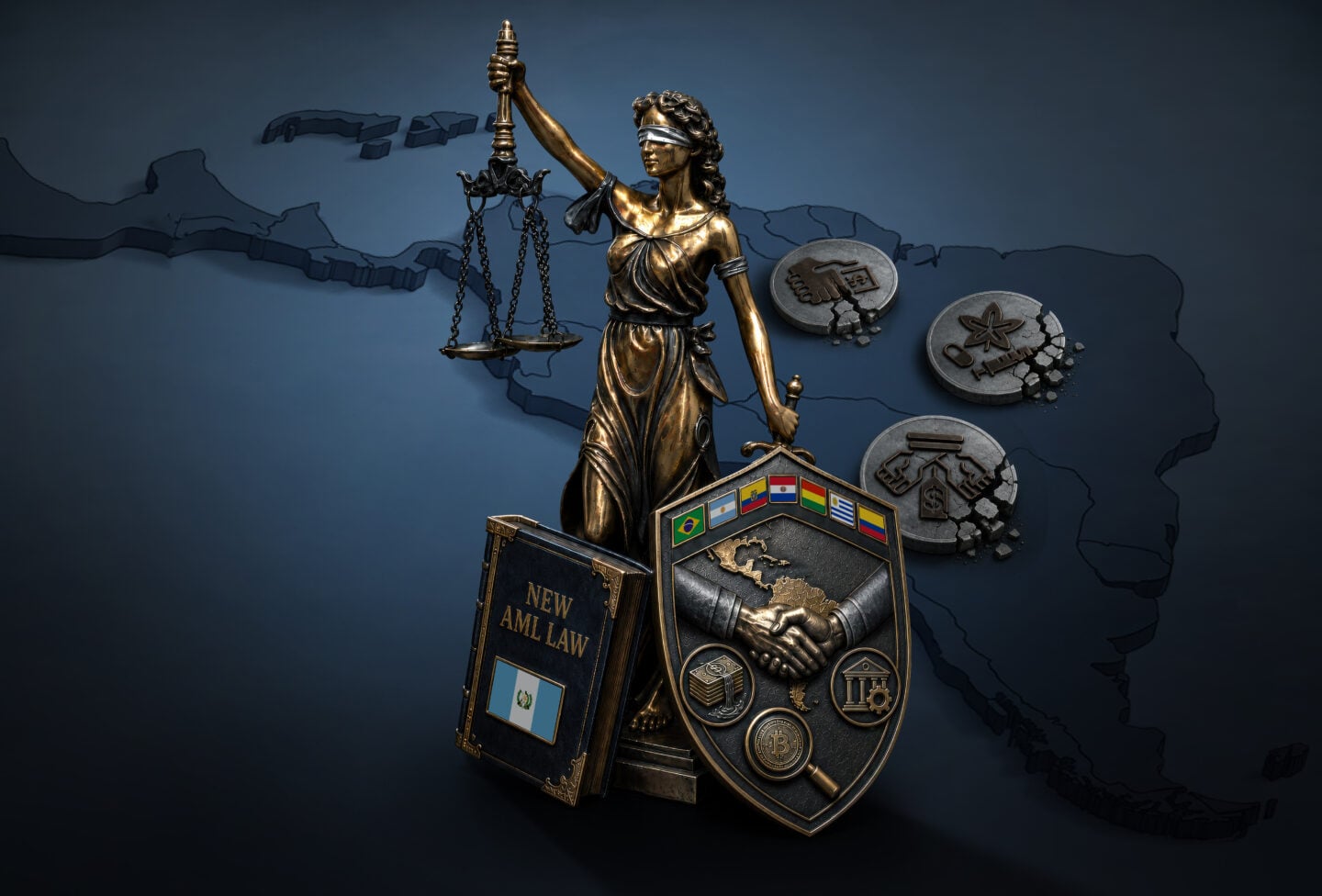
That shift was reflected in Guatemala with the September entry into force of the Comprehensive Law for the Prevention and Suppression of Money Laundering or Other Assets and Terrorist Financing. The law strengthens the government’s ability to detect suspicious transactions, trace illicit assets, and improve coordination among institutions responsible for financial investigations, according to the Guatemalan Congress.
For José Andrés Romero, former director of Colombia’s National Tax and Customs Authority (DIAN) and former alternate executive director at the International Monetary Fund (IMF), the reform responds to a reality confronting security agencies across the hemisphere.
“Following illicit money is the most effective way to weaken criminal organizations. When their ability to move and conceal resources is constrained, so too is their ability to corrupt institutions, finance new operations, and expand their influence,” Romero said.
From drug trafficking to complex criminal conglomerates
Criminal organizations no longer rely exclusively on drug trafficking. According to the Global Organized Crime Index 2025, produced by the Global Initiative Against Transnational Organized Crime (GI-TOC), these networks participate in a range of illicit markets. The index examines 15 illicit markets, including illegal mining, human trafficking, arms trafficking, environmental crimes, and smuggling.
The diversification of illicit economies has also led to increasingly sophisticated financial mechanisms. Today, proceeds from different criminal activities are channeled through front companies, real estate investments, international trade, trade-based money laundering, cryptocurrencies, and informal financial networks.
“Criminal organizations increasingly operate like business conglomerates,” Romero explained. “Today, different illicit economies share the same financial structures to conceal funds, launder assets, and finance their expansion.”
Disrupting the flow of illicit funds and dismantling money-laundering networks is emerging as one of the most effective strategies for weakening transnational organized crime over the long term.
Guatemala strengthens financial intelligence
Guatemala’s reform updates a legal framework that had remained largely unchanged for more than 25 years.
The change seeks to provide the government with new tools to target the financial structures that sustain organized crime. After signing the law, President Bernardo Arévalo summed up the reform’s objective in direct terms. “For years, drug traffickers, criminal gangs, and corrupt actors filled their pockets with complete impunity. No controls, no oversight, no punishment. That is about to end!” he wrote on X. “The Anti-Money Laundering Law is a powerful tool to move toward a cleaner, fairer, and more transparent economy,” he added.
According to the Superintendency of Banks (SIB), the law brings provisions to combat money laundering and terrorist financing together in a single legal instrument for the first time, strengthening the country’s prevention system.
The reform also improves coordination among the institutions responsible for preventing, investigating, and prosecuting these crimes, while strengthening the role of the Special Verification Intendancy (IVE), Guatemala’s financial intelligence unit.
The change also has an international dimension. The reform brings Guatemala closer to the standards of the Financial Action Task Force (FATF) and the Financial Action Task Force of Latin America (GAFILAT), whose evaluation processes directly affect market confidence and access to the international financial system.
A strategy spreading across the region
Following the money is becoming an increasingly important tool for dismantling organized crime in Latin America and the Caribbean. In Ecuador, prosecutors and financial analysts, with support from the United Nations Office on Drugs and Crime (UNODC), are tracing assets linked to illegal mining and investigating their beneficial owners. Colombia has strengthened this approach through its Financial Information and Analysis Unit (UIAF), which incorporates financial intelligence into investigations involving drug trafficking, corruption, illegal mining, and environmental crimes.
Brazil has taken the offensive against larger-scale financial structures. In one recent operation targeting money laundering and tax evasion in the fuel sector, the Federal Police identified a network linked to the First Capital Command (PCC) that allegedly moved more than $4.8 billion, underscoring the corporate scale that criminal finances can reach.
Paraguay, meanwhile, is seeking to strengthen coordination among financial, prosecutorial, law enforcement, and customs authorities to track the economic structures of the PCC and the Red Command (CV) in the Tri-Border Area through a strategic plan led by the Secretariat for the Prevention of Money or Asset Laundering (SEPRELAD), with support from the Development Bank of Latin America and the Caribbean (CAF).
From national financial intelligence to regional cooperation
The strengthening of national capabilities has been accompanied by greater cooperation among countries.
Faced with criminal organizations that recognize no borders and operate transnationally, governments have come to understand that an effective response requires closer coordination among their institutions and sustained regional cooperation.
In June 2026, the American Bar Association Rule of Law Initiative (ABA ROLI) brought together the financial intelligence units of Argentina, Brazil, and Paraguay to strengthen information sharing on money laundering and terrorist financing in the Tri-Border Area. The goal is to develop joint investigations, share early warnings, and harmonize methodologies for identifying transnational financial networks.
“It is an important milestone and sends a strong message to the world about the commitment of Argentina, Brazil, and Paraguay to cooperate on sensitive issues that affect security and integrity,” said Mariano Federici, former head of Argentina’s Financial Intelligence Unit (UIF).
Cooperation is also advancing in the Andean region. Between May and July 2026, Chile, Argentina, Peru, Ecuador, Bolivia, Paraguay, and Uruguay signed the Santiago Commitment to expand cooperation against organized crime, with an emphasis on financial intelligence sharing and asset recovery.
The same approach was reflected in the first Regional Cross-Border Control Operation carried out by Ecuador, Colombia, and Peru, which included simultaneous controls at airports and border crossings to detect illicit cash movements and exchange financial intelligence.
Based on FATF standards, particularly the implementation of Recommendation 32 on the cross-border movement of cash, the operation sought to close gaps exploited for the cross-border movement of illicit funds and strengthen the coordinated response to organized crime.
U.S. expands cooperation
The United States has also strengthened cooperation with countries across the region to enhance financial investigations, asset recovery, and efforts to combat money laundering.
Through the Department of Justice (DOJ), IRS Criminal Investigation (IRS-CI), and the Bureau of International Narcotics and Law Enforcement Affairs (INL), Washington has supported training programs for prosecutors, investigators, and financial analysts.
For Romero, bilateral cooperation provides strategic value that extends beyond technical assistance. “The exchange of knowledge, methodologies, and information with partners such as the United States strengthens countries’ investigative capabilities and enables them to respond more effectively to criminal organizations operating across multiple jurisdictions. No country can, on its own, reconstruct the origin, movement, and destination of the illicit funds that finance these criminal structures,” he said.
The approach is already translating into concrete action. In early 2026, DOJ and IRS-CI trained police investigators, prosecutor’s office investigators, and cadets in Colombia on tracing illicit funds, money laundering, cryptocurrencies, blockchain, and terrorist financing, with the aim of strengthening the response to increasingly sophisticated transnational criminal networks.
Targeting organized crime’s financial center of gravity
Transnational organized crime has evolved into highly resilient business-like structures. These organizations can quickly replace their leaders or establish new routes for their illicit activities, but rebuilding dismantled financial networks, recovering seized assets, or reestablishing complex money-laundering mechanisms poses a far greater challenge.
“Following the trail of illicit funds is not merely a tool for investigating a crime after it has occurred. It must be understood as a national security strategy aimed at preventing criminal organizations from continuing to finance, adapt, and expand their operations,” Romero said.
Guatemala’s reform therefore extends beyond the national level. It reflects a regional trend toward targeting the key resource that enables criminal organizations to sustain their power.
Financial intelligence, international cooperation, and asset recovery are thus becoming key tools in regional strategies to deprive these networks of the resources that finance their expansion and threaten hemispheric security.