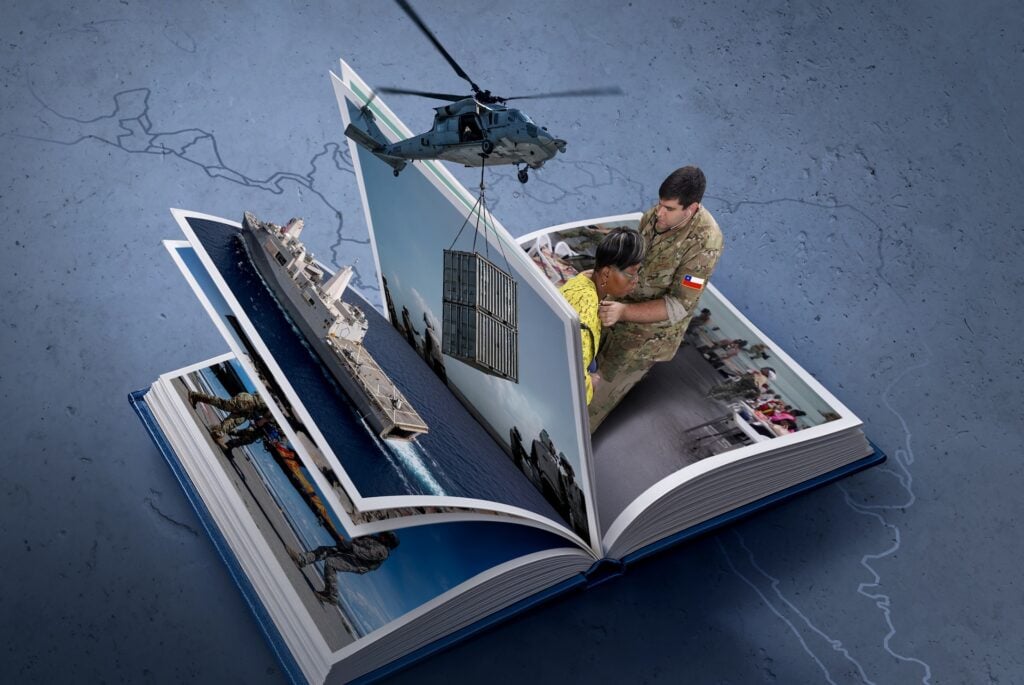

Hurricanes devastate Caribbean islands, earthquakes destroy infrastructure across multiple countries, and volcanoes spew lava, isolating mountain towns from the rest of the country. These disasters often exceed a nation’s capacity to rescue and care for its affected citizens. When that happens, nations typically turn to national and international civilian organizations, such as the United Nations.
However, when those organizations cannot respond in time or with sufficient resources, neighboring militaries often become the responders of last resort, leveraging their expertise and capabilities to act quickly. Such responses require the rapid and effective movement of personnel and materiel from their home nations to the affected areas.
In the Americas, this poses unique challenges, as not all nations have the means or procedures to deploy support effectively. Recognizing this, a group of Caribbean, North, Central, and South American nations agreed to address the problem.
The Humanitarian Assistance and Disaster Relief (HADR) Logistics Handbook for the Western Hemisphere
In every crisis, one of the greatest challenges is moving people and equipment from their home stations to the point of need. Distances can be vast, road networks may be limited, and many nations lack the sealift and airlift capabilities required to cross continents and oceans.
In recognition of these challenges, at the 2021 Senior Leader Logistics Symposium (SLLS), regional nations authorized the creation of an Experts Working Group to address the issues and make recommendations on how to improve regional HADR. By 2022, 15 nations had signed the HADR Logistics Handbook for the Western Hemisphere project charter, establishing a Movement and Transportation (M&T) Working Group to enhance their collective ability to deploy personnel and equipment during crises.
Drawing on lessons learned from regional and global HADR events, the M&T Working Group analyzed opportunities and challenges related to sharing national assets to move people and transport equipment around the region. Chile offered to chair the working group and Navy Captain Eduardo Torres took on the role with gusto.
Under his leadership, supported by Steve Carro from U.S. Southern Command (SOUTHCOM) J4 Staff as the secretariat, and with expertise from the Institute for Security Governance (ISG), the working group set out to identify why nations did not routinely share transportation assets in a crisis. The group also examined the regulatory issues that limit nations’ ability to receive approvals to move through or into another nation’s territory quickly for HADR; addressed concerns regarding the safety and security of deployed personnel and equipment being deployed in a crisis; establish voluntary standards and procedures to enable better integration of M&T assets in a crisis response; capture all the recommendations in a document that nations could use to guide their training, force development and operational deployments; test the proposed solutions in an international live exercise.
Moving from problems to solutions
Meeting monthly online, the M&T Working Group explored various methods to address these challenges. The working group first investigated how other organizations addressed similar challenges. They studied how organizations like NATO and the United Nations resolved similar issues. The group determined that the HADR Handbook nations needed standardized procedures, modeled on NATO processes, to enable seamless integration among NATO and non-NATO nations operating in the region.
Chile took on the task of drafting the initial version of the M&T Annex to the HADR Logistics Handbook. By early 2024, the annex was ready for testing and the participating nations set out to include a multinational movement of personnel and equipment as part of Exercise Tradewinds 2024. Unfortunately, despite heroic efforts to assemble ship and airlift options for the exercise, equipment availability issues prevented the nations from assembling the resources necessary to perform an effective test of the procedures.
Undaunted, the Working Group turned its attention to Tradewinds 2025. The initial plan was to move a Jamaica Defence Force (JDF) Disaster Assistance Response Team (DART) from Kingston, Jamaica, by sea to the Dominican Republic on a U.K. warship. The Dominican Republic generously offered to receive the ship at its Santo Domingo naval port, then use its Army resources to move the personnel and equipment to the Air Force base. The personnel were to be housed there for several days of load training by U.S. trainers from the United States Air Force’s 156th Tactical Advisory Squadron. After the training, the DART was to be transported by an Argentine C-130 to Trinidad where it would participate in Tradewinds 2025 before being returned to Jamaica.
However, an unexpected maintenance issue prevented the ship from departing the United Kingdom, forcing the cancellation of the sealift portion of the movement. However, with the lesson learned the previous year, SOUTHCOM and Argentina amended the deployment schedule so that the Argentine C-130 could pick up the JDF DART in Kingston, deliver the team and its equipment to Trinidad, and then return the team back to Kingston at the end of the exercise.
This allowed the project to confirm that the new procedures incorporated into the M&T Manual were fit for purpose. The scenario evaluators also identified several areas which could be improved. The evaluators believed that the document needed explicit diagrams and pictures to illustrate how to use key equipment. There were also a few important procedures that needed to be added. In the weeks that followed the validation exercise, the M&T Manual was amended to address those issues. The revised draft document was completed by the end of 2025.
The HADR Logistics Handbook, while still evolving, serves as a valuable guide for nations to enhance regional logistics cooperation and interoperability. With the completion of the current version of the M&T Manual, the Steering Committee decided to address other logistics issues. It directed the formation of a new Experts Working Group (EWG) to examine the feasibility of creating new procedures that would allow multiple nations to share the responsibilities of establishing and running a base camp from which they can support HADR activities when required.
Colonel Heredia from the Dominican Republic immediately offered to chair the EWG. The first chair of the HADR project’s Steering Committee, Colonel Hernández, also from the Dominican Republic, offered to assist. The EWG is using the lessons learned from the M&T Manual to draw up a project management plan for the new Common Camp Services project which will be discussed at the 2026 SLLS.
At the same time, the HADR Charter nations are examining opportunities to continue to practice the new procedures that were created by the M&T Working Group.
The HADR Charter nations have made significant strides in strengthening their collective humanitarian assistance and disaster relief efforts through collaboration and the development of innovative common procedures. By leveraging the strengths of each of the partners, sharing best practices, and incorporating lessons learned from exercises and past crises, member nations are finding new procedures to mutually support each other.
These procedures are being collected and published in the new Humanitarian Assistance and Disaster Relief Logistics Handbook for the Western Hemisphere. Although still in draft, the manual can be used today as a guide for nations to cooperate on movement and transportation issues. As the program matures, additional logistics competencies will be added to the manual to enhance regional logistics cooperation.
The next major disaster could strike any Western Hemisphere country at any time. To be as effective as possible, regional militaries must work together to ensure that they can provide an appropriate and well-organized logistical response that meets the needs of the affected nations.
Nations that might receive assistance also need to understand how to leverage and organized those logistical capabilities to support affected populations effectively. The new HADR logistics handbook is one tool to help nations be more logistically effective and efficient in their responses and help receiving nations understand how to best integrate the sending nations’ support into their national requirements.
The handbook will be hosted on SOUTHCOM’s new web portal so that nations that wish to voluntarily use the new logistics procedures will be able to download it in either Spanish or English.
Nations interested in contributing to the future development of the manual, or to access it so that they can work with other regional militaries, are invited to contact Steve Carro, the project secretariat, at USSOUTHCOM-SCJ4-MNL@groups.mail.mil.
Note: The title is drawn from a quote often attributed to Albert Einstein: “Nothing happens until something moves. When something vibrates, the electrons of the entire universe resonate with it. Everything is connected.” The HADR Logistics Handbook Program seeks to strengthen the logistics connections that already exists among nations, enabling them to move personnel, equipment, and assistance more effectively when disaster strikes.
Michael Boomer is an independent contractor to Booz Allen Hamilton, supporting US SOUTHCOM’s Enhanced Logistics Readiness Program.