
This article was originally published on FORUM, the U.S. Indo-Pacific Command magazine, on March 12, 2026.
The synthetic drug trade, spearheaded by fentanyl and methamphetamine, has metastasized from a criminal enterprise into a complex geopolitical phenomenon, demanding an expansive, multidimensional international response.
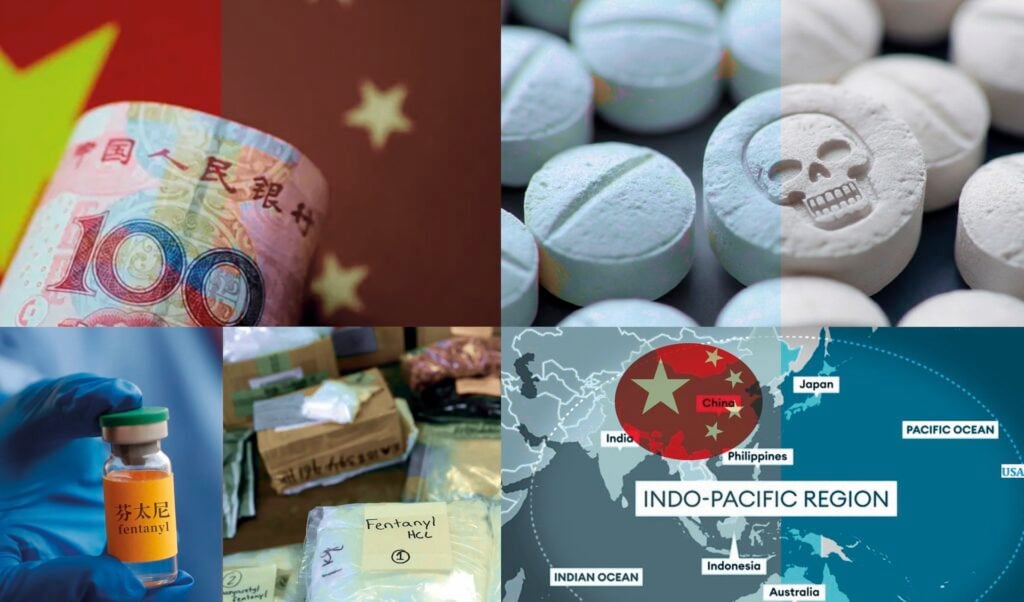
This global crisis hinges on the ready supply of precursor chemicals — primarily from China — driving two distinct but connected epidemics across the Indo-Pacific. It is defined by trafficking, mislabeling, the use of front companies, and exploitation of legal ambiguities and variance between nations and fragile state institutions.
Synthetic opioids, primarily fentanyl, account for tens of thousands of overdose deaths in the United States alone each year. Though deaths declined for consecutive years in 2024 and 2025, fentanyl remains a crisis, with the U.S. declaring fentanyl a weapon of mass destruction in December 2025.
The fentanyl crisis in North America stems from well-established trade routes originating in China, with refinement in Mexico and smuggling of the end product into the U.S. In 2019, China added all fentanyl-related substances to its controlled narcotics list, a significant move because it automatically controlled new chemical variations of fentanyl, called analogs, that could be manufactured to avoid existing laws. But manufacturers adapted rapidly by shifting focus to export massive volumes of legal analogs and dual-use chemicals and similar compounds that remain legal to ship.
This transition exploits the inherent weakness in global drug control: the difficulty in preemptively regulating every possible chemical permutation. These chemicals are shipped via commercial maritime freight to Mexican transnational criminal organizations (TCOs), notably the Sinaloa and Jalisco New Generation cartels, which operate sophisticated laboratories and leverage their logistical networks at the U.S. border to distribute the finished synthetic opioid.
The speed and adaptability of synthetic chemistry innovation outpaces the cumbersome, politically fraught process of chemical scheduling within international entities such as the United Nations Commission on Narcotic Drugs, creating a regulatory gap. A significant portion of these diverted chemicals have legitimate industrial or research applications, making oversight a logistical and political challenge, and allowing for the masking of illicit shipments within high volumes of legitimate trade.
Fentanyl-Methamphetamine axis
The flow of methamphetamine poses a profound threat to the stability of Indo-Pacific Allies and Partners. China-sourced precursors fuel the industrial-scale production hubs of the so-called Golden Triangle, the 200,000-square-kilometer mountainous region straddling northern Laos, northeastern Myanmar and northern Thailand that is long-associated with the opium trade and drug cartels. This is especially true in Myanmar, where a 2021 military coup shattered central governance and created a permissive environment where ethnic-armed organizations and criminal groups operate synthetic drug laboratories without state interference. Revenue generated from this drug trade, estimated in the tens of billions of dollars, fuels conflict and allows criminal organizations to co-opt local government, law enforcement and judicial systems. The resulting flow of high-purity meth strains law enforcement, challenges maritime security and drives addiction across Southeast Asia and beyond.
Moreover, the drug trade has transformed Pacific Island Countries from transit nodes to strategic convergence zones for criminal influence and systemic corruption. Criminal enterprises have sought to target countries such as Fiji and Tonga as critical infrastructure hubs for criminal ecosystems, blurring the lines between illicit economies, political access and the use of front companies. This is not merely a law enforcement concern but also a direct threat to regional resilience and stability.
An illicit finance infrastructure enables fentanyl and methamphetamine flow. TCOs rely heavily on China-based money-laundering organizations (MLOs), which fuse traditional trade-based money laundering (TBML) with digital assets. The shift to cryptocurrency provides MLOs and TCOs with near-instantaneous, borderless payment capabilities, ideal for rapidly paying suppliers in China. The MLOs use these crypto assets to purchase legitimate, easily transportable China-made goods — a process known as TBML fusion — that are shipped to North America or other global markets and sold at a loss, masking the illicit origins of the funds through complex commercial transactions.
This sophistication in digital finance has outpaced traditional anti-money laundering frameworks, dramatically increasing the transmissibility and opacity of drug profits. China’s selective noncooperation complicates counter-finance efforts. China, for instance, voted at the U.N. to ban some of these chemicals, but it doesn’t implement the ban domestically. It also does little to target illicit finance issues involving its citizens caught up in international money laundering or drug trade-related investigations. “China continued to fall short of the decisive measures needed to stop this supply and shut down money laundering TCOs,” the U.S. State Department reported in 2025.
Beijing often treats precursor control as a bargaining chip in its broader relations with the U.S., citing legal hurdles to delay or refuse information on specific China-based chemical manufacturers implicated in TCO supply chains. This strategic ambiguity allows manufacturers to operate with near impunity, knowing extradition and asset forfeiture are unlikely.
Unified, resilient response
The lack of uniform international legal frameworks hampers enforcement. China insists it cannot prosecute its citizens for selling nonscheduled substances, claiming a lack of “material support” laws pertaining to organized crime.
This strategic noncooperation by key actors forces Allies and Partners to rely on unilateral or restricted multilateral actions, further complicating cross-border enforcement. The volume of legitimate global maritime trade, with millions of containers moving annually, also means even advanced interdiction methods likely will catch only a fraction of illicit shipments.
A comprehensive multinational counter-synthetic strategy must be intrusive, legally innovative and structurally oriented. Sustained financial warfare is paramount: the federal Fentanyl Eradication and Narcotics Deterrence (FEND) Off Fentanyl Act, which empowers the U.S. Treasury Department to designate foreign financial institutions as a “primary money-laundering concern,” must be fully leveraged to sanction TCOs and China-based MLOs and their crypto finances. This requires financial intelligence units globally, including in Australia, Japan and the U.S., to build joint digital asset tracking task forces with expertise in tracing crypto transactions.
Concurrently, an adaptive chemical control and intelligence regime is recommended, moving beyond the U.N.’s scheduling process. This would involve establishing a shared, real-time chemical surveillance list among partner customs and intelligence agencies, integrating data from the Australian Border Force, the U.S. Drug Enforcement Administration and others to track suspicious, high-volume orders of dual-use chemicals or emerging pre-precursors to nontraditional destinations. This would enable proactive intelligence-driven interdiction.
Additionally, U.S. counter-drug support via intelligence, surveillance and reconnaissance capabilities should be institutionalized through joint programs across the Indo-Pacific. Through combined maritime patrols, joint training and bilateral law enforcement, or shiprider, agreements among regional coast guards and navies, coalition partners can target containerized precursor shipments in strategic maritime choke points, simultaneously disrupting logistics and reinforcing states’ capacity to deter TCOs.
The synthetic drug scourge is a profound challenge to public health and global security. By forging a unified, resilient coalition that marries unrelenting financial warfare with preemptive chemical intelligence and institutional support, the international community can dismantle the economic and logistical infrastructure that sustains this epidemic.
The 8th Theater Sustainment Command National Security Law Team is based in Hawaii.
Disclaimer: The views and opinions expressed in this article are those of the author. They do not necessarily reflect the official policy or position of any agency of the U.S. government, Diálogo magazine, or its members.