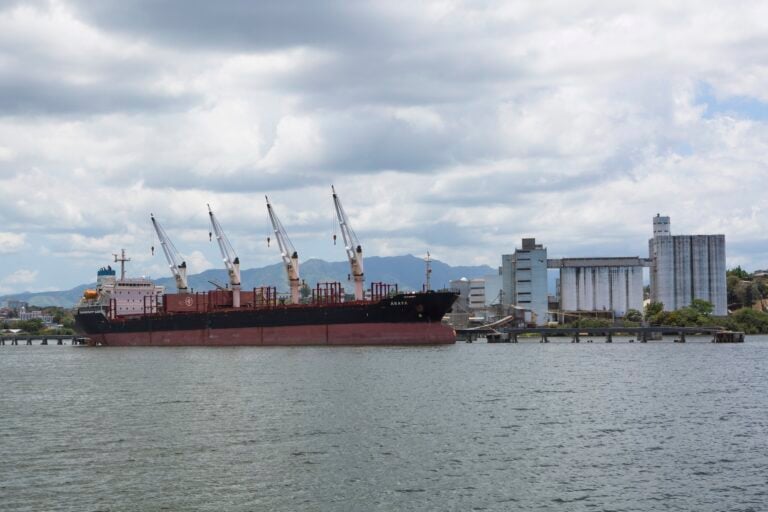


The Guatemalan steel industry is facing unprecedented pressure from China’s trade offensive, Guatemalan media outlet Soy 502 reported. This tension, which already exceeds local production capacities, is part of a broader global dynamic.
According to the OECD Steel Outlook 2025 report of the Organization for Economic Cooperation and Development, Beijing is using its overproduction, underpinned by state subsidies, as a strategy of massive dumping that distorts markets and undercuts local producers.
“China’s excess capacity allows it to easily flood relatively small markets, such as those in Central America, with a deluge of cheap, even low-quality steel,” Henry Ziemer, associate researcher at the Americas Program at the Center for Strategic and International Studies (CSIS), told Diálogo. “The price means that many end users cannot avoid buying from China instead of more expensive regional alternatives.”
Faced with a sustained increase in low-cost imports, Guatemala launched an anti-dumping investigation into Chinese galvanized steel in October 2024. The investigation could take up to 18 months, Guatemalan daily Prensa Libre reported.
“Governments must act more quickly and decisively, with measures that level the playing field and defend our industries from unfair practices,” Ezequiel Tavernelli, executive director of the Latin American Steel Association (ALACERO), told mining news site Guía Minera de Chile. “But every day that passes without a coordinated response means more jobs lost and greater dependence on foreign steel.”
Guatemala led steel production in Central America in 2024, with 249,500 tons. In contrast, China produced more than 1 billion tons in the same period, representing about 55 percent of the world total, according to Soy 502. The magnitude of this gap illustrates the structural imbalance facing regional producers.
“The Guatemalan steel industry is also affected by the lack of active mines in the country, which forces refineries to obtain their raw materials from other countries,” Ziemer added. “[This] raises operating costs at a time when they risk being priced out of the market.”
But the root of this phenomenon is structural. An economic slowdown and falling domestic demand in China have left the Asian country with a stubborn excess of industrial capacity, including steel.
The ACINDAR case in Argentina
Argentina is an example of the disastrous impacts of Chinese overproduction. Its historic ACINDAR plant, owned by the Indian conglomerate ArcelorMittal, is experiencing its most serious crisis in years: It has halted 80 percent of production in the city of Villa Constitución, in Santa Fe province.
This has brought one of the rolling mills to a standstill and led to the suspension of 500 workers, who are receiving only 80 percent of their wages, Infobae reported.
The company acknowledged importing 1,500 tons of steel from China, equivalent to almost a month of local production. And although plant managers claim that this is a “circumstantial measure,” workers confirmed that local steel is being replaced by material from China. ACINDAR has already reduced its workforce by more than 25 percent through a restructuring plan, local mining media Agenda Industrial reported.
“The label clearly says ‘Origin: China.’ Below, ACINDAR is listed as the importer. This is very serious. It could spread to all the plants,” said Matías Ruffini, a delegate of the Metalworkers’ Union, told local media BAE Negocios. “We’ve already said it: We’re going to denounce this everywhere. ACINDAR is selling Chinese steel. It smells like a very strange maneuver. The paradox is that they themselves warned about it before.”
The ACINDAR case reflects a more complex phenomenon: the systematic displacement of regional steel by Chinese products. This dynamic, combined with business decisions aimed at reducing costs and the absence of regulations that protect local production, is dismantling value chains in Latin America from within and putting them in check, reported Argentine outlet Radio UNR.
“Without stronger anti-dumping and mitigation measures, Guatemala and Central America in general will see their metallurgical sectors come under increasing pressure as China turns to international markets to sell off its excess production,” Ziemer said.
Regional impact and employment
Between 2008 and 2024, indirect steel exports from China to Latin America grew by 338 percent, driven by the massive influx of finished products such as appliances, vehicles, and machinery.
This phenomenon not only weakens local steel production, but also compromises its entire value chain, putting at risk more than 1.4 million direct and indirect jobs in an industry that is key to the industrial development and productive autonomy of the region, ALACERO concluded.