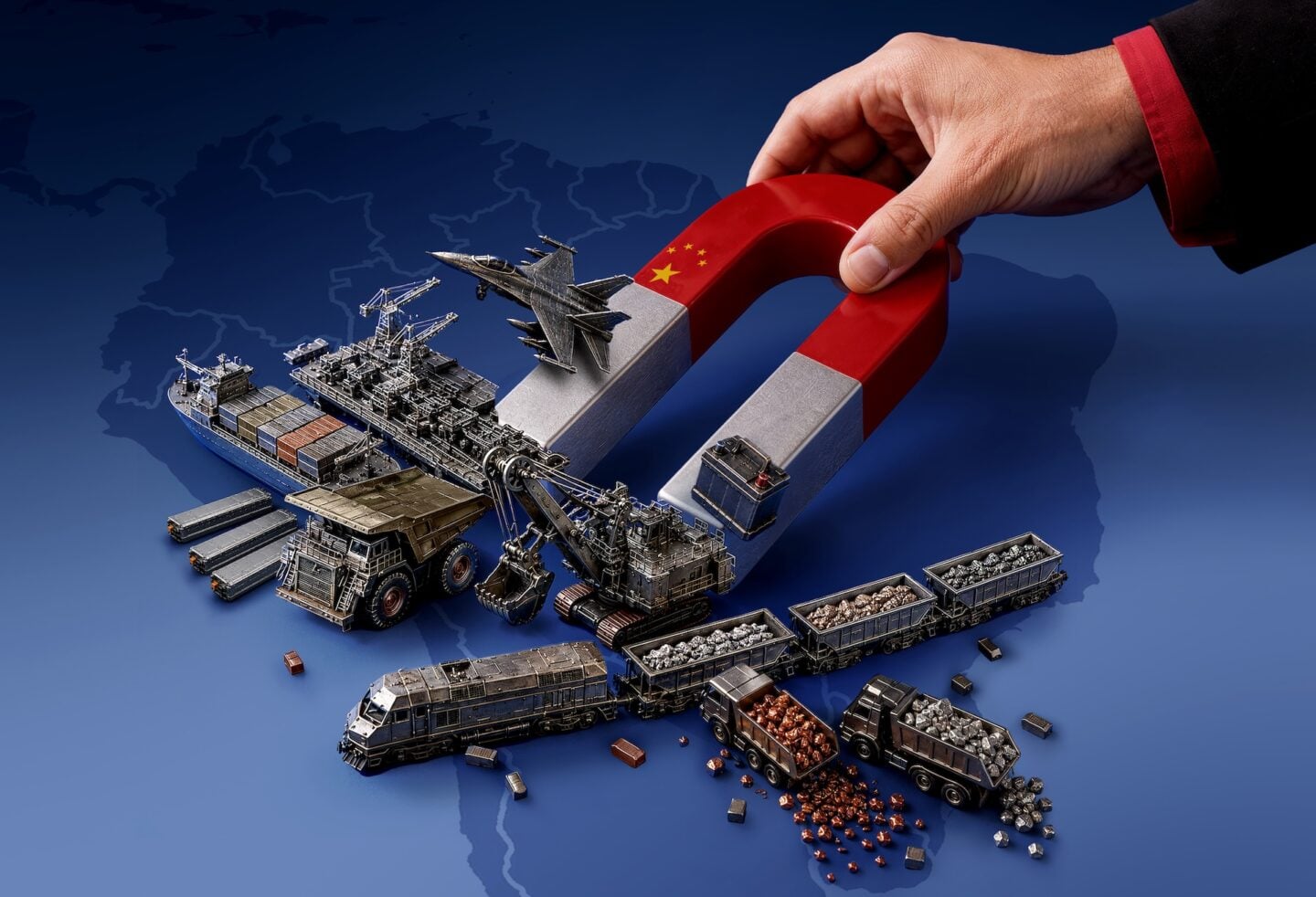

China has steadily expanded its presence in Latin America’s critical minerals sector, investing in lithium, copper, and other resources that underpin advanced technologies, defense systems, semiconductors, and the global energy transition. Accompanied by investments in ports, transportation corridors, and processing facilities, Beijing’s growing footprint in the region has fueled concerns over economic security, strategic dependence, and countries’ ability to retain sovereign control over resources increasingly viewed as vital to national security.
According to Bloomberg, China holds mining interests in 12 countries across Latin America, with a significant presence in Argentina, Brazil, Ecuador, Guyana, and Peru. Argentina, home to some of the world’s largest lithium resources, hosts the greatest number of Chinese mining projects, while Brazil and Peru rank among the leading destinations for investments linked to copper, iron, and other minerals essential to industry and advanced manufacturing.
Analysts increasingly view Latin America as central to global critical mineral supply chains. A study by the Center for Strategic and International Studies (CSIS) notes that the region’s vast mineral wealth could help diversify global supply chains while creating opportunities for higher-value industrial development.
Giselle Sanabria, an expert in development policy at the National University of La Plata, Argentina, told Diálogo that China’s involvement has evolved far beyond purchasing raw minerals.
“We are no longer talking about a simple buyer of raw materials, but rather an investor who wants to get involved in that territory,” she said. That presence, Sanabria explained, allows China to “gain direct operational control in other strategic sectors of the same chain.”
From extraction to strategic influence
China’s involvement extends well beyond mining operations. A report by the Collective on Chinese Financing and Investments, Human Rights, and the Environment (CICDHA) notes that Chinese companies have expanded across multiple stages of the lithium supply chain through acquisitions, partnerships, and new projects in Argentina, Bolivia, Brazil, Chile, and Mexico.
The significance goes beyond lithium. Argentina, Bolivia and Chile — known collectively as the Lithium Triangle — contain one of the world’s largest concentrations of lithium resources, while Chile and Peru rank among the world’s leading holders of copper reserves, according to Canadian publication Investing News Network.
This expansion reflects Beijing’s broader effort to secure long-term access to the raw materials that support technological innovation, industrial production, energy transition, and military modernization. According to Infobae, access to lithium, copper, and niobium forms part of China’s strategy to strengthen advanced manufacturing capabilities and defense-related industries.
For Sanabria, this approach serves long-term objectives. “It is a national energy security tactic and, on the other hand, a way to maintain control over the supply chain to ensure its own security.”
Processing concentrates strategic value
Owning a mine is only one part of the equation. Processing and refining determine how raw materials are transformed into components used in batteries, semiconductors, advanced electronics, renewable energy systems, and defense technologies.
According to the International Energy Agency (IEA), China leads the refining of 19 of the world’s 20 strategic minerals and accounts for nearly 70 percent of global refining capacity. The agency also notes that China dominates approximately 94 percent of the world’s rare-earth permanent magnets, critical components used in aircraft, missile systems, electronic vehicles, and other advanced technologies.
That concentration has heightened international concerns over the resilience of critical mineral supply chains. Recent Chinese exports restrictions on several critical minerals and processing technologies have reinforced concerns about the risks of concentrating key stages of strategic supply chains in China, and accelerated efforts by governments and industries worldwide to diversify suppliers.
Sanabria warned that some countries could face greater challenges in preserving decision-making authority over strategic industries.
“The most vulnerable would be Argentina and Peru,” she said, while identifying Bolivia and Chile as countries that have implemented strong mechanisms to retain state control over their resources.
In her view, one issue is frequently overlooked. “The aspect that goes unnoticed is that governments should be the ones setting the rules of the game.”
Strategic infrastructure and market access
The growing importance of critical minerals has also elevated the strategic value of the infrastructure that transports, processes, and exports them. Ports, railways, power networks, and logistics corridors increasingly connect mineral-producing regions with global markets.
CSIS notes that Chinese investment has expanded beyond mining operations into this broader infrastructure network, reflecting Beijing’s long-term effort to secure access not only to strategic resources but also to the transportation systems that move them.
Another CSIS study identified China’s involvement in dozens of port projects across Latin America and the Caribbean, including 31 active ports. In testimony before the U.S.-China Economic and Security Review Commission, CSIS warned that these investments provide Beijing greater access to strategic resources, commercial markets, and geographically significant locations throughout the hemisphere.
Sanabria cited Peru’s Port of Chancay as an example of infrastructure designed to integrate extraction, processing, transportation, and exports in a single logistics network.
Because these minerals are essential to advanced manufacturing, critical infrastructure, and defense technologies, decisions about who extracts, processes, transports, and exports them increasingly carry strategic implications that extend well beyond the mining sector.
Strengthening sovereignty through diversification
Faced with this challenge, analysts argue that Latin American countries will need more coordinated strategies to protect their long-term interests. According to Spanish daily El País, governments can strengthen their negotiating position by diversifying international partnerships, imposing more rigorous contractual requirements, and enhancing state capacity to oversee large-scale mining and infrastructure projects. Greater regional coordination could also help harmonize fiscal, environmental, and labor standards when negotiating with China.
Control over the minerals that power advanced electronics, batteries, aircraft, communications systems, and weapons platforms will increasingly shape industrial and military capacity, technological innovation, and strategic autonomy.
As China expands its presence across every stage of the critical minerals value chain — from extraction and processing to ports and logistics corridors — Latin America governments face growing pressure to ensure that strategic resources remain aligned with national priorities rather than external influence. Diversifying partners, strengthening negotiating capacity, and protecting critical infrastructure are becoming increasingly important not only for economic development, but also for preserving sovereignty over assets that will help shape the region’s technological and security future.