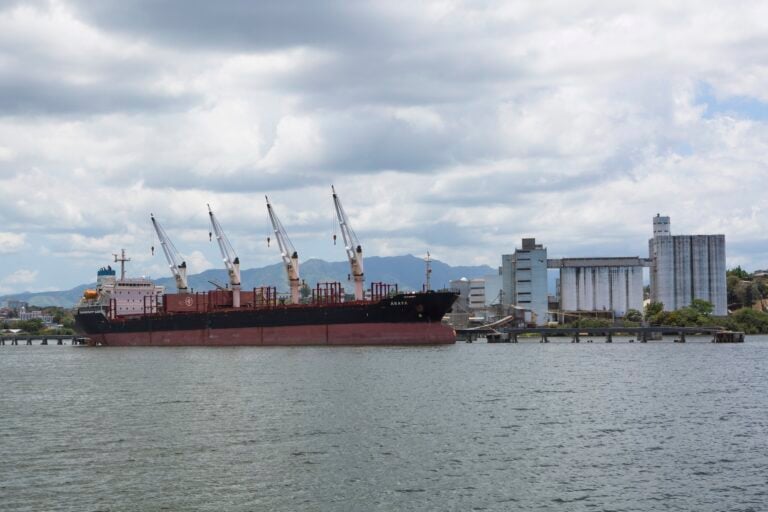
Bolivia is preparing to start production at its Mutún Steel Complex, a joint project with China in the Bolivian Pantanal wetlands. The project, however, raises concerns of threats to ecosystems in a region home to thousands of species, investigative journalism platform Dialogue Earth indicated in a recent report.
Construction of the Mutún Steel Complex is 92 percent complete. According to the schedule, six of the seven plants that make up the complex will be completed in August. The seventh plant, dedicated to direct iron reduction, will be completed in February 2025, the Mutún Steel Company, which manages the mine’s operations, said in a June 6 statement.
Substantial turnaround
In 2016, Bolivia made a substantial turnaround in the history of the Mutún deposit, one of the world’s largest iron and manganese reserves. After failed negotiations with the Indian group Jindal Steel and Power, which in 2007 won the tender for the construction of the country’s first steel mill, Bolivia awarded the project to China state-owned company Sinosteel, Reuters reported.
This new project seeks to take advantage of the Mutún’s vast reserves, estimated at 40 billion tons of iron and 10 billion tons of manganese, to convert them into commercial products.
“The fact that they end up building a plant with a smaller capacity than the one originally proposed with Jindal, now with a Chinese company, says a lot,” Gonzalo Mondaca, associate researcher at the Documentation and Information Center Bolivia, told Diálogo on July 14. “It shows that China is increasing its presence in the iron industry globally.”
Starting in 2024, according to Bolivian daily Los Tiempos, and for the next 10 years, the Bolivian government is expected to begin paying back a $461 million debt to China’s Eximbank for the construction of the 42-hectare steel complex. As with many projects tied to China state-owned firms, the Mutún complex has faced delays and allegations of irregularities, which creates mistrust.
“Considering Bolivia’s institutional weaknesses in addressing the mining industrialization project, there is little chance that the project will move forward without external support, apparently from Chinese companies,” Mondaca said. “Iron is starting to be a difficult mineral to access on the planet.”
Iron is essential for the manufacture of steel, a fundamental material in industrial and technological development. Its use ranges from construction and manufacturing to innovation in various technologies, making it a key resource for global economic and technological progress, CNN reported.
Vital ecosystem at risk
Located on the country’s southeastern border, the Bolivian Pantanal is part of the Gran Pantanal that stretches between Bolivia, Brazil, and Paraguay over a 200,000 square-kilometer area, the world’s largest wetland. It is home to 463 species of birds, 269 species of fish, more than 236 species of mammals, 141 species of reptiles and amphibians, and more than 9,000 subspecies of invertebrates, Dialogue Earth reported.
Thus, the Gran Pantanal is an ecosystem of rich biodiversity, which plays a fundamental role in the water cycle, regulating the climate, and mitigating global warming. Its ecological importance earned it the designation as a Ramsar site or wetland of international importance in 2001, according to Dialogue Earth. In Bolivia, this region includes four municipalities of the Santa Cruz department: San Matías, El Carmen, Puerto Quijarro, and Puerto Suárez, where Mutún is located.
However, over the last four decades, the Bolivian Pantanal has experienced an average 23 percent reduction in rainfall. The construction of the Mutún steel mill and its negative environmental impact is concerning, as the water naturally filtered by the Pantanal also supports local industries and agriculture.
Although current President of the Mutún Steel Company Jorge Alvarado assures that there will be no environmental impact, biologist Juan Carlos Urgel, who since 2014 has been studying the Otuquis National Park, located a few kilometers from Mutún, told Dialogue Earth that bodies of water were diverted in the area, “which were wetlands and have now dried up”.
A document to which Dialogue Earth had access reveals that Sinosteel subcontracted other Chinese companies for open-pit iron ore mining. One of these firms operates the iron ore wash plant using water from the San Juan River, which pollutes water through metal contamination and heightens sediment levels in streams, while the water for the construction and assembly of the mega factory is pumped from Los Mangales Creek.
The report also noted that large ditches were dug in Otuquis Park for the construction of the aqueduct and the transportation of machinery for clearing and leveling, generating a major impact on the protected area’s ecosystem.
The Bolivian National Environmental Authority did not issue an environmental license for the mineral exploitation. Regarding the use of water from the San Juan River and other bodies of water in the area, which is classified as “good quality,” Dialogo Earth explained that the only water withdrawal authorized for industrial processes is from the Paraguay River.
“Bolivian environmental regulation has become more flexible and sectorized, granting more powers to the hydrocarbon, oil, and mining sectors than to the Ministry of Environment and Water. This leads to prioritizing business with China without ecological protection,” Mondaca said.
International market
Bolivian iron production will be traded mostly in the international market. “Bolivia has a low domestic demand and a small market in South America. Production will be mainly destined abroad, without generating large domestic profits, due to the lack of scientific and technological capabilities to add value within the country,” Mondaca said.
Most likely, with China’s advice, Bolivia will manage to trade its iron, but always under China’s objectives, he said. This is worrying, as China’s control over iron deposits, including Bolivia’s, is not insignificant, he added.
“China has a huge production capacity that can reduce prices, putting pressure on some companies to the point of bankruptcy. The next step would be for Beijing to buy these companies in South America, increasing its control over the iron ore market,” Mondaca said. “A worrying aspect from a geopolitical perspective.”