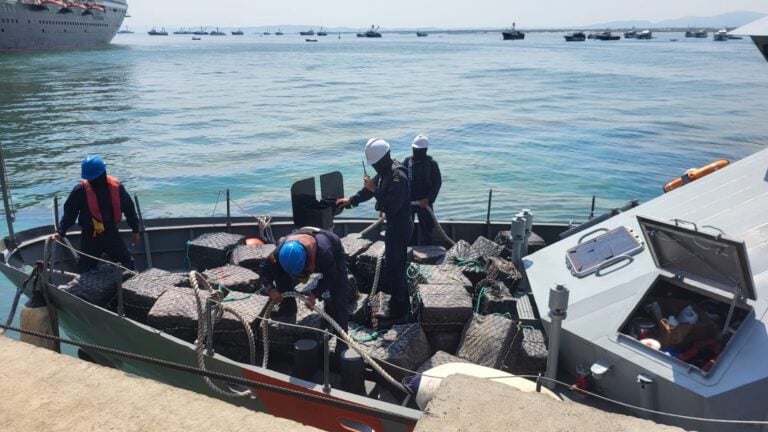

Months of coordinated investigative work culminated in the largest seizure of stolen copper in Chile’s history. Operation High Voltage, carried out in April 2026 by the Investigative Police (PDI), the Public Prosecutor’s Office, the Internal Revenue Service, and the National Customs Service, led to simultaneous raids on 49 locations across seven regions of the country.
The operation resulted in the arrest of 25 people — including the organization’s leaders and key operatives — and the seizure of 187 metric tons of stolen copper, along with weapons and vehicles. “This is the largest seizure ever made in our country’s history for this type of crime,” then Undersecretary of Public Security Andrés Jouannet said.
A five-year scheme that exploited trade and tax systems
Between 2020 and 2025, the international criminal organization trafficked nearly $917 million worth of stolen copper, according to the PDI’s National Headquarters for Combating Theft and Criminal Hotspots. During the same period, it fraudulently obtained more than $55 million in export tax refunds. Rather than operating outside the system, the network infiltrated Chile’s legitimate commercial infrastructure, introducing stolen copper into legal supply chains while evading detection.
María Angélica de Miguel, acting regional prosecutor for the Los Lagos Region, described the method used to conceal the copper’s origin: The stolen material was burned, stripped, and crushed to eliminate any trace of its source before being exported to buyers in China through logistics networks that included northern Chilean ports. According to South China Morning Post, investigators also identified routes that passed through Peru, underscoring the network’s cross-border reach. The scheme illustrates a level of logistical, legal, and financial sophistication that extends far beyond conventional criminal activity.
Criminal sophistication: Lawyers, tax specialists, and transnational networks
International analyst Guillermo Holzmann told Diálogo that the Chilean case reflects a broader regional trend rather than an isolated incident. “We are currently witnessing an evolution of criminal gangs toward a level of sophistication that is frankly impressive in terms of how quickly their illegal businesses adapt to the characteristics of different markets,” he said. “The demand for natural resources is the most profitable source of income for these organizations.”
Holzmann said the sophistication of these networks lies not only in identifying the profitable markets but also in building supply chains capable of meeting demand while minimizing legal risk. To achieve this, criminal organizations rely on legitimate professional services — including law firms and tax specialists — to navigate regulatory requirements, exploit legal loopholes, and give illicit transactions the appearance of legitimacy.
Holzmann also pointed to the growing presence of Chinese criminal groups involved in these activities.
“There is a proliferation here of Chinese criminal groups and gangs carrying out most of these criminal activities. The question is whether they have backing or some kind of relationship with Beijing […],” Holzmann said. “These gangs subsequently sell these resources to the Chinese legal system, so there is a cover that allows this to happen.”
He added that legal shortcomings also contribute to the problem. “Copper theft thrives mainly because many of these operations are not adequately classified as crimes in the legal or criminal systems of these countries,” Holzmann added. “Establishing liability, filing charges, and, particularly, securing convictions is a very complicated process.”
Chile as the forefront of an expanding criminal threat
Operation High Voltage represents the largest case uncovered to date, but it is part of a broader pattern.
In December 2025, the PDI dismantled a criminal organization responsible for a series of violent copper thefts targeting mining operations in northern Chile. Earlier that year, Operation Oro Rojo dismantled another international network responsible for stealing more than 50 metric tons of copper cables and other materials, which were later exported to markets in India and Belgium.
The problem extends back several years. In 2023, armed criminals stole 12 containers of Codelco copper from the Port of San Antonio in one of the country’s largest copper heists. A year earlier, gangs repeatedly targeted freight trains carrying copper from northern mines to Pacific ports, forcing some mining companies to shift shipments from rail to road because of the security risk.
TT Club, a specialist insurer serving the global freight transport and logistics industry, warns that copper theft now affects every stage of the supply chain, extending well beyond cargo in transit to include storage yards, terminals, warehouses, and production facilities.
“Over the past decade, copper theft has evolved from an opportunistic crime to a persistent threat to supply chains, driven by the metal’s value, the involvement of organized crime, and vulnerabilities in transportation and storage controls,” the insurer states. “We are seeing a significant and accelerating increase in both the frequency of incidents and their financial impact, which reinforces the need to consider copper as a high-risk cargo.”
The economic incentives driving these crimes are unlikely to diminish. During the World Copper Conference in Santiago in April 2026, a researcher from the Chinese state-owned company Minmetals Corp projected that China’s copper consumption could grow by an average of 3.7 percent annually, reaching nearly 23 million metric tons by 2035 — a 43 percent increase from the 16 million recorded in 2025.
Operation High Voltage demonstrates that transnational organized crime no longer operates solely on the margins of the formal economy. Increasingly, it infiltrates legitimate commercial systems, by exploiting financial, tax and logistical mechanisms normally associated with lawful businesses. As copper becomes increasingly vital for electric vehicles, artificial intelligence, telecommunications, advanced manufacturing, and defense systems, protecting critical mineral supply chains is emerging as both an economic and national security priority for producing countries.
Strong global demand suggests these criminal incentives will persist. Addressing the threat will require more than isolated law enforcement operations. It will depend on stronger legal frameworks, cross-border judicial cooperation, enhanced financial oversight, and tighter export controls. Chile’s experience offers both a warning and a model of coordinated interagency action that other critical mineral-producing countries in the region would benefit from studying.