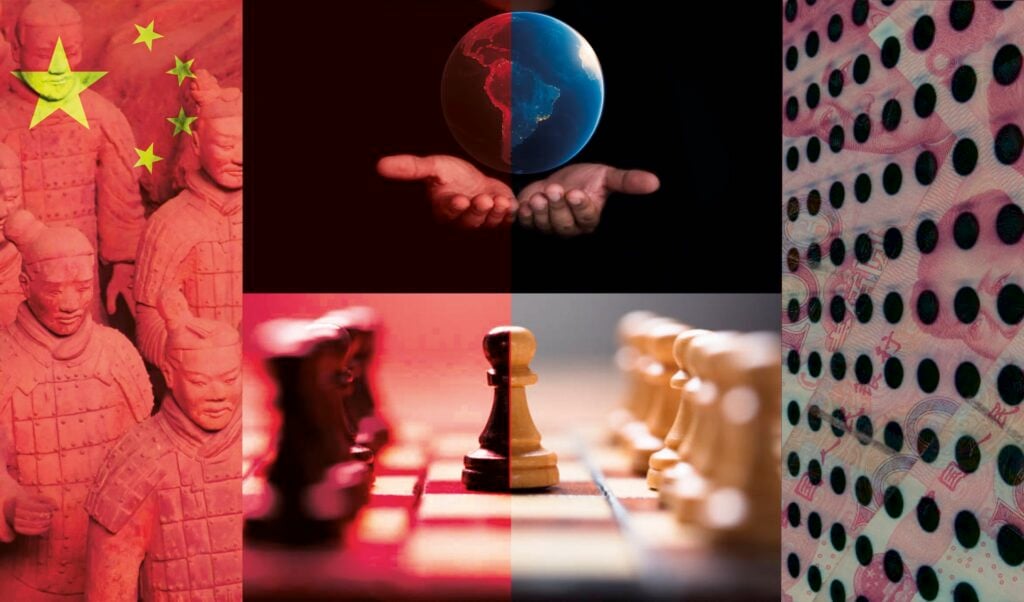

In recent years, China has deployed a unique version of its so-called “wolf warrior diplomacy” in Latin America, characterized by a confrontational tone on social media and in public statements, while also promoting cultural, economic, and digital campaigns that present it as a reliable partner in the region. This dual strategy, in which controversy and seduction coexist, raises questions about its impact on public opinion, the information space, and bilateral ties.
The term “wolf warrior” refers to the combative style of certain Chinese Communist Party (CCP) diplomats. As current affairs magazine The Diplomat points out, this rhetoric intensified after the COVID-19 outbreak, in an attempt to counter accusations about China’s handling of the pandemic and project strength on the international stage.
In Latin America, the wolf warrior attitude has been felt in immediate responses and confrontations by Chinese diplomats in the face of criticism over human rights, investments, or geopolitical influence. The goal, explains The Diplomat, is to contain adverse narratives through social media or state media, thereby consolidating China’s presence in the region.
The study, “The Boys Who Cried Wolf Warrior!”, published in the magazine Colombia Internacional, emphasizes that although some diplomats opt for an aggressive style, China’s strategy in Latin America combines this rhetoric with classic mechanisms such as economic cooperation, political visibility, and cultural diplomacy.
While the wolf warrior attitude has subsided worldwide, in Latin America the digital offensive persists. According to think tank Brookings Institution, Chinese diplomats in Latin America continue to use platforms such as X to respond directly to journalists or critics, often with sarcastic or confrontational messages.
“It’s important to understand that China’s strategy, including in politics and diplomacy, continues to evolve. What is happening is often interpreted as a result, when in fact it’s part of a process,” Vladimir Rouvinski, director of the Department of Politics and International Relations at ICESI University in Colombia, told Diálogo. “Beijing shows a constant ability to adjust to contexts and, in doing so, also modifies them.”
Emblematic public responses
In Mexico, on July 31, the Chinese Embassy accused Larry Rubin, president of the American Society think tank, of acting with a “hegemonic mentality” and “arrogance” after Rubin warned of the risks to Mexico of getting closer to the BRICS group, particularly Russia and China, El Economista reported.
The same embassy branded in early April the U.S.-based performing arts company Shen Yun and its show, operated by the Falun Gong religious movement, which features classical Chinese dance, orchestral music, and vocal performances, as a “political tool” used by “an anti-social and anti-human heretical sect.”
In December 2024, following a joint announcement by the United States and Costa Rica on the interference of Chinese cybercriminal groups, Xu Tiefei, counselor at the Chinese Embassy in Costa Rica, posted on X: “Guided by the North, you will lose your way.” The joint statement was issued following a comprehensive cybersecurity review in which the hacking of criminal groups based in China was detected in Costa Rica’s telecommunications and technology systems.
In Colombia, Ambassador Zhu Jingyang reacted to a Deutsche Welle report on censorship from Chinese chatbot Deepseek, calling them “China haters” and “stupid.” The ambassador also accused local media outlet Entorno of spreading fake news about China’s “debt trap” strategy.
“Beijing’s confrontational rhetoric does not arise from the individual decisions of its diplomats. Although some messages may seem spontaneous, they respond to guidelines from the Chinese Communist Party,” Rouvinski said. “Embassies, media, and digital campaigns are part of a coordinated ecosystem, which makes this strategy effective and difficult to counter.”
Information control and its risks
China’s strategy goes beyond public responses, driving a digital offensive that spreads favorable narratives and discredits critical voices. This “soft power” operates as a geopolitical tool: Campaigns, local alliances, and digital diplomacy seek to shape the information ecosystem, reinforce China’s legitimacy, and contain rival powers, with risks to freedom of expression and pluralism, Central American think tank Expediente Abierto indicated.
According to the same report, China adapts its narratives to each country, demanding “unconditional” cooperation, while seeking to counter criticism of its political model and conceal human rights violations. In addition to embassies and diplomats, it uses state media such as Xinhua and CGTN en Español, sympathetic local press, and academic or political actors.
These tactics correspond to the concept of Foreign Information Manipulation and Interference, applied to shape public opinion, influence political processes, and expand the CCP’s reach, Expediente Abierto explained.
“The true impact of China remains to be seen,” Rouvinski said. “With resources, knowledge, and networks that few can match, the CCP has gained influence in universities and public opinion, building a positive image in much of Latin America over the last decade.”
Challenges for regional governments
According to Rouvinski, many Latin American governments respond without a clear strategic vision to China’s diplomacy. “They remain trapped in the narrative of the global south and anti-imperialism, without recognizing that behind it all are Beijing’s strategic calculations,” Rouvinski said. “By refusing to see this reality, they risk becoming trapped in dependencies that are difficult to control.”
“China will continue to combine aggressive rhetoric and friendly diplomacy as long as it yields results. Being a centralized and authoritarian regime, it has the ability to quickly adjust its strategy and change course when it deems necessary,” Rouvinski concluded. “This means that Latin America will face a flexible, calculated, and difficult-to-anticipate policy from China.”