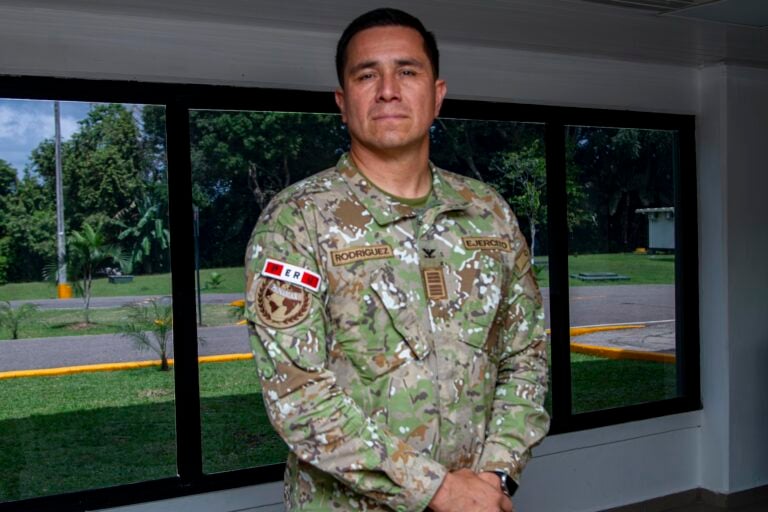


With more than 20 years actively contributing to the security of his nation with Panama’s National Border Service (SENAFRONT), Commissioner Raymond Cáceres Cedeño now focuses on strengthening the Panama-U.S. collaboration and partnership. His experience as director of Intelligence and director of Operations of the SENAFRONT, as well as his training in complex, joint, interinstitutional, and multinational environments, are valuable assets in his current role as foreign liaison officer at U.S. Southern Command (SOUTHCOM). Commissioner Cáceres is one of nine foreign liaison officers currently assigned to SOUTHCOM.
Diálogo had the opportunity to speak with Commissioner Cáceres at the SOUTHCOM headquarters about his role in helping to strengthen mutual understanding and trust between the Panamanian security forces and their U.S. counterparts, building on a legacy of decades of collaboration and friendship to develop a higher level of teamwork.
Diálogo: How long have you been Panama’s liaison officer at SOUTHCOM?
SENAFRONT Commissioner Raymond Caceres, Panama’s liaison officer at SOUTHCOM: I am the first Panamanian officer to assume this responsibility, which I did on July 1, 2023. I have already been here for a year and eight months, sharing and carrying out this work. As this assignment is for two years, I have about four months left to complete my mission.
Diálogo: Why is it important for Panama to participate in SOUTHCOM’s foreign liaison officer program?
Commissioner Cáceres: This is an important program for Panama, as it helps us strengthen our cooperation relations in security and defense with the United States, facilitating coordination in the fight against the common threats we face, such as narcotrafficking, transnational organized crime, and the challenges posed by irregular migration. It also helps to highlight that strategic value as a partner of Panama, in this case SOUTHCOM.
Diálogo: What are your objectives as the Panama representative in SOUTHCOM?
Commissioner Cáceres: My objectives are focused on strengthening cooperation in security and defense, all while promoting exchange of information and good practices to face our common threats. Similarly, it is noteworthy to highlight Panama’s strategic value in the region, which also promotes or helps in the planning of initiatives that contribute to capacity building and regional stability.
Diálogo: How important is it for Panama to host this year’s iteration of the Central American Security Conference (CENTSEC)?
Commissioner Cáceres: CENTSEC is a platform, a key arena to share information and good practices among the countries of the region, the Central American countries and Panama’s strategic partners. Hosting this year’s CENTSEC not only represents but also reinforces our commitment to regional stability and security.
Diálogo: One of the topics of CENTSEC this year, and one of great relevance for the region, is cybersecurity. How does collaboration with partner nations and with SOUTHCOM help strengthen cyber defense and prevent and counter attacks from state-backed criminal groups?
Commissioner Cáceres: Cybersecurity is a priority issue for the countries in the region, as the threats from cyberspace are constantly evolving and have the capacity to affect the stability of states and the security of institutions and citizens. Collaboration between countries, friends, and SOUTHCOM is essential to strengthen our cybersecurity capabilities and our resilience to these cyberattacks from criminal groups. This collaboration will help us formulate joint strategies to help us protect critical structures and strengthen our resilience to these threats.
Diálogo: How important is the role of the liaison officer in the planning of annual exercise PANAMAX Alpha for the defense and security of the Panama Canal?
Commissioner Cáceres: I had the opportunity, as a member of the SENAFRONT, to lead the development, planning, and execution of this exercise in Panama. Currently, I have the experience to be able to say that the role played by the liaison officer here in SOUTHCOM for this specific exercise is fundamental in facilitating and improving coordination for both parties’ planners. This helps us improve all the protective measures for the Panama Canal. It helps us improve our responses to crises and everything that has to do with the interoperability of the forces.
Diálogo: How does this SOUTHCOM foreign liaison officer program strengthen collaboration and security in the region?
Commissioner Cáceres: This is about collaboration and integration. This program helps develop capabilities that are important for confronting the common threats we have in the region. It helps foster that camaraderie, that exchange of information and knowledge, which are important for addressing the fight against the threats affecting the region and all the security challenges we currently have.
Diálogo: What lessons in cooperation do you hope to take back to Panama at the end of your mission at SOUTHCOM?
Commissioner Cáceres: There are many valuable lessons that I will take back to Panama. The first lesson, related to the previous question, is the importance of strengthening this multinational cooperation. It is key to managing integration and it is crucial to face the threats that we have in common within our region.