

El Salvador and the United States are bolstering their security and defense alliance to jointly combat terrorism, narcotrafficking, and transnational organized crime. This cooperation, which has contributed to strengthening the operational capabilities both forces for decades, reaffirms the countries’ shared commitment to regional security and hemispheric stability.
A recent display of this partnership was the April visit of Salvadoran President Nayib Bukele to his counterpart President Donald Trump in Washington, D.C., to further the collaboration against terrorism and cross-border crime.
Likewise, in March, during her visit to the Central American country, U.S. Secretary of Homeland Security Kristi Noem signed a memorandum of cooperation to update the Security Alliance for Fugitive Enforcement (SAFE), which facilitates the exchange of criminal records of fugitives between both countries, the U.S. Embassy in El Salvador indicated. SAFE is a police program established in 2012, which primarily operates in El Salvador, Guatemala, and Honduras.

In another display of the dedication to peace and to improving the lives of the region’s inhabitants, in February, U.S. military personnel attached to U.S. Southern Command’s (SOUTHCOM) Joint Task Force Bravo (JTF-Bravo), together with El Salvador’s Ministry of Agriculture, carried out two medical events for animal health, aimed at tackling overpopulation. JTF-Bravo teams routinely deploy to the region to support partner nations and their populations’ needs. In 2024, for instance, JTF-Bravo medical personnel brought medical assistance to multiple communities in El Salvador, as part of mission AMISTAD, in which U.S. troops collaborate with local counterparts to enhance mutual medical knowledge and deliver optimal patient care.
El Salvador also received support to strengthen its disaster response capability. In October 2024, the U.S. Embassy in El Salvador, through SOUTHCOM’s Humanitarian Assistance Program, inaugurated the new Crisis Prevention and Education Center in Zacatecoluca. The U.S. government also delivered four Bambi Bucket to support El Salvador’s efforts to fight wildfires, and donated protective equipment to Salvadoran firefighters, including suits and breathing apparatuses valued at more than $1 million.
Meanwhile, seeking to increase maritime response capability to narcotrafficking in the region, the United States, through the Bureau of International Narcotics and Law Enforcement Affairs (INL), delivered two ships to the Salvadoran Navy (MNES) in 2023 to reinforce operations in the Pacific. This assistance was part of a support package worth more than $1.1 million in specialized training, state-of-the-art tactical equipment, and improvements to naval base infrastructures, Salvadoran radio station radio YSKL reported.
“U.S. assistance undoubtedly contributes to tangible improvements in El Salvador’s ability to counter threats such as drug trafficking and transnational crime, in terms of training, equipment, and the establishment of specialized units,” Salvadoran security expert and criminologist Ricardo Sosa told Diálogo. “The impact is evident in specific operational successes and improved institutional capabilities. This strategic alliance is based on a shared understanding of the threats and a commitment to a cooperative and multifaceted response.”
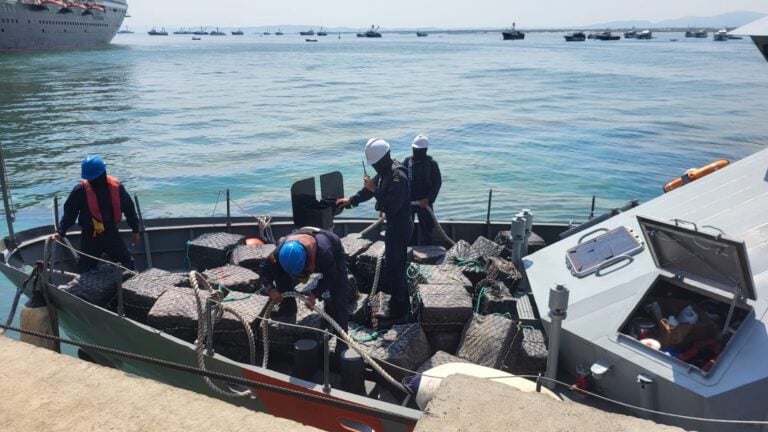
Among MNES’ successes is its ability to conduct operations outside the 200-nautical-mile territorial zone, as an expansion of its jurisdiction. This was demonstrated on March 27, when the Trident Naval Task Force seized 1.3 tons of cocaine from six Guatemalans and three Ecuadorians who had devised a plan to receive, transport, and deliver the shipment with the help of three speedboats, local daily El Diario de Hoy reported.
“We have the best drug-hunting sailors the American continent has in the Pacific Ocean. We have earned that job, that experience, through sheer hard work and dedication,” said El Salvador’s Minister of Security Gustavo Villatoro, referring to the seizure. “So far in 2025 alone, more than 10.6 tons have been seized, and in the last six years, more than 60 tons of drugs have been seized.”
The Salvadoran Armed Forces (FAES) have a close relationship with other U.S. institutions to continuously strengthen the tactical and operational capabilities of their troops. Among the ongoing projects to support the Salvadoran Navy’s operational readiness and counternarcotics operations, SOUTHCOM teams are evaluating repairs at a pier of La Unión Naval Base.
“Security cooperation between the United States and El Salvador has evolved from assistance focused on reconstruction to a strategic alliance focused on combating the complex threats of transnational organized crime,” Sosa said. “Shared interests, El Salvador’s geostrategic location, and the need to confront common threats have made this relationship crucial to the security not only of both countries but of the entire Central American region.”
Cooperation between the United States and El Salvador addresses the growing need to confront organized crime as a transnational threat. With U.S. support, the Salvadoran government is consolidating its security strategy and sending a clear message that there will be no tolerance for those who threaten peace and stability in the region, Argentine news site Infobae reported.