The atomization of organized crime in Ecuador has become both a survival strategy and an expansion model — one that is reshaping territorial control across the country. Where criminal hierarchies were once more centralized and identifiable, today dozens of cells and splinter factions compete, form tactical alliances, and betray one another with alarming speed.
According to the Report on the Characterization of Organized Crime in Ecuador, published in January by the Ecuadorian Observatory on Organized Crime (OECO), this fragmentation has transformed neighborhoods, ports, and transportation corridors into simultaneous battlegrounds in a nationwide war over extortion and control of illicit markets.
“Whereas before we had to search for the leaders of four or five organized crime groups, now we have to approach investigations by territory — which criminal force or forces dominate and what their sources of financing are,” Alexandra Zumárraga, lawyer and former director of Ecuador’s National Social Rehabilitation System, told Diálogo. “The strategy is to follow the money and strike at the source, because we’ve seen that arresting leaders is not enough.”
The OECO report links the geographic dispersion of illicit activities to internal fragmentation within criminal organizations struggling to maintain control of illegal markets. This dynamic has fueled an increase in violent clashes between factions. During 2024, for example, the group Los Lobos maintained at least 10 open fronts, followed by Los Tiguerones with six, and Las Águilas and Chone Killers with three each.
Expansion and growing complexity
The conflict extends beyond local gangs. Reporting by Ecuadorian outlet Primicias indicates that the country is also facing the expansion of eight Colombian armed groups operating near the border. These include the Comando de Frontera, Comuneros del Sur — a cell of the National Liberation Army (ELN) — and dissident fronts of the Revolutionary Armed Forces of Colombia (FARC).
The criminal landscape is further complicated by the entrenched power of gangs within Ecuador’s prison system. A January 2026 report by the Global Initiative Against Transnational Organized Crime (GI-TOC), Carceral Capture: Criminal Governance in Ecuador’s Prison System, argues that inmates are not merely directing operations from behind bars, but have developed parallel governance structures capable of challenging state authority.
“We have reached the point of a level of infiltration where organized crime actors exist within both the state and the private sector — that’s precisely their strength,” Zumárraga said. “A teacher, a contractor, a customs worker, a high school student, can all be part of criminal groups. The fact that the enemy could be anyone is something that law enforcement must take into account to tackle organized crime.”
Government response: Military deployment and technology
Faced with escalating violence, the Ecuadorian government has launched what authorities describe as a “total offensive” against criminal structures.
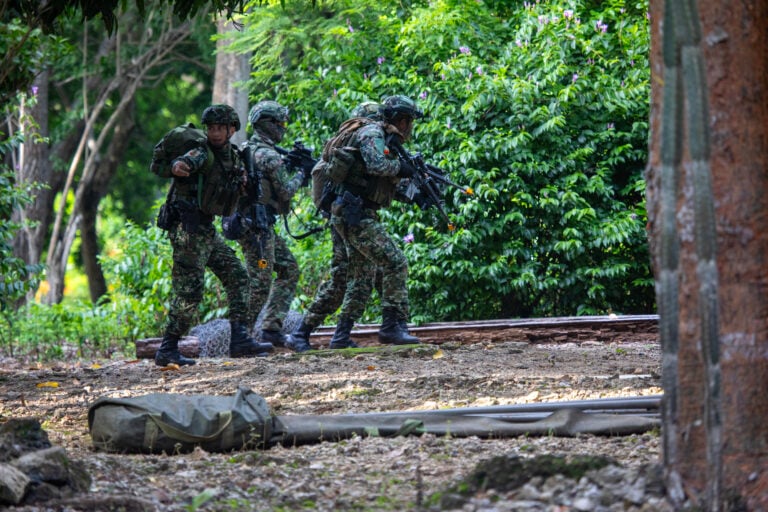
In mid-January, some 10,000 military personnel were deployed to key provinces along the coastal corridor, including Guayas, Los Ríos, and Manabí. The Ministry of Defense said priority sectors were defined based on military intelligence, with elite and specialized units assigned to high-risk areas.
President Daniel Noboa also announced a $180 million investment in 11 strategic security projects. Planned acquisitions include seven twin-engine helicopters, a multipurpose logistics vessel, a 3D radar system, scanners, and drones for border surveillance.
Interior Minister John Reimberg said the plan incorporates “technology without precedent,” including IBIS and AFIS identification systems designed to trace weapons and ammunition with scientific precision — tools authorities say will help increase case resolution and reduce impunity.
In parallel, Ecuador’s Security Block — composed of military and police forces — received a visit in January from Joseph Humire, acting assistant secretary of War for Homeland Defense and Americas Security Affairs. According to news reports, the meetings focused on strengthening bilateral cooperation and information exchange, as well as identifying critical drug trafficking hotspots and illegal activities such as illicit mining and armed group camps.
Strategic shift: Guayaquil as operational hub
In a move underscoring the government’s resolve to confront criminal violence head-on, both the Ecuadorian National Police and the Armed Forces relocated their high commands to Guayaquil in February, effectively turning the country’s most violent city into the operational nerve center of the state’s security response.
On February 13, the National Police announced that its top leadership would remain in Guayaquil indefinitely to oversee operations under the so-called “3D Operational Strategy,” aimed at weakening, disorganizing, and dismantling criminal organizations. The Armed Forces adopted a similar posture, reinforcing Guayaquil’s role as the focal point of coordinated security operations.
Beyond force: A comprehensive strategy
While military operations and technological upgrades are central to the government’s approach, experts warn that addressing organized crime requires a comprehensive strategy.
“The challenge posed by this complex threat requires a comprehensive strategy. All sectors must be involved — education, health, rehabilitation, civil society, and the labor market — to prevent criminal culture from becoming predominant in society. The more state and legal actors are present, the more opportunities people will have in life other than crime,” Zumárraga concluded.
Ecuador’s path to recovery will not be easy. Yet through a combination of technology, international cooperation, and comprehensive action across all sectors of society, authorities aim to reduce the power of criminal structures that threaten the country’s security and stability.