

In a recent report, China in Peru: The Hidden Costs of an Unequal Relationship, the United States Institute of Peace denounces the harm of Chinese expansion in Peru, particularly in the mining sector. “The combination of a permissive political and legal environment in Peru, the poor social responsibility of Chinese companies and banks, and the absence of real control — in China or in Peru — of Chinese actors’ activities have devastating consequences,” writes the report’s author, Juan Pablo Cardenal, a research associate at the Argentina-based Center for the Opening and Development of Latin America (CADAL), whose writings focus on content about China.
Chinese mining projects have so far caused environmental and social problems, among others. This is the case, for example, of the Las Bambas copper mine, at the center of protests from workers over poor working conditions and local indigenous people over environmental damage.
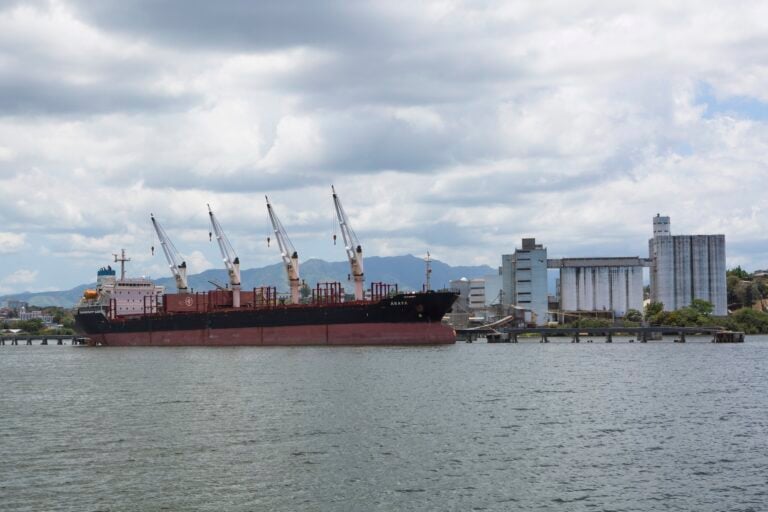
Peru’s Port of Chancay, exit route for Latin America’s lithium
This difficult scenario could be complicated by lithium exploration. According to the 2023 Mineral Commodity Summaries report by the United States Geological Survey (USGS), Peru has great potential for the exploitation of the mineral. In fact, in 2023, the Peruvian government granted exploration permits at the Falchani field in the Puno region, on the border with Bolivia, to Macusani Yellowcake, owned by Canada’s American Lithium Corp. In 2018, the company claimed to have identified 2.5 million tons of lithium. In addition, several prospecting studies have identified other deposits in the form of salt flats and volcanic rock in Laguna de Salinas in the department of Arequipa, in Coasa and Santa Rosa in Puno, and in Carumas in the department of Moquegua. According to Reuters, Chinese lithium companies, such as Tianqi Lithium Corp, are waiting to see what is actually mined to enter the market.

“Compared to the Lithium Triangle [Argentina, Bolivia, Chile], in Peru the quantities of lithium are smaller, but Chinese companies’ predatory behavior remains the same, especially if China imposes itself as a local employer, as has already been seen at the Las Bambas mine,” Evan Ellis, a research professor at the U.S. Army War College’s Strategic Studies Institute, tells Diálogo. “Added to this is the port issue.”
In Peru, the construction of the port of Chancay, 80 kilometers from the capital Lima, which will shorten shipping time from Shanghai to 25 days, will also have an impact on China’s lithium strategy, as Beijing will find it easier to extract all kinds of resources from the mainland and take them.
In March, the Peruvian government also announced that the Peruvian subsidiary of China’s firm Jinzhao had been awarded the construction, operations control, and maintenance of another port, the new San Juan de Marcona Port Terminal, in the southern Peruvian province of Nazca, for the export of minerals. The duration of the concession will be 30 years.
“The question is whether these ports will be managed as planned, with a level of access for all interested commercial actors, or whether, instead, and as is feared, they will be managed with the consent of the Peruvian government as essentially private ports for specific Chinese mines, in the future also for lithium, and to the disadvantage of other commercial actors,” Ellis told Diálogo.
As such, Peruvian ports will serve to extend Beijing’s regional dominance in the lithium sector as well. Thanks to the boom in electric cars, of which China has become one of the world’s leading exporters, Beijing’s appetite for the white gold in Latin America is spreading beyond the borders of the main production hub, the so-called Lithium Triangle that includes Argentina, Bolivia, and Chile.
China is now looking at the whole region following its “vertical integration” strategy, i.e. the creation of a self-sufficient system in which electric vehicle manufacturers not only manage the car assembly but also other processes such as, for example, the production of batteries and export. Vertical integration is part of China’s quest for economic security and, more generally, its national security. However, not relying on foreign supply chains reinforces Beijing’s predatory dynamics and its policy of dominance in the countries where it operates.
Brazil’s lithium

In late May in Brazil, Shenzhen-based electric vehicle company BYD transported 5,500 electric cars to the port of Suape, in Pernambuco, on one of its ships, the BYD Explorer, for the first time. The goal was to speed up exports and avoid the import tax the Brazilian government applied on electric car in July.
For China, Brazil is central for lithium because in the former Ford factory in Bahia state, BYD installed its first Latin American production plant and is investing $194 million to produce chassis for electric buses and trucks, electric passenger vehicles and hybrids with a planned initial capacity of 150,000 units per year. In 2020, BYD inaugurated Latin America’s first lithium-ion battery factory in Manaus, Amazonas state.
In the short term, however, Beijing is forced into industrial pragmatism. As Chinese companies cannot yet control the entire production process in Latin America, they are partnering with others operating in the lithium sector in the region. This is the case, for example, of Chinese company Yahua, which in July 2023 bought from Sigma Lithium its first 15,000 tons of processed lithium, as well as 15,000 tons of scrap. A company created in Brazil and registered in Canada, Sigma Lithium is one of the main operators in the Jequitinhonha Valley, in Minas Gerais state, where 85 percent of Brazil’s lithium is concentrated, with nearly one million tons of reserves. The Chinese electric vehicle battery company Contemporary Amperex Technology (CATL) tried in early 2024 to buy it, but the offer has so far been rejected.
“This Chinese expansion in Brazil is also dangerous for the lithium industry,” Ellis said, “because it risks blocking an entire supply chain and excluding other competitors. And it is especially dangerous for the automotive sector, where BYD is eating up the competition with an economic return only for Chinese companies and subcontractors, while there is little technology transfer to Brazilian institutions.”
Ganfeng against nationalization in Mexico
Following the Lithium Nationalization Decree of February 18, 2023, the Andrés Manuel López Obrador administration revoked the concessions of Chinese investors from Ganfeng, owner of Bacanora Lithium in the Sonora desert. Although the country does not have the technology to extract the mineral, the objective of the decree is to have control of the deposits. Ganfeng, which obtained 10 concessions in Sonora, calculated that there are 8.8 million tons of lithium in that desert.
As such, in late June the Chinese company initiated arbitration against Mexico before the International Center for Settlement of Investment Disputes (ICSID), which operates under the auspices of the World Bank. A few days later, López Obrador stated in his morning press conference that he had offered to “seek a solution” with Ganfeng’s investors and that he had addressed the issue in April during a visit by the Chinese government’s special representative for Latin American affairs and vice-president of the Chinese Association of Public Diplomacy, Qiu Xiaoqi.
“It’s likely that the new government of Claudia Sheinbaum will continue with this idea of state control, but in a more flexible way to allow Ganfeng to come back again, but differently. In fact, Mexico wants to offer itself as a nearshoring destination for Chinese companies like BYD, which intends to build a car production factory. The problem is that even in Mexico they want to control the supply chain, thus hurting competition,” Ellis said.
China’s Progress in the Lithium Triangle

While China is attempting to source lithium outside the Triangle, it is also continuing its expansion in Argentina, Bolivia, and Chile, but not without difficulties. In Chile, Tianqi, the Chinese shareholder of the second largest lithium producer, SQM, announced in June its intention to take legal action against the decision of Chilean regulatory authorities. These authorized, without a shareholder vote, a joint venture between SQM, of which Tianqi owns about one-fifth, and Chilean state giant Codelco.
“It remains to be seen what the impact will be on China’s decision to continue investing. In Chile, Chinese companies may face difficulties and some of their positions may cause delays in the progress of this project. Issues related to water and environmental impact could also slow down the exploitation of Chilean lithium in general,” Ellis said.
Chinese company Tsingshan is scheduled to inaugurate a lithium battery factory in May 2025 with an announced investment of $233 million. It will be built in Mejillones, 65 kilometers north of Antofagasta. The project is part of the National Lithium Strategy President Gabriel Boric announced in 2023.
In April, the Chilean government also announced five new lithium exploration projects to be carried out over the next two years as part of the same national strategy. More than 50 domestic and foreign companies whose names were not disclosed, including several Chinese companies, have expressed interest. However, investors voiced their concern about how the Chilean government will award lithium contracts in the salt flats and the risk of dual ownership on land claimed by indigenous communities.
In Bolivia, Chinese consortium CATL BRUNP & CMOC (CBC), and the company Citic Guoan Group have already signed agreements with the government, while Citic Guoan has recently been testing the Uyuni pilot plant. China Machinery Engineering Corporation (CMEC), a subsidiary of China National Machinery Industry Corporation (SINOMACH), is also one of the finalists in the tender called by the Bolivian state-owned lithium company, Yacimientos de Litio Bolivianos (YLB), for the development of pilot projects for direct lithium extraction in seven of the country’s 28 salt mines.
In Argentina, according to a BBC investigation of early April 2024, Beijing has interest in at least eight lithium mining projects and is seeking to snap up more. In the Salta province, for example, China’s Tsinghan Holding Group’s Salar Centenario-Ratones project opened in July and is expected to produce 24,000 tons of lithium carbonate per year, equivalent to more than half of Argentina’s lithium exports by 2023.
“In the Lithium Triangle, despite these various initiatives, there are many unknowns for China. From the nationalization of lithium in Chile, to the difficulties of fighting local corruption in Bolivia, or the new relationship of President Javier Milei in Argentina with Beijing. In addition, China’s strategy of seeking to monopolize the entire lithium supply chain in Latin America may boomerang in the long term because it is not certain that lithium will still be the dominant battery technology in five or ten years’ time,” Ellis said.
The risks
As China’s white gold rush continues, there is increasing concern about the Asian country’s growing power in the sector. China not only seeks to create a monopoly over the different phases of lithium, which would allow it to use lithium in all its forms as ammunition for its economic coercion, but also to use corruption and regional institutional weaknesses to its advantage to advance and destroy the competition. China’s strategy, moreover, has limited benefits for the host countries.
What’s more, China’s socio-environmental impact remains of considerable concern. Chinese companies, notorious for their low environmental standards and human rights violations, are maintaining their practices in Latin America, abusing the environment and violating labor rights, while ignoring the rights of the indigenous and tribal people on whose soil these extractive activities are carried out.
They also harm agriculture and livestock farming, with soil degradation, water diversion, and air and water pollution that their plants cause. Lithium extraction requires an average of 2.2 million liters of water per ton. In the arid regions of Latin America, where the mineral is frequently found, this has led to conflicts with local communities, as in Toconao, Chile. In 2023 there were protests and roadblocks by indigenous groups in the Atacama Desert and in the province of Jujuy, in northern Argentina, where they also denounced terrible working conditions.
Experts emphasize that China’s lithium rush is leading to land grabs, water shortages, potentially irreparable environmental damage and community conflicts. Latin American countries should carefully consider with whom they choose to partner so as not to become dependent on China.