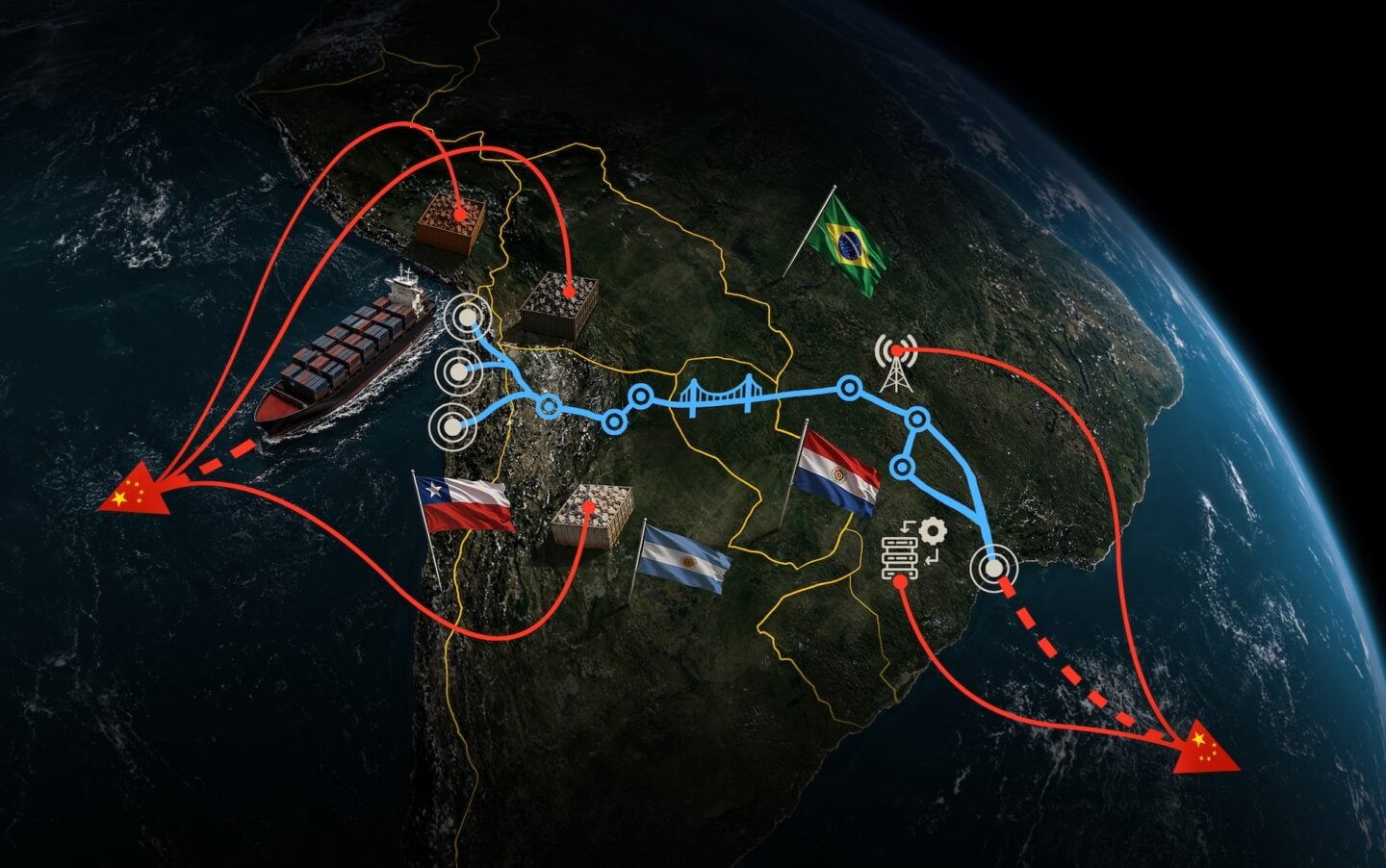

The completion of a key section of the Capricorn Bio-Oceanic Corridor marks a new phase in South America’s logistical integration. As the route brings the continent’s interior closer to Pacific ports and Asian markets, analysts warn that it could also strengthen the trade, logistics, and infrastructure network underpinning China’s growing strategic influence in Latin America.
The corridor brings together Argentina, Brazil, Chile, and Paraguay in a regional integration initiative that will connect the Atlantic and Pacific oceans through highways, bridges, border crossings, logistics centers, and port infrastructure. Its action plan defines the project as a mechanism to strengthen connectivity, facilitate trade, and promote development across the territories it traverses.
The Regional Master Plan for Integration and Development, supported by the Inter-American Development Bank, also prioritizes the coordination of investments, cross-border procedures, regulatory harmonization, and physical and digital infrastructure. These systems will be essential to the corridor’s operation and will help determine which companies and technologies gain access to its logistics networks and commercial data.
Once fully operational, the corridor will create a more direct land connection between productive regions in South America’s interior and ports in northern Chile, facilitating access to Asia-Pacific markets. Chile’s official action plan estimates that the route could reduce transportation times between inland Brazil and Paraguay and Asian markets by as much as 10 days.
In July 2026, construction crews completed the physical connection between the Paraguayan and Brazilian sections of the Bioceanic Bridge, linking Carmelo Peralta, Paraguay, with Porto Murtinho, Brazil. The bridge represents one of the corridor’s most visible milestones, although access roads, border facilities, customs systems, and other supporting infrastructure must still be completed before the route becomes fully operational.
Beijing’s interest goes beyond trade
The corridor’s orientation toward Pacific ports and Asian markets could increase its value to China, already one of the principal destinations for South American soybeans, iron ore, oil, copper, and other strategic commodities.
An analysis published by Diálogo Político argues that the corridor has the potential to “redesign global trade flows in the Southern Cone.” By imposing connections between inland production centers and Pacific routes, the project could reinforce trade patterns that channel South American raw materials toward China while increasing the region’s demand for Chinese manufactured goods, machinery, telecommunications equipment, and technology.
Jorge Serrano, a member of the advisory team to the Peruvian Congress’s Intelligence Committee, noted that the Capricorn Bioceanic Corridor should be understood as part of a broader logistics network.
“When various strategic infrastructure projects begin to interconnect, they stop being merely transportation or trade initiatives and take on a geopolitical dimension that can increase the influence of the country that dominates trade flows,” Serrano told Diálogo.
China’s potential advantage does not depend on constructing the highways and bridges themselves. It could grow through greater access to the ports, telecommunications networks, customs technologies, cargo-management platforms, logistics services, and digital systems that will support the movement of goods along the route. “Unlike other countries, China maintains close integration between the state, the Communist Party, and its intelligence agencies,” Serrano added.
An expanding “silent occupation” strategy
According to economist Rafael Marrero, CEO of Rafael Marrero & Company, China is pursuing a long-term strategy of “silent occupation” in Latin America based on critical infrastructure, financing, telecommunications, and logistics. In an interview with Expediente Público, he argued that Beijing’s presence is advancing gradually through sectors that strengthen its economic and strategic influence across the region.
The concern extends beyond the ownership of roads, bridges, or ports. Influence over terminal operations, communications networks, digital platforms, cargo information, maintenance services, and logistics software can create strategic dependence even when the underlying infrastructure remains under national ownership.
Marrero’s assessment aligns with concerns raised in the Center for Strategic and International Studies (CSIS) report No Safe Harbor. The study examined Chinese-linked involvement in dozens of ports across Latin America and the Caribbean and warned that ownership or extensive operational participation can provide access to maritime logistics information, critical supply-chain nodes, and strategically important infrastructure.
The level of exposure varies according to the type of participation involved. Financing a project does not create the same degree of influence as operating a terminal, managing its logistics systems, supplying its communications network, or controlling access to its data. Nevertheless, CSIS warns that extensive involvement in port operations can create opportunities for intelligence collection, economic leverage, and the disruption or denial of access during a crisis.
As the Capricorn Corridor channels more cargo toward Pacific ports, the strategic value of those supporting systems will increase. Chinese participation in port operations, telecommunications, digital platforms, or cargo-management infrastructure could allow Beijing to benefit from the corridor’s expansion while deepening its influence over the systems that make the route commercially viable.
Pacific routes strengthen China-oriented supply chains
The corridor is taking shape as China continues to expand its involvement in regional connectivity projects. In 2025, Brazil’s state-owned infrastructure planning company and a research entity affiliated with China State Railway Group agreed to study the feasibility of a proposed bi-oceanic railway connecting Brazil with Peru’s Chancay Port.
The proposed railway remains at an early stage. No final route, construction agreement, financing arrangement, or complete binational authorization has been established. It also follows a different route from the Capricorn Corridor and is not a physical extension of it.
Nevertheless, the two projects reflect a broader shift in South American logistics toward routes that move agricultural products, minerals, and other commodities from the continent’s interior to Pacific ports and Asian markets. China’s involvement in studies for the proposed railway, together with Chinese-linked participation in regional ports and logistics infrastructure, demonstrates Beijing’s interest in the networks that support those trade flows.
Environmental platform Mongabay has warned that potential railway routes through the Amazon could generate serious environmental and social consequences, including deforestation and effects on Indigenous territories. The concerns demonstrate that large connectivity projects can reshape territorial control, economic activity, and security conditions far beyond the transportation sector.
Asymmetric trade and strategic dependence
Trade between China and Latin America remains heavily concentrated in commodities. Brazil exports large quantities of soybeans, iron ore, and oil to China, while Peru and Chile depend heavily on copper and other mineral exports. In return, the region imports Chinese manufactured goods, machinery, vehicles, telecommunications equipment, and technology.
Major commodity exporters can record trade surpluses with Beijing, but the concentration of exports in a limited number of raw materials can deepen dependence on Chinese demand and expose national economies to price volatility, market pressure, and potential political leverage.
The expansion of Pacific-oriented routes could further consolidate that pattern by making it faster and less expensive to move commodities to China without necessarily strengthening South America’s own industrial and technological capacity.
Serrano argues that infrastructure projects supporting these trade flows should not be analyzed in isolation. “The railway project linking Brazil, the Peruvian port of Chancay, and the Capricorn Bioceanic Corridor must be understood as complementary initiatives within a single regional connectivity strategy in which China has a significant interest,” he said.
The projects are not formally integrated and do not follow the same route. Serrano’s assessment instead points to their potential strategic complementarity: each could strengthen South America’s capacity to move commodities toward Pacific ports and the Chinese market.
Ignoring that broader pattern, he added, can lead to incomplete interpretations of the interests surrounding regional connectivity projects.
The analyst believes that even if the corridor were not to materialize, this would not alter the strategic position China has achieved, although it could delay some of its regional connectivity plans, since its position does not depend on a single project but rather on an international network of infrastructure and logistics developed over recent years.
“Although the physical infrastructure of the corridor is progressing, the integration of the technological systems necessary for its operation remains pending,” he cautioned. “The project will not be fully completed until that digital and operational infrastructure is integrated, the evolution of which will depend on the geopolitical environment in which it develops.”
Security must advance with connectivity
The strategic risks surrounding the corridor are not limited to foreign influence. Chile’s official action plan identifies national security as one of the initiative’s priority areas and calls for permanent border patrols, stronger cargo-inspection capacity, additional police resources, monitoring technologies, and closer coordination among customs, immigration, agricultural inspection, and security agencies.
The plan also identifies the presence of organized crime groups in Tarapacá and Antofagasta as a risk requiring mitigation. Increased cargo volumes and faster cross-border movement could create new opportunities for drug trafficking, contraband, money laundering, cargo theft, and the infiltration of legitimate supply chains.
These threats make the governance of the corridor’s digital and operational infrastructure even more consequential. Customs scanners, communications networks, port-management platforms, cargo databases, and logistics systems will process sensitive information about shipments, companies, routes, inspections, and government operations.
If Chinese-linked companies secure dominant positions in these systems without adequate safeguards, participating countries could become dependent on Chinese technology, software, maintenance, and data services. Such dependence could limit their ability to audit critical systems, protect commercially and strategically sensitive information, or guarantee continuity during a diplomatic or security crisis.
Transparent procurement, diversified suppliers, national access to operational data, independent cybersecurity audits, secure data storage, continuity provisions, and rigorous screening of companies seeking to operate sensitive infrastructure can help prevent deeper connectivity from becoming another channel for Beijing to expand strategic dependence in South America.
The Capricorn Corridor was created to strengthen regional integration. Ensuring that China does not convert the route’s expanding trade flows, ports, technologies, and logistics systems into additional sources of strategic leverage will be essential to protecting the sovereignty and security of the countries it connects.