

As bioceanic corridors advance as key axes of regional integration and commerce in South America, a memorandum of understanding signed on July 21 between Brazil and China for a potential 3,000-kilometer railroad is raising questions about the region’s sovereignty and strategic autonomy, Uruguayan platform Diálogo Político reported.
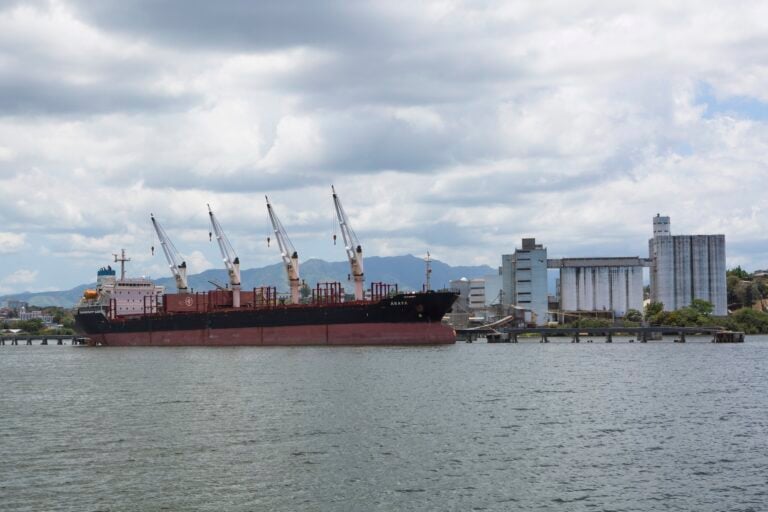
The proposed railway, part of the South American Integration Routes initiative, would connect Bahia, Brazil, with the Port of Chancay on Peru’s Pacific coast. As Brazil’s main trading partner, China absorbs a significant portion of its exports, including soybeans, minerals, oil, and meat. The new rail route could reduce shipping time to Asia by up to 10 days.
In Peru, the government clarified that it has not formally committed to the project and is not involved in the initial agreement. A senior official pointed out the need of including Peru in the ongoing discussions, Diálogo Político added. This situation exits in parallel with the Chancay megaport, a joint project with China, whose success depends on efficient land connectivity, which is currently deficient. A key concern is the high cost of the infrastructure, estimated at more than $10 billion, Argentine news site Infobae reported.
The agreement to conduct technical and feasibility studies for the rail connection was signed between the Brazilian public company Infra and the China Railway Economic Planning Institute, linked to state-owned China State Railway Group. The goal is to define the route for the corridor, daily El Imparcial reported.
“More than a corridor, it represents the projection of geopolitical and geoeconomic interests in a region where Beijing has made progress,” Jorge Serrano, security and intelligence advisor to the Peruvian Congress, told Diálogo. “The bi-oceanic corridor opens new doors for China, which will not stop there. It has its sights set on the Port of Corío, in Peru, with a capacity three times greater than that of Chancay.”
China’s infrastructure model in the region
China’s infrastructure projects in South America, such as the proposed bi-oceanic corridor, follow a vertical model that prioritizes external demands. This can generate uneven geographic development and consolidate transport and logistics systems oriented toward trade flows to China, Chilean magazine Izquierdas reported.
These corridors are designed to serve China’s demand for raw materials. Under the so-called Beijing Consensus, South America is deepening its ties with China, although in practice this can reproduce a center-periphery dependency. China seeks to shape the global order to its interests by boosting traffic to the Pacific and has become a major influence on the development aspirations of countries in the region, Izquierdas added.
“Let’s not forget that China is a supplier of chemical inputs used in the production of fentanyl, which facilitates access to these materials for Mexican international terrorist groups,” Serrano said. “There is a risk that the Port of Chancay will open a new route for the entry of these inputs to produce fentanyl, and that they will be able to use this bi-oceanic route as a means of transport.”
Obstacles along the way
The Brazilian-Chinese bi-oceanic project faces significant environmental and social challenges, from resistance from indigenous communities in the Amazon and the Andes to coordination issues between Brazil, Bolivia, and Peru. Unlike Brazil, which already has an extensive rail network, Peru would have to build its sections from scratch and resolve technical differences such as different track gauges, according to Argentina’s legal weekly Comercio y Justicia.
Serrano pointed out that governments are prioritizing the investments offered by China over the warnings of their own intelligence services. “Although reports warn of Beijing’s dual game — its presence in Patagonia and its support for regimes such as Venezuela, Cuba, and Nicaragua — these risks are overshadowed by the investment and development benefits that the region seeks,” he said.
Regional alternative
A report by the Institute of International Studies at the University of Chile indicates that in 2015, Argentina, Brazil, Chile, and Paraguay formed an initial working group to study the possibility of establishing the Bi-oceanic Road Corridor or Capricorn Corridor. This ongoing project aims to connect the Atlantic and Pacific oceans, facilitating trade, and strengthening cooperation between the participating countries.
The Corridor is not a single project with a single start date but a multinational effort consisting of different sections, some of which already exist. Road works and preparations began in the 2010s, with main works starting around 2017, especially in Paraguay. Development continues in all four countries, which are implementing specific infrastructure projects to connect the Atlantic with the Pacific.
This road-based infrastructure would connect Brazilian ports with those in Chile, crossing the Brazilian state of Mato Grosso do Sul, the Paraguayan Chaco, and the Argentine provinces of Salta and Jujuy, to the Chilean ports of Antofagasta, Mejillones, and Iquique. The 2,400-kilometer route is scheduled for completion in the first half of 2027, according to local website Bichos de Campo.
Governance of the Capricorn Corridor falls to a Working Group made up of experts from the participating countries. During a November 2024 meeting in Asunción, a Regional Master Plan was promoted to optimize logistics and the flow of goods, addressing public works, transportation, trade, and border security, for direct access to Asia-Pacific markets, Bichos de Campo reported.
Unlike the Chinese-Brazilian project, this initiative prioritizes regional sovereignty and development, leveraging the countries’ own capabilities and financing from participating nations, Diálogo Político reported. Its goal is to streamline trade, increase logistical competitiveness, and strengthen commercial and cultural ties.
“The Capricorn Corridor could be limited to regional trade with the arrival of the bi-oceanic train and the Port of Chancay, which have high Chinese financing,” Serrano said, adding that “at this time, security is being left aside.”