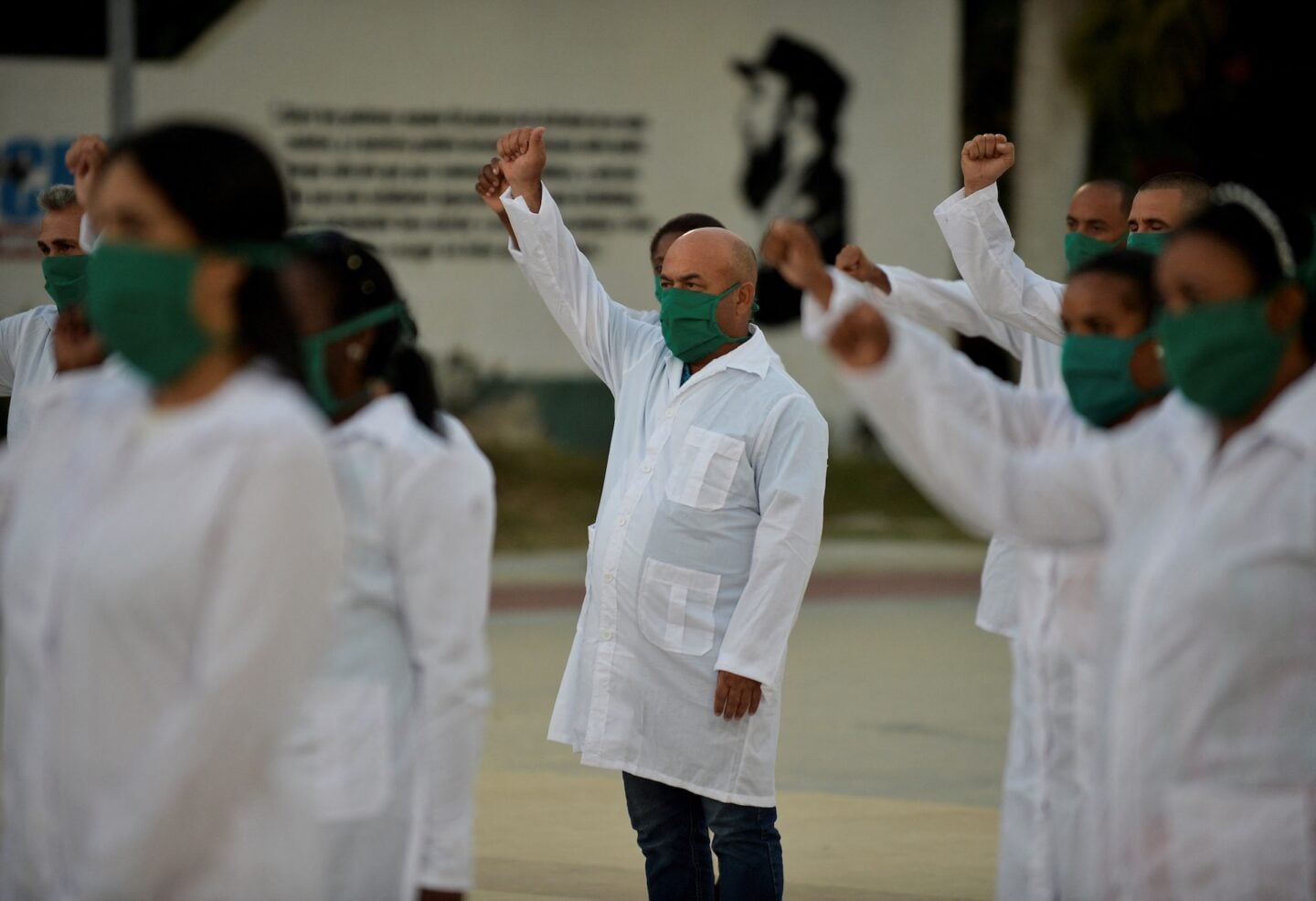

As Cuba’s health care system faces one of the worst crises in its history, marked by increasingly frequent blackouts, chronic medicine shortages, and hospitals in poor condition, its international medical missions continue to represent one of Havana’s main sources of revenue, in some cases surpassing even tourism. Each year, they generate billions of dollars, providing the regime with essential resources to remain in power and strengthen its influence abroad.
The origins of the program date back to 1960, when Fidel Castro sent a small medical delegation to Chile following a devastating earthquake that struck the country. In 1963, the deployment of a permanent brigade to Algeria marked the formal beginning of Cuba’s international medical missions. Since then, they have become a structural component of Cuban foreign policy.
According to official figures from Havana, more than 400,000 health care professionals have participated in missions in at least 164 countries since the program began. According to official figures from the Cuban regime, more than 24,000 doctors and other health care workers remained deployed in approximately 50 countries in 2025.
Presented by Cuba for decades as a model of international cooperation, the program has faced growing criticism and condemnation. Independent United Nations experts, the Inter-American Commission on Human Rights, and the European Parliament have denounced practices comparable to “slavery and forced labor.” In July, the U.S. Department of State sanctioned entities and officials involved in administering the overseas medical missions “for facilitating and benefiting from human trafficking.”
According to the nongovernmental organization Prisoners Defenders, the Cuban regime allegedly retains between 85 and 94 percent of the funds paid by host countries, while exercising strict control over the professionals during their time abroad. “This is a crime against humanity, not an act of solidarity, whose purpose is to enrich the regime,” Javier Larrondo, founder and president of Prisoners Defenders, told Diálogo.
These allegations, combined with growing complaints about the working conditions of Cuban doctors and the lack of transparency in the financial mechanisms governing the missions, have intensified international scrutiny of the program. As a result, a growing number of countries are reviewing or scaling back these health cooperation agreements, while also questioning their use by Havana as an instrument of strategic influence.
The business of white coats and the human cost of missions
For more than half a century, the export of health care personnel has been one of the most profitable tools of the Cuban regime’s foreign policy. According to the U.S. Department of State, between 2018 and 2020 alone, the sector generated between $6 billion and $8 billion annually, equivalent to more than 40 percent of the island’s exports.
In most cases, recipient governments do not directly hire Cuban doctors and nurses. Instead, they sign agreements with Cuba’s Ministry of Public Health (MINSAP) or Cuban Medical Services Marketing Company (CSMC), the state-owned company responsible for managing the missions abroad. This system allows Havana to maintain control over personnel recruitment, assignments, and, above all, the financial flows generated by the contracts.
“On average, the Cuban government retains 85 percent of the salaries agreed upon with host countries on behalf of doctors and nurses. In Mexico, we demonstrated that they retained 94 percent of the salaries, while in Brazil the figure was 90 percent. It has been a massive, immense slave business,” Larrondo said.
According to numerous studies and complaints by dissidents, independent economists, and human rights organizations, the financial structure that manages revenue from the medical missions is characterized by significant opacity. In addition to CSMC, ANTEX S.A., a company linked to GAESA (the Armed Forces Business Enterprises Group), the powerful economic conglomerate controlled by the Cuban Armed Forces, participates in the management of some international contracts.
For years, GAESA has been described as a kind of “black box” of Cuban power, through which a significant portion of the country’s economic resources is captured by the military leadership, beyond any public or parliamentary oversight. Payments made by host countries are reportedly channeled through Banco Financiero Internacional (BFI), which is also controlled by GAESA, making it extremely difficult to verify the final destination of the resources generated by the missions.
According to a report published in April by the Inter-American Commission on Human Rights (IACHR), the regime enriches itself through forced labor and authoritarian control over doctors deployed abroad. The report documented practices such as passport confiscation and restrictions on freedom of movement. These limitations also affect the doctors’ family lives, as they are often unable to bring their spouses and children with them. In addition, those who leave the program risk being classified as “deserters” and losing the economic benefits accumulated during the mission. Even so, thousands of professionals have chosen to leave the system.
In addition to allegations of exploitation, concerns have also been raised about the quality and transparency of the missions. In Mexico, where the government invested approximately $24 million in hiring Cuban doctors between 2022 and 2024, an investigation by Fuerza Informativa Azteca raised questions about the credentials of some professionals and the transparency of the contracts.
“This has been possible because the regime has imposed agreements under which the participants’ certified university credentials were never provided to the authorities of the host country, allowing for the widespread falsification of medical credentials,” Larrondo said.
In Brazil, the Más Médicos program also generated considerable controversy because Cuban doctors were exempted from the requirement to revalidate their professional qualifications. Medical associations denounced the creation of a double regulatory standard and the difficulty of verifying participants’ qualifications.
Diplomacy, intelligence, and regional influence
For the Cuban regime, the medical missions, in addition to representing one of its most significant sources of revenue, constitute one of its principal instruments of international projection. According to former mission participants, some brigades are also used as cover for Cuban intelligence personnel tasked not only with monitoring doctors abroad, but also with collecting information and building local influence networks.
“In many countries, they have been used to carry out acts of political interference in support of authoritarian leaders in power, influencing the population and concealing espionage networks on behalf of those leaders, including during election periods,” Larrondo said.
According to Prisoners Defenders, of the more than 700 members of the Cuban medical mission present in Bolivia in 2019, just over 200 were actually doctors. That same year, Ecuador ended its cooperation agreements with Cuba amid diplomatic tensions following the October protests, during which the Ecuadorian government denounced the involvement of Cuban citizens in destabilization activities.
“Moreover, the entire program has served to create a network of international allies and increase the power and influence of the Cuban regime within institutions such as the United Nations, the World Health Organization (WHO), and the Pan American Health Organization (PAHO),” Larrondo said.
For this reason, in recent years several Latin American countries have begun to reconsider health care cooperation with Cuba, questioning the political cost of a model that has allowed the Cuban regime to transform its human capital into an instrument of influence and power projection.
In March, Honduras decided not to renew an agreement with Havana after an internal review identified nonmedical personnel within the Cuban delegation. Guatemala and El Salvador have also reduced their programs, while The Bahamas and Guyana have requested that salaries be paid directly to the professionals rather than to the Cuban regime.
By reducing or reforming these programs, governments are seeking not only greater protections for the doctors involved, but also to limit Havana’s ability to use medical missions as a geopolitical tool, thereby helping to strengthen institutional transparency and regional security.