
The expansion of China’s fishing fleet in South American waters is no longer limited to the large concentrations of vessels operating on the high seas along the edge of the region’s exclusive economic zones (EEZs). Chinese companies have also expanded their presence within national fishing fleets through acquisitions, local subsidiaries, and the reflagging of vessels, allowing them to operate both inside and outside national waters.
Squid is at the center of that pressure. China’s distant-water fishing fleet, widely regarded as the world’s leading source of illegal, unreported, and unregulated (IUU) fishing, has deployed a harvesting capacity in the Southwest Atlantic unmatched by any coastal nation. Its presence — both on the high seas and within national fishing industries — creates new challenges for catch traceability, corporate oversight, and the sovereign management of marine resources.
Chinese capital dominates Argentina’s squid fleet

Companies controlled by Chinese capital now own nearly two-thirds of the vessels licensed to fish squid in Argentina, while Argentine capital accounts for just 17.9 percent of fleet ownership.
The findings come from China and the Control of Fishing Within Argentina’s EEZ, a report by Argentine marine conservation and illegal fishing expert Milko Schvartzman. The study analyzed the 84 vessels authorized to fish squid in Argentina’s EEZ, along with the permits, corporate records, and ownership structures behind them.
“There is a systematic process of foreign ownership and loss of sovereign control over the squid (Illex argentinus) fishery within the EEZ, where corporations under the direct and indirect control of China now manage 63.1 percent of Argentina’s squid fleet,” Schvartzman told Diálogo.
The findings broaden the discussion surrounding China’s fishing presence. The pressure no longer comes solely from the hundreds of vessels operating beyond the 200-nautical-mile limit that illegally enter Argentina’s EEZ. It also includes vessels legally authorized to operate within Argentina’s jurisdiction under the Argentine flag but controlled through Chinese capital, subsidiaries, or beneficial ownership.
Two decades of acquisitions and reflagging
The expansion did not happen overnight. Since 2005, Chinese companies have acquired Argentine fishing firms, established local subsidiaries, and reflagged their own vessels, gradually securing a significant share of the country’s offshore fishing fleet, Schvartzman explained.
The report identifies companies including China National Fisheries Corporation, Shanghai Fisheries Group Co. Ltd., Zhejiang Ocean Family Co. Ltd., Qingdao Haoyang Ocean Fishery Co. Ltd., and Dalian Huafeng Aquatic Products Co. Ltd. Through various corporate structures, these firms operate vessels licensed to fish inside Argentina’s EEZ as well as on the high seas.
The report highlights the cases of China National Fisheries Corporation and Shanghai Fisheries Group to demonstrate how corporate networks previously linked to illegal fishing incidents later became legally integrated into Argentina’s fishing sector. In other cases, Chinese companies simultaneously operate Argentine-licensed vessels inside the EEZ and distant-water vessels outside it to harvest the same migratory squid stocks.
That dual presence exploits gaps in oversight and transparency.
“The lack of oversight, transparency, and traceability, along with violations of Argentina’s Federal Fisheries Law, has enabled unfair competition, fisheries fraud, abuse of crew members, and allowed companies that own vessels involved in illegal fishing to operate on Argentina’s fisheries resources,” Schvartzman said.
According to Schvartzman, this structure creates a gray area in which companies involved in authorized fishing inside Argentina’s EEZ also maintain ties to vessels accused of illegal or unregulated fishing in other jurisdictions and on the high seas. Once catches from different sources are mixed at processing plants, it becomes difficult to determine which seafood was harvested under Argentine regulations and which originated in areas lacking effective oversight.
Vertical integration also provides commercial advantages. According to the report, Chinese regulations allow seafood caught abroad by Chinese companies to enter China as domestic products, qualifying for tax benefits unavailable to Argentine companies exporting to the same market. That imbalance strengthens the expansion of Chinese firms while reducing the competitiveness of Argentine operators.
A biologically fragile resource under growing pressure

The scale of extraction heightens the risk. The Latin American Fisheries Sustainability Foundation (FULASP) estimates that foreign fleets harvest between 1.5 million and 3 million metric tons of marine resources annually in the Southwest Atlantic. China accounts for the largest presence and harvesting capacity within those fleets, compared with the 750,000 to 900,000 metric tons landed annually by Argentina’s fishing industry, according to Infobae.
Between 400 and 600 Chinese fishing vessels operate in the region each year. While overall harvest levels increased 65 percent between 2019 and 2024, the Chinese fleet’s fishing effort grew by 85 percent during the same period.
FULASP Director Raúl Cereseto warned that squid “live only one or two years and play a central role in the food chain,” meaning that “a combination of overfishing and environmental change could soon force us to discuss not merely economic losses, but the depletion of resources that are essential to Argentina’s fishing industry and the entire South Atlantic ecosystem.”
Surveillance, cooperation, and sanctions: The regional response
Countries across the region continue to strengthen efforts against IUU fishing while maintaining maritime domain awareness of Chinese fleet activity in waters adjacent to their EEZs.
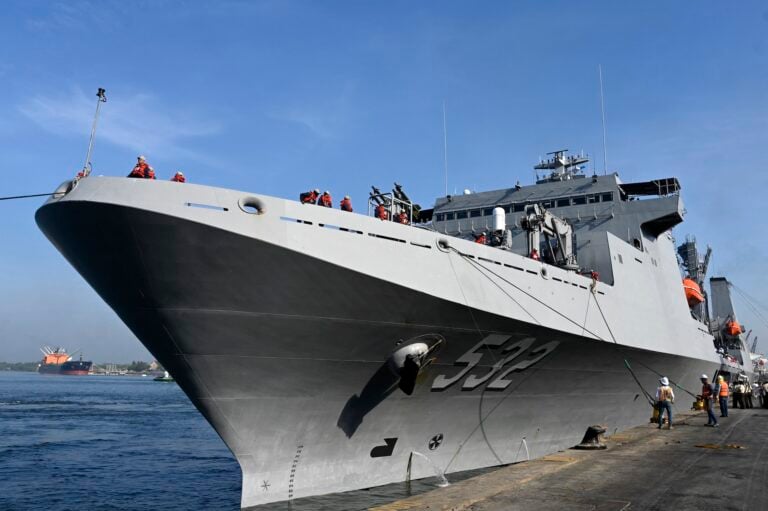
In early May, Argentine naval and air assets carried out the 11th edition of Operation Mare Nostrum, a maritime surveillance and control mission coordinated by the Armed Forces Joint Staff Joint Maritime Command.
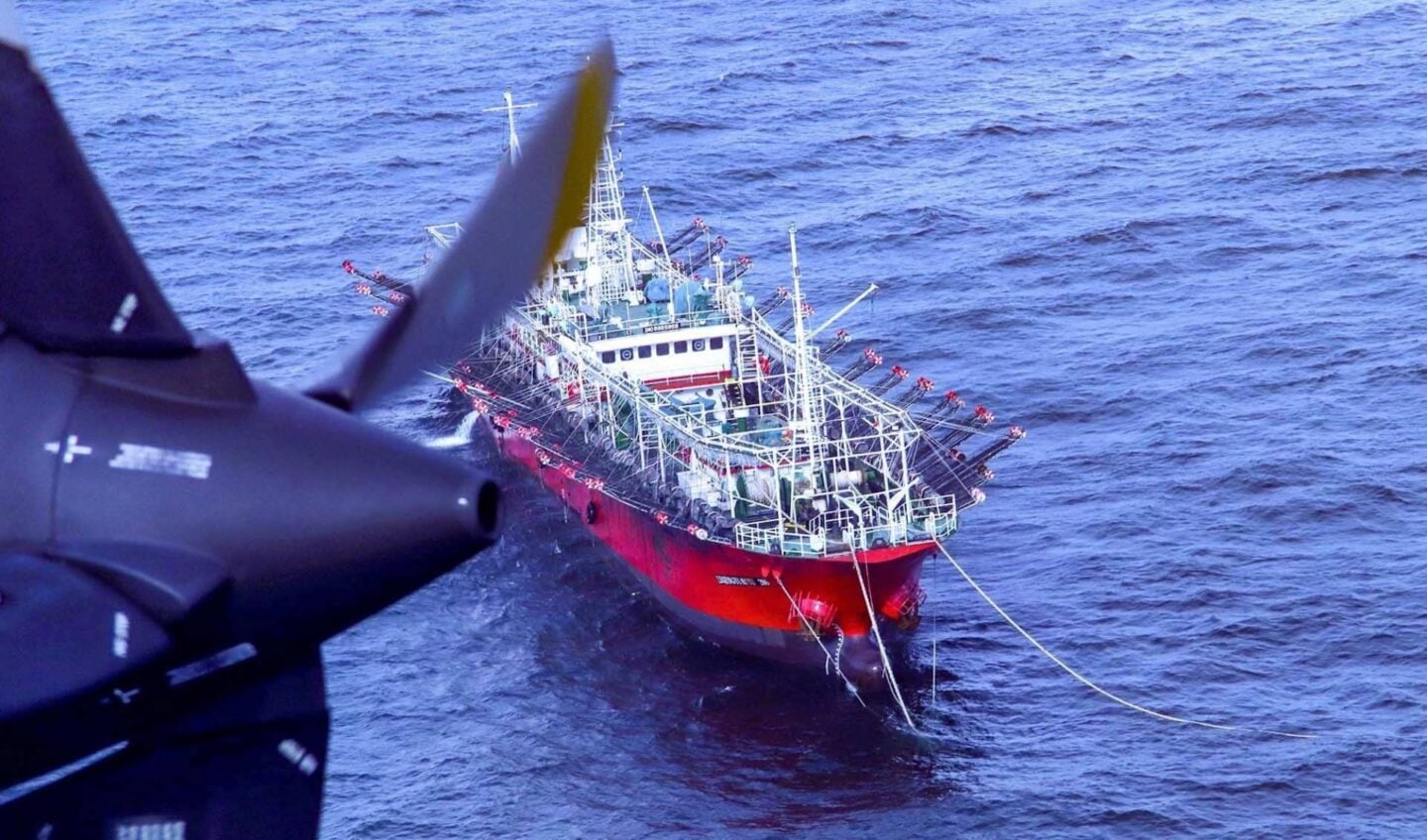
The integration of ships and aircraft extends surveillance coverage and improves monitoring of Chinese fishing vessels operating along the edge of Argentina’s EEZ and in adjacent high-seas areas. According to Argentina’s Ministry of Defense, aerial surveillance allows authorities to rapidly scan vast maritime areas, identify fishing gear, and collect evidence of violations involving both squid jiggers and bottom trawlers operating in prohibited zones.
International cooperation is reinforcing those capabilities. Following the signing of a letter of intent in May 2026, Argentina is moving forward with a five-year plan with the U.S. Department of Defense to strengthen its maritime patrol, surveillance, and enforcement capabilities.
The program includes technology transfers, personnel training, and technical assistance, as well as new sensors, command-and-control systems, maritime patrol aircraft, and unmanned aerial vehicles capable of operating from the Argentine Navy’s offshore patrol vessels.
Chile’s Navy also conducted an offshore fisheries enforcement operation west of Iquique on July 6. Using a C295 maritime patrol aircraft and specialized personnel, the service detected two groups of foreign fishing vessels operating between 300 and 400 nautical miles offshore, outside Chile’s EEZ but within an area of responsibility established under international treaties and agreements.
In late June, the Peruvian Navy carried out an aerial and maritime surveillance operation in response to the presence of a foreign fleet targeting jumbo flying squid.
The operations conducted by Chile and Peru detected no incursions into their respective maritime zones but demonstrated the importance of maintaining an up-to-date operational picture of large fishing fleets operating near national maritime boundaries and capable of rapidly shifting between different areas of the Pacific.
Argentina has complemented surveillance efforts with economic sanctions. On July 22, the Secretariat of Agriculture, Livestock, and Fisheries of Argentina’s Ministry of Economy upheld fines totaling approximately $1.82 million against the Chinese vessels Bao Feng and Bao Win, which were detected carrying out movements and maneuvers consistent with fishing activity inside Argentina’s EEZ.
“Monitoring and deterrence measures are appropriate, but illegal fishing in the South Atlantic remains a critical problem, particularly because of the Chinese fleet’s efforts to conceal illicit activities,” Schvartzman said, calling for stronger enforcement “because China disregards labor regulations for its crews, jeopardizes maritime safety, and causes environmental damage in the South Atlantic.”
Beyond tracking vessels
China’s expanding control over the companies and vessels exploiting one of Argentina’s strategic marine resources may limit the country’s ability to identify beneficial owners, ensure catch traceability, and guarantee that fishing activities serve national priorities.
The challenge extends beyond fisheries enforcement and reaches the realm of national security. It affects crew welfare, the sustainability of marine resources, corporate transparency, and maritime domain awareness.
Enhanced aerial and naval surveillance, international cooperation, and economic sanctions demonstrate growing regional capacity to detect and respond to illegal activity. Yet these measures primarily target vessel behavior. Addressing the underlying structure requires countries to scrutinize beneficial ownership, share information on vessels and corporate owners, strengthen port and labor inspections, and ensure full traceability of seafood from the point of capture to the marketplace.