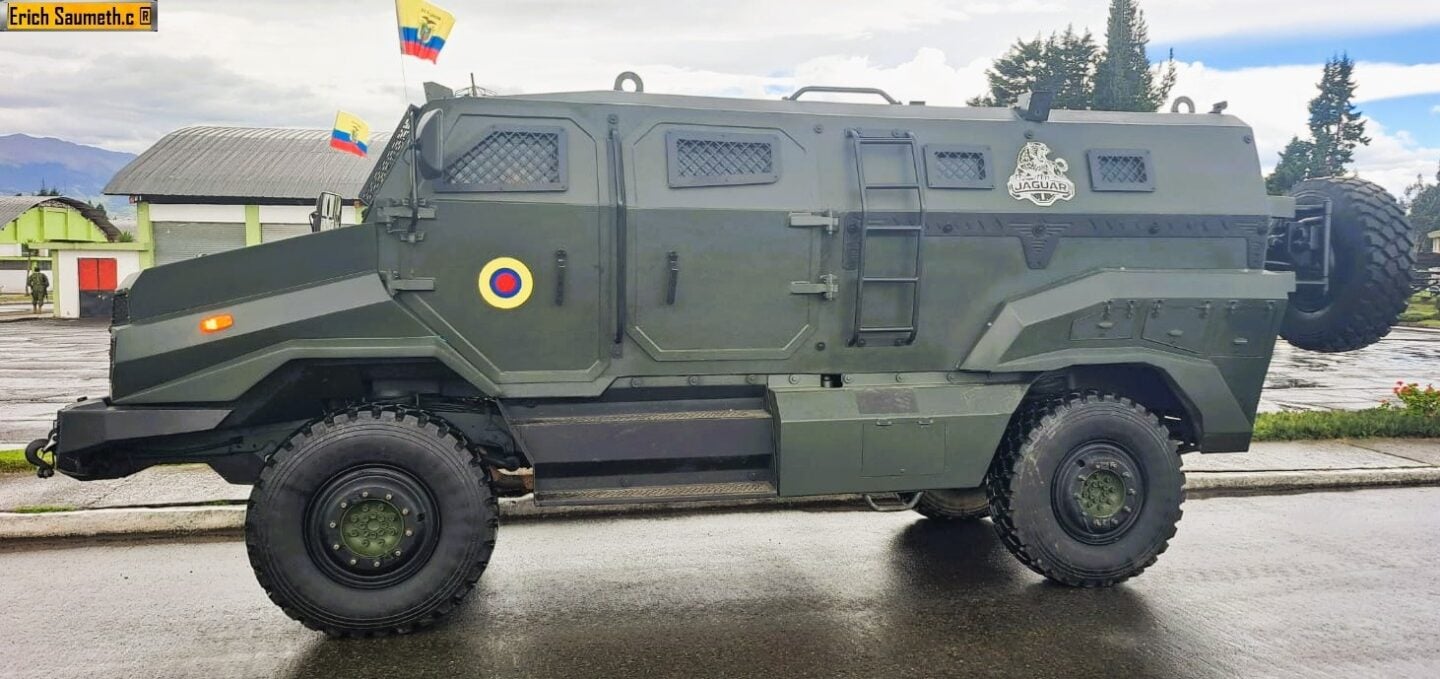

The Ecuadorian Army has advanced with the first operational unit of the Jaguar-1, a new armored personnel carrier that represents a significant step forward both in the fight against organized crime and in the development of Ecuador’s domestic defense industry.
Designed and built in Ecuador, the vehicle was conceived to protect military personnel in increasingly dangerous environments characterized by ambushes, attacks with heavy weapons, and improvised explosive devices. Its entry into service marks the beginning of the program’s operational phase and, according to defense outlet Pucará Defensa, up to 60 units are expected to be produced for different Army units.
The need for a platform such as the Jaguar-1 stems from the sharp deterioration of security conditions in the country. In recent years, the expansion of transnational criminal organizations linked to drug trafficking, illegal mining, and arms trafficking has transformed some regions of Ecuador into high threat environments.
“Platforms such as the Jaguar are intended to provide a response tailored to emerging threats and help protect personnel deployed on increasingly complex and dangerous missions,” Colombian defense expert Erich Saumeth Cadavid told Diálogo.
One notable example is the Alto Punino ambush in Ecuador’s Amazon region in May 2025, when 11 military personnel were killed during an operation against illegal mining by an armed group equipped with explosives, grenades, and assault rifles. Located between the provinces of Napo and Orellana, the area presents many of the challenges typical of the Amazon rainforest: dense vegetation, limited access routes, difficult communications, and long response times. Incidents such as this have highlighted the need for vehicles capable of providing greater protection for troops during patrols, border operations, and missions in remote areas.
Technological sovereignty
The Jaguar-1 also represents a significant step in Ecuador’s pursuit of technological sovereignty.
“It is one of the few Latin American developments of an MRAP (Mine Resistant Ambush Protected) platform specifically designed to meet the operational requirements of a country in the region,” Cadavid said.
MRAP vehicles are armored platforms designed to protect crews from landmines, improvised explosive devices (IEDs), and ambushes involving heavy weapons. Their defining feature is a reinforced structure, often incorporating a V-shaped hull, designed to deflect blast waves and increase the survivability of personnel on board.
Designing an MRAP is particularly complex because it requires integrating advanced ballistic protection, blast resistance, and off-road mobility capabilities. The Jaguar-1 is considered the first tactical armored vehicle developed and integrated in Ecuador with a high degree of national participation.
“One of the most significant aspects of the program was the close cooperation among military personnel, technicians, and Ecuadorian engineers during the platform’s design, integration, and validation phases,” Cadavid said.
According to the expert, the experience gained by the Armed Forces in border operations, Amazon security missions, and strategic surveillance activities was incorporated into the Jaguar-1’s development, helping ensure its effectiveness across the country’s diverse operating environments.
“The result is a platform that seeks to balance protection, tactical mobility, and logistical sustainability within the capabilities of the national industrial base,” Cadavid said.
Supporting internal security
The arrival of the Jaguar-1 comes at a time when Ecuador’s Armed Forces have assumed an increasingly active role in operations against criminal organizations involved in drug trafficking, illegal mining, and other illicit economies.
Following the sharp rise in homicides in 2023, the government declared an internal armed conflict and expanded the Armed Forces’ role in operations against criminal organizations.
“The increase in activities by transnational criminal organizations linked to drug trafficking, illegal mining, trafficking of precursor materials, as well as weapons, ammunition, explosives, and other illicit economies, has forced the Armed Forces to undertake increasingly complex missions in support of internal security,” Cadavid said.
One example of the challenges facing military personnel occurred in January 2024, when armed groups linked to the country’s leading criminal organizations launched coordinated attacks against police stations, public infrastructure, and even a television station in Guayaquil, prompting the government to deploy thousands of soldiers to cities and along major transportation corridors.
Meanwhile, along the northern border with Colombia and in the coastal provinces of Esmeraldas and Manabí, security forces continue operating in areas used for cocaine trafficking, where armed groups possess assault rifles, explosives, and paramilitary-style capabilities.
In these environments, the Jaguar-1 can provide a significant operational advantage. Its combination of protection, tactical mobility, and troop-carrying capacity supports patrol missions, territorial control operations, convoy protection, and operations targeting drug trafficking logistics hubs.
Crew protection
The Jaguar-1 can carry up to 12 personnel and is built on a Mercedes-Benz Unimog chassis, known for its durability and reliability in demanding environments. The introduction of this type of platform is intended to improve the protection and mobility of troops deployed in high-risk operations, particularly in areas where criminal organizations possess military-grade weapons and the capability to conduct ambushes.
Beyond its operational capabilities, the Jaguar-1 reflects how Ecuador’s Armed Forces are adapting their capabilities to an increasingly complex security environment. Its entry into service combines the need to better protect troops facing criminal organizations in high-risk operations with the strengthening of domestic industrial and technological capabilities.