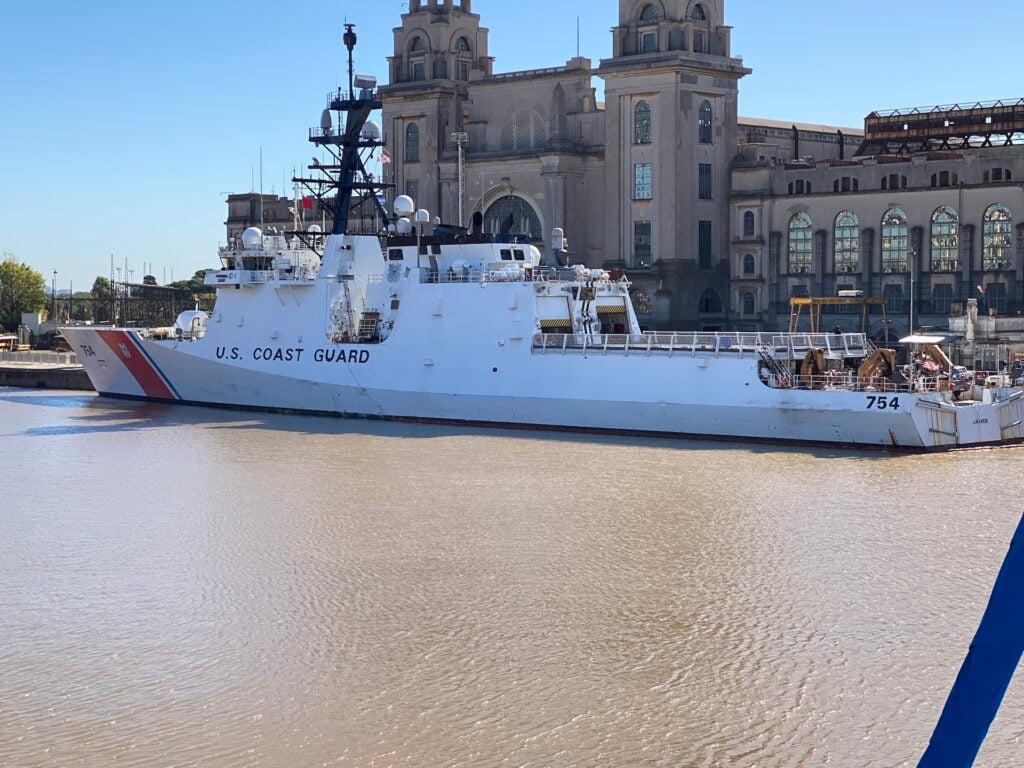

In line with the U.S. Coast Guard’s (USCG) dedication to combating illicit maritime activities and to promote maritime security, the USCG Cutter James (WMSL 754) deployed to the South Atlantic Ocean to conduct joint missions with their South American counterparts aimed at combating illegal Chinese fishing in the region.
Coastal South American countries have criticized the massive Chinese fishing fleet for its invasive and oftentimes illegal fishing strategies that deplete fish stock and damage the biodiversity of the region.
In late May, the USCG Cutter James arrived in the Port of Rio de Janeiro, Brazil, marking its third stop in the region. The Cutter James’ visit, as the United States and Brazil celebrate 200 years of diplomatic relations, highlights the ever-increasing cooperation between both nations and maritime forces as they seek to counter illicit maritime activities and reinforce maritime sovereignty.
“Working with the Brazilian Navy has been a successful demonstration of how our countries can work together,” USCG Captain Donald Terkanian, the Cutter James’ commanding officer, said in a statement. “James has had the opportunity to enhance relations between the U.S. and Brazil, while also addressing the threats posed by illegal, unreported, and unregulated [IUU] fishing, port security, and in facilitating safe and lawful maritime commerce and travel.”
The Cutter James embarked Brazilian Navy Lieutenant Commander Fernando Schild in April 2024. Brazil and the U.S. navies both use unmanned aerial systems to provide increased maritime domain awareness across a variety of missions. The embarked Brazilian officer is part of Brazil’s first ship-based unmanned aerial systems squadron.
Prior to Brazil, the USCG Cutter James stopped in Buenos Aires, arriving on April 29, to conduct training with its counterparts from the Argentine Naval Prefecture (PNA). “We carried out joint training with the USCG on control of maritime spaces and surveillance of fishing tasks, with the participation of students from our colleges and cadets,” said the PNA via X.
“This visit [to Buenos Aires] marks a significant moment in the ongoing collaboration between the United States and Argentina, with the aim of improving maritime security and combating illicit activities at sea,” the U.S. Embassy in Buenos Aires said in a statement.
With a crew of 150 men and women, the USCG Cutter James is one of the largest and most advanced ships in the USCG fleet. “The crew is dedicated to missions that include combating drug trafficking and monitoring IUU fishing activities in the Atlantic. Their work not only supports U.S. needs, but also contributes to regional stability and security,” the U.S. Embassy in Buenos Aires added.
The ship also carries out “counternarcotics operations in search of shipments of marijuana and cocaine,” Argentine newspaper Perfil reported.
During their visit to Buenos Aires, the crew of the USCG Cutter James took part in a workshop on IUU fishing with PNA officers. They also visited the Aviation Service, the Communications Directorate, and the PNA’s Coastguard Boat Service, Argentine news site Infobae reported.
The ship made its first stop in Montevideo, Uruguay, in late April, for a scheduled port visit.
Threat from China
The naval cooperation between the United States and countries of the region comes amid warnings from experts about China’s fishing fleet, which has been leaving a trail of destruction in the south Atlantic Ocean for years. “A fleet of 800 Chinese vessels is plundering South America’s fishing grounds,” Milko Schvartzman, an Argentine marine conservation and IUU fishing expert, told Diálogo.
“The totality of this fleet belongs to or is subsidized by its government and carries out IUU fishing, putting the ecosystems of the Pacific and Atlantic at risk and leaving coastal communities without food, especially in Peru, Ecuador, Argentina, and Uruguay,” Schvartzman said.
According to the expert, the fishing effort and the number of Chinese vessels plundering South America’s marine ecosystems are increasing each year. “The lack of control, monitoring, and management can only lead to environmental collapse,” Schvartzman said, adding that it is “important and necessary for the different control and surveillance forces to exchange” methodologies and experiences to prevent IUU fishing.
“In the case of the Argentine Naval Prefecture, there is plenty of experience in the use of force, as well as in the use of legal and technological tools to crack down on illegal fishing. Just as exercises have been carried out with the United States, it is important that they are carried out with other countries in the region and on other continents,” Schvartzman concluded.