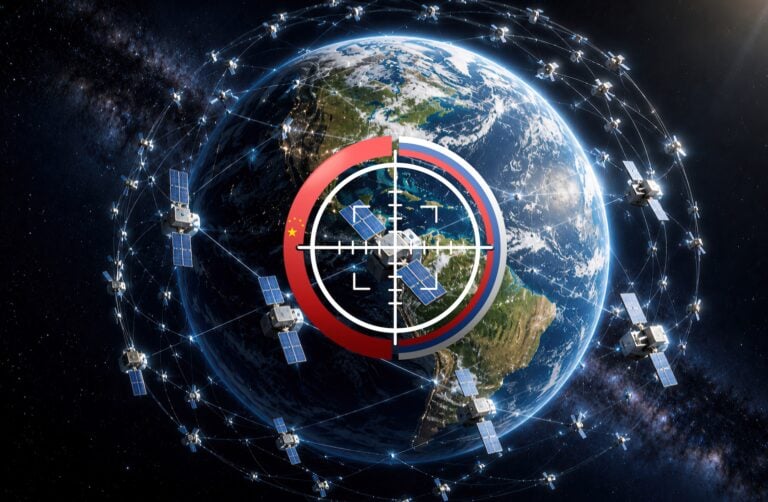


The existing asymmetries between China and Russia are an element to distinguish the influence capabilities of both countries in Latin America. While the People’s Republic of China is understood as a rising global power, provided with abundant financial resources to capture elites and access strategic sectors within Latin American nations -through investment projects, loans and “non-reimbursable cooperation”, the regional reach of the Russian Federation is usually evaluated from its alliances with illiberal governments in very specific fields such as military-technical and information.
It is understood, not without reason, that an economy considerably smaller than that of the European powers, also deteriorated by Western sanctions after the invasion of Ukraine, depends to a large extent on its military strength and certain forms of incisive power that, unlike China, do not involve the systematic spending of billions of dollars on initiatives of global scope such as the Belt and Road. Hence, certain strategies of regional influence, such as the Kremlin’s (dis)information campaigns through the RT, Sputnik platforms and their local proxies , arouse the interest of think tanks, researchers and journalists. Although to a lesser extent, so do Russian intelligence operations that are deployed with the support of diplomatic attachés in various embassies in the hemisphere – from Mexico City to Brasilia.
This does not imply that Russia is considered -in specialized opinion- as a country incapable of exercising hard power in Latin America. On the contrary, beyond the manipulation of public opinion and the massive distribution of propaganda, various actors are concerned about the growing military cooperation between Putin and his closest regional allies, namely the autocracies of Cuba, Venezuela and Nicaragua. Recently, these facts have been denounced by the Latin American press critical of Moscow. Think, for example, of the arrival, in recent months, of Russian nuclear-powered submarines off the Cuban coast, or the arrival of the Admiral Gorshkov ship in Venezuela. The same with the espionage center installed at the Mokorón military base in Managua, which violates Nicaraguan sovereignty by being operated exclusively by Russian technology and hands, as documented by the newspaper Confidencial.
In spite of everything, the economic coercion that Russia may exercise in Latin America still seems to be a matter reserved for certain cases, where illiberal regimes and leaderships welcome the Kremlin in various spaces of influence, thanks to the affinity between narratives and governance models. Thus, we find Russian investments in the Bolivian energy sector -sponsored by the governments of the Movement Towards Socialism, the exploitation of hydrocarbons in Venezuela and the corruption networks there facilitated by Russia through oligarchs, officials and high-ranking military officials.1
In Central America, although the Kremlin’s close ties with the Ortega-Murillo regime in Nicaragua and, in recent years, with the government of Xiomara Castro in Honduras are visible, the economic relations of both countries with Moscow are described as insubstantial, as internationalist Vladimir Rouvinski has stated for Expediente Abierto. As we have glimpsed, Russian-Central American cooperation is reduced in most cases to military alliances, communication agreements and, ultimately, diplomatic support in multilateral bodies. Much has already been said, for example, about the reluctance of Managua and Tegucigalpa to condemn the Russian invasion of Ukraine in forums such as the United Nations and the Organization of American States.
Not contradicting this perspective, but elaborating on it, the Center for the Study of Democracy (CSD) has recently presented its report Global Reach. The Kremlin Playbook in Latin America (2024, Center for the Study of Democracy, 104 pp.), which offers abundant evidence on the economic influence that Russia maintains in the region through various countries, businesses and networks. For the more specific case of Central America, this research announces some interesting findings that force us to rethink, to a certain extent, the existing analyses on the role of the Kremlin in the region and its mechanisms of penetration in the local political-economic structures.
Without ignoring the case of Nicaragua, where Russia “has forged close ties with the Ortega administration, providing economic assistance, military training and intelligence support”, also seeking to “exert influence on regional security dynamics and counter US interests”, the CSD report pays particular attention to Russian-Panamanian ties. As a global financial center, Panama has served the Kremlin as a “key mechanism to evade international sanctions”, becoming also an important receptacle for Russian investment from oligarchs close to Putin’s government. For these reasons, the country is identified by the CSD as “increasingly vulnerable to stronger foreign authoritarian coercion”.
Among other details, the report in question points out the existence, until July 2024, of 74 Russian companies with Panamanian owners, many of which maintain connections with Russian state entities. One of them, Publishing House AST LLC, is sanctioned by the Ukrainian Government due to the media distribution of various anti-Ukrainian contents. Another, aqueous dispersions producer Akrilan LLC, has a stake in Russian state-owned nanotechnology company Rusnano, which faces sanctions from the U.S. Treasury Department.
Russia has also left “a deep footprint in Panama’s energy sector” through companies such as Energolatina, a subsidiary of Moscow-based Energomashexport Corporation LLC. Energolatina, while maintaining ties with Russian companies sanctioned by the United States, such as JSC Power Machines, is led by oligarchs of the Eurasian giant. For example, Yury Igorevich Vereemenko, who is also CEO of other companies based in Latin America and Europe. Thus, states the CSD, “the corporate structure of Energolatina’s businesses reveals that one of the ways in which Russian entities evade sanctions is by using their current or former owners as de jure owners of their subsidiaries”.
In addition to Panama, the study developed by the CSD reveals some of the Russian operations in Costa Rica and Guatemala. In the first case, the Fintech company Punto Pago, founded by Andrey Gorsky and with investment from the Russian financial giant FINAM, develops “certain unspecified operations”, which could be taking advantage of the poorly regulated digital financial environment of some Central American countries. In Guatemala, on the other hand, indirect investments of Russian capital have been detected. In 2011, the director for Latin America of the Russian Ministry of Foreign Affairs personally announced the agreement to acquire the state-owned Guatemalan Nickel for USD 170 million, through the Swiss-registered Solway Investment Company. Presumably, these deals were suspended “in the midst of a large-scale investigation into possible money laundering operations” by the Russians.
The Kremlin’s influence on the Central American economy thus exceeds the barely significant commercial exchanges with the countries of the region. This does not imply, on the other hand, the existence of considerable levels of Russian investment in Central America, or of forms of cooperation more relevant than some arms transfers and access to propaganda media such as RT. However, beyond the strengthening of autocratic networks with Managua, Moscow has managed to penetrate some strategic sectors of the Central American economies -as in the case of Panama, instrumentalizing all kinds of loopholes to evade the sanctions imposed from the West on its oligarchs and state enterprises, as demonstrated in its report by the Center for the Study of Democracy.
1See, for example, Cardozo Uzcátegui, A., & Mijares, V.M. (2019). Russia-Venezuela corruption ties. An alliance with other means. Foreign Affairs Latinoamerica 19(2), 64-74.
Disclaimer: The views and opinions expressed in this article are those of the author. They do not necessarily reflect the official policy or position of any agency of the U.S. government, Diálogo magazine, or its members.