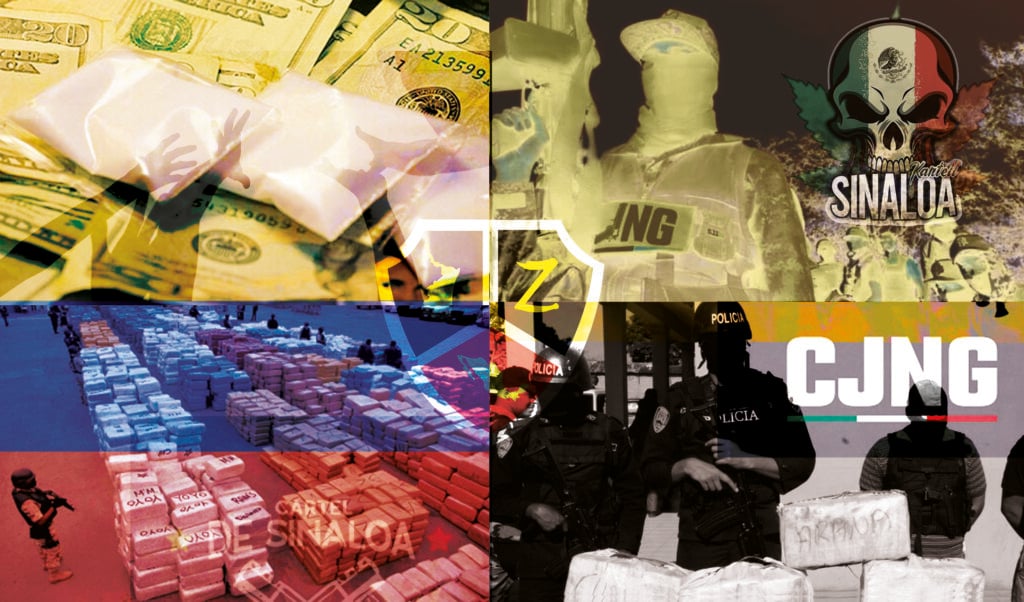

In its report, The Contrasts of Humanitarian Reality, the Ombudsman’s Office, an agency of Colombia’s Public Ministry, highlights the presence and the areas of operations of three of the strongest Mexican drug cartels: the Jalisco New Generation Cartel, Los Zetas, and the Sinaloa Cartel.
“In Colombia […] there is infiltration by many international cartels,” Daniel Adler, an Argentine specialist in security and urban counterterrorism, told Diálogo on July 18. “Colombia is the main cocaine producer on the planet. Logistically, it also has a window: It borders Ecuador where there is little governance and, because of its location, it serves as a platform for exporting alkaloids to the Americas and Europe.”
According to the Ombudsman’s Office investigation, these criminal groups have become embedded, above all, in Atlantic territories. The Zetas are spread throughout the province of Cali; the Jalisco New Generation Cartel is present in the Caribbean coast; and the Sinaloa Cartel is present in the province of Cali, Barranquilla, and the Caribbean.
The latter is considered the most dangerous for its different networks around the world for moving cocaine, heroin, methamphetamine and, recently, fentanyl, Argentine news site Infobae reported on June 6.
“Illegal armed groups mainly benefit from drug trafficking, as the region is an important route for smuggling drugs to international markets,” the report indicates. “In addition, extortion of traders, transporters, and the general civilian population is a common source of funding in the area, as well as involvement in illegal activities such as illegal mining and deforestation for the exploitation of natural resources.”
These Mexican criminal groups benefit from the illicit profits obtained from drug trafficking, among other criminal modalities that they use through an intricate network of local gangs, Colombian media outlet RCN Noticias reported.
“The payment from these macro gangs to the 26 local Colombian gangs is with weapons, drugs, or licit merchandise, which they sell and launder money with,” Adler said.
The National Police and the Colombian Attorney General’s Office established that the Sinaloa Cartel uses sacks to move drugs. According to the investigations, which began in 2022, artisanal divers transport the drugs under the hulls of ships, where other divers put them in sacks made of strong material. When the surveillance decreases, they extract them from the water with ropes to haul them up to the containers, Mexican media outlet El Diario de Yucatan reported.
Mario Luis Fuentes, researcher at the University Program for Development Studies of the National Autonomous University of Mexico, told the press on July 13 that “to continue thinking of organized crime as a phenomenon specific to national territories is a perception and public policy error.” “What is urgent is to build new cooperation mechanisms to standardize legislation, share information and intelligence in a secure manner, develop more effective fiscal strategies for control and sanction and reduce, through shared strategies, the consumption of drugs, weapons, and to contain and eradicate crimes such as human trafficking.”
There are indications that the Sinaloa Cartel and Jalisco New Generation Cartel are in alliance with Colombian criminal groups to move synthetic drugs to Europe, Infobae reported on July 17.
“The situation is quite unusual, as normally traffickers in our country export cocaine; but sending methamphetamines to Asia is a very new business,” a narcotics agent told daily El Colombiano on July 14. “The Colombians have a monopoly on cocaine production, but we know that they also want to gain space in the methamphetamine, heroin, and creepy marijuana markets. Unfortunately, there is a belief among foreign consumers that Colombian drugs are of high quality, so the narcos capitalize on that.”
Cocaine seizures in Colombia during the first half of 2024 reached 443.9 tons of cocaine, that is a 27 percent increase compared to the same period in 2023, a Defense Ministry report indicated, Colombian media outlet Blue Radio reported on July 17.