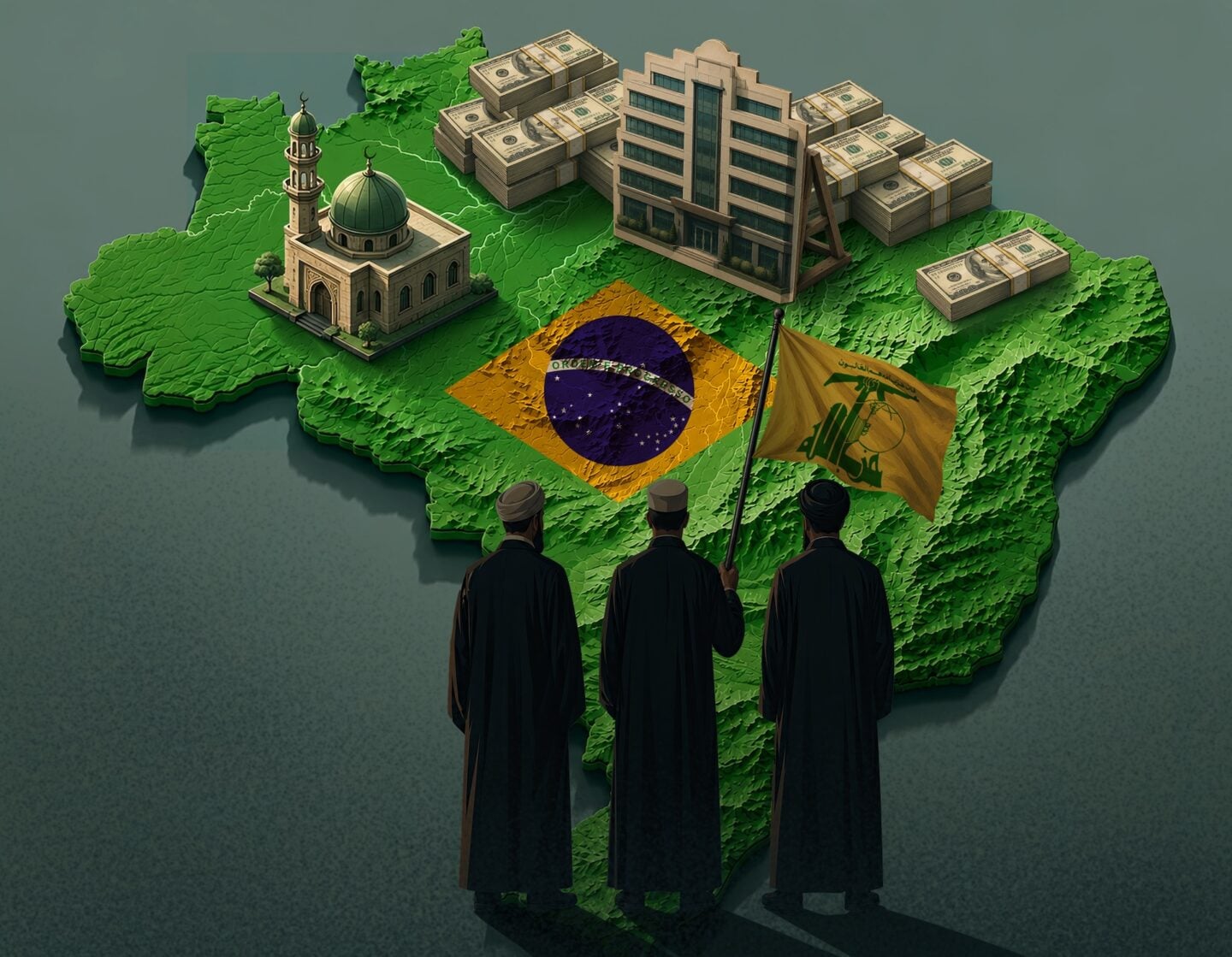

The rapid expansion of Brazil’s major criminal organizations — particularly the recently U.S.-designated Foreign Terrorist Organizations Primeiro Comando da Capital (PCC) and Comando Vermelho (Red Command) — is driving them to collaborate with actors linked to Middle Eastern terrorism, including Lebanon’s Hezbollah. Fueled by billions of dollars in proceeds from drug trafficking and other illicit activities, these groups increasingly rely on sophisticated international schemes to move and launder money, undermining regional security and posing a threat across the hemisphere.
Underscoring the scale of this challenge, on July 15, Brazil’s Federal Police launched Operation Hawala, a major investigation that led to the arrest of 10 individuals and the indictment of 12 others.
Operation Hawala targets an international network that reportedly laundered 100 million Brazilian Reais (nearly $20 million) over a three-year period on behalf of Brazil’s three largest crime syndicates: the PCC, the Red Command, and the Terceiro Comando Puro (Third Pure Command). Although the investigation remains in its early stages, authorities are already pursuing links to both Al Qaeda and Hezbollah.
They have good reasons: Hezbollah’s track record as a financial intermediary for organized crime has been well documented. Among the 22 indicted individuals in Operation Hawala are seven Lebanese nationals, all members of Brazil’s Shi’a Lebanese community, who ran a vast network of front companies to launder criminal proceeds on their clients’ behalf. According to reports, the Lebanese businesspeople implicated are believed to be responsible for expanding the interstate and international flow of illicit funds, using cutouts in the Tri-Border Area (TBA) of Argentina, Brazil, and Paraguay — a haven for illicit finance, home to a large Lebanese community, and historically a hub of Hezbollah’s terror finance.
While it is too early to confirm a Hezbollah connection, Brazil is central to Hezbollah’s Latin America strategy and poses a significant challenge to regional security precisely because of the working relationships Hezbollah has, over the years, established with crime syndicates across Latin America.
Evidence of how significant Brazil is for Hezbollah abounds. Brazil, for almost 30 years, has been the permanent seat of Hezbollah’s regional representative.
The first known Hezbollah cleric to permanently reside in Brazil was the late Sheikh Ali Abou Raya, who served as Imam of the Mohamad Messenger of God Mosque, popularly known as Mesquita do Bras, after the São Paulo neighborhood where it is located. Abou Raya worked for Hezbollah’s Foreign Relations Department (FRD), and also served in Canada and Belgium, before and after his time in Brazil. His affiliation with Hezbollah emerged after he was killed in an Israeli strike in Southern Lebanon on September 23, 2024, alongside other Hezbollah clerics.
His successor, Sheikh Bilal Mohsen Wehbe, was another member of Hezbollah’s FRD. In 2010, the U.S. Department of Treasury named Wehbe as “Hizballah’s chief representative in South America” and sanctioned him. Those sanctions, however, had little visible impact in Brazil. Wehbe continued to openly lead his community until 2019, when he returned to Lebanon.
Wehbe’s successor and current place holder, Sheikh Badri Abdul Menhem Mouawia, also known as Sheikh Badri Zeineddine, is also a Hezbollah cleric. According to leaked files accessed through the risk intelligence platform, 240 Analytics (for which the author serves as a senior advisor), Sheikh Mouawia maintains three U.S. dollar-denominated bank accounts at Al Qard al Hassan, a Hezbollah-controlled, U.S. sanctioned financial institution. During his time in Lebanon, the sheikh worked at the Maaref Al Hikmiya Institute, a cultural institution associated with Hezbollah, where he served as the editor of the institute’s journal, Al Mahajjah.
He moved to Brazil in 2024, on a temporary visa sponsored by the Islamic Religious Charitable Association of Brazil (Asociaçao Religiosa Beneficente Islamica do Brasil – ARBIB), the organization that runs Mesquita do Bras. According to a Brazilian government official familiar with his immigration status, he was granted permanent residency in April 2026. Like Sheikh Abou Raya, Sheikh Mouawia was previously affiliated with the Imam Al Rida Center, a Shi’a Mosque and cultural center in Brussels, Belgium.
Taken together, over nearly three decades, these successive appointments suggest that Hezbollah has consistently chosen São Paulo as the base for its envoys in charge of Latin America. They presided over a community with strong familial ties and deep emotional links to Hezbollah and its worldview. The São Paulo mosque is a hub for activities that closely resemble Hezbollah’s resistance society in Lebanon: the ecosystem includes a school, a scouts’ movement, a cultural association in charge of events and publications, which all align, through their educational, religious, cultural, and political activities, with Hezbollah’s worldview.
Close family ties with Hezbollah that inextricably link local Brazilian families with Hezbollah members back in Lebanon are also evident. One example is Hassan Ali Gharib, president of the Mesquita do Bras, whose extended family includes individuals who have fought and died for Hezbollah. Among them was his nephew, Mohamad Jawad Mohsen Gharib.
The young Gharib migrated to Brazil as a teenager. Official records show that in 2011, at the age of 20, Brazilian authorities recognized his Lebanese high school diploma. For many years, he was a scout leader at his uncle’s mosque in São Paulo, before rejoining Hezbollah’s military ranks following the escalation of hostilities between Israel and Hezbollah after October 2023.
According to social media posts published by family members, his decision to return was influenced by the death of another relative and Hezbollah commander, Mehdi Nasrallah Gharib, who was killed by Israel in December 2024, according to Hezbollah martyrdom announcements accessed through the 240 Analytics platform. On May 6, 2026, Mohamad Jawad was also killed in action and entered Hezbollah’s pantheon of martyrs. His funeral in Chaqra, Lebanon, was attended by his uncle, Hassan Gharib, the mosque president, who appeared in video footage wearing a Hezbollah scarf while accompanying his nephew’s coffin. The Instagram reel, no longer publicly available, remains in the author’s possession.
Hassan Gharib’s pro-Hezbollah sentiment is no secret. Gharib has publicly expressed admiration for Hezbollah’s late leader, Hassan Nasrallah. During an event held at the São Paulo Parliamentary Assembly in November 2024, he eulogized Nasrallah, describing him as “the man of the century” and “the symbol of justice in the 21st century.”
The mosque he presides regularly celebrates May 25, marking Israel’s withdrawal from South Lebanon in 2000, as “a day of resistance and freedom”, rather than Lebanon’s Independence Day. The Mosque also regularly marks the anniversary of the death of the founder of the Islamic revolution in Iran, Imam Khomeini. In May 2024, the Mosque held a commemoration for the death of Iran’s president Ebrahim Raisi. In the past year, it has commemorated Hezbollah’s leaders, Hassan Nasrallah, Hicham Safieddine, and Ali Abou Raya, as well as the late Supreme Leader, Ali Khamenei. The Mosque has also advertised travel packages for those wishing to attend Iran’s Supreme Leader, Ali Khamenei’s funeral in Tehran.
The mosque’s youth activities have also drawn attention. Its Al Huda Scouts resemble Hezbollah’s Al Mahdi Scouts as an incubator of loyal support among the youth. In May 2026, the group affectionately commemorated Mohamad Jawad Mohsen Gharib, the late scout’s leader and Hezbollah martyr. In September 2025, the Al Huda Scouts held a Taklif Shara’i ceremony, a religious rite of passage routinely held across southern Lebanon for Hezbollah girl scouts that, according to researcher Sofia Maria Tagliabue, who studies Hezbollah’s social and youth programs, marks the first time girls, typically 8 or 9 years old, celebrate “the first time they wear the hijab, the veil, as a symbol of deeper religious commitment and the approach of adulthood.”
The ecosystem presided over by Gharib and Sheikh Mouawia serves a community with close familial ties to Hezbollah. Prominent Hezbollah figures have next of kin living in Brazil and attending Mesquita do Bras. The brother of FRD’s leader Sheikh Khalil Rizk lives in São Paulo, as does the brother of Mohamad Youssef Mansour, a Hezbollah terrorist incarcerated in Egypt between 2008 and 2011 for plotting to carry out a terror attack in the Sinai Peninsula.
Relatives of Khaled Mohamad Kassem, a key planner of the 1994 AMIA bombing in Buenos Aires, are also community members. Kassem’s case is not an anomaly. Other individuals based in Brazil, who oversaw logistics and finance in the runup to the AMIA bombing, continue to live in Brazil.
Social media also reveal the close family and emotional ties linking members of the community to Hezbollah. Since October 2023, much like the case of the mosque’s president, Gharib, numerous community members have publicly mourned Hezbollah fighters killed in combat, congratulating them on their martyrdom. The frequency of these announcements illustrates the extent of connectivity between segments of the community in Brazil and the terror organization in Lebanon.
Communal institutions also routinely engage in pro-Hezbollah and pro-Iranian regime soft power campaigns. Channeling broad support for the Iranian regime and Hezbollah among their members, they devote time and resources not only into activities designed to mobilize the community and indoctrinate its youth but also to outreach and to building relationships with like-minded organizations and social influencers.
More recently, Mesquita do Bras hosted Thiago Ávila, a prominent member of the Global Summud Flotilla, as a featured guest speaker at the mosque during its Ashura ceremonies. The mosque also routinely organizes Al Quds Day events, while one of its cultural branches, Islam Brasil, has a dedicated page to promote Al Quds Day narratives.
The broader Hezbollah network in Brazil is not limited to fundraising within the local Lebanese Shi’a, indoctrinating its youth, and publicly championing Hezbollah’s cause. Community members have been actively engaged in terrorism and terror finance over decades.
As early as 2004 and 2006, the U.S. Department of Treasury sanctioned several Hezbollah financiers based in the TBA, all of them dual Lebanese-Brazilian nationals. Those who, 20 years later, are still alive, have mostly remained and continue to live in Brazil. Between 2016 and 2023, U.S. authorities successfully extradited and prosecuted Lebanese money exchangers, also from the TBA, whom they identified as Hezbollah facilitators.
Then, in late 2023, tipped off by U.S. authorities, Brazilian law enforcement launched Operation Trapiche, uncovering a Hezbollah plot to direct Brazilian nationals to carry out terror attacks against Jewish targets in Brasilia, the nation’s capital. The plot’s principal suspects, two Brazilian nationals of Lebanese descent, also with close ties to Mesquita do Bras, are believed to have recruited local Brazilians to travel to Lebanon where Hezbollah handlers provided them guidance, training, and funding for the terror attack planned in Brazil. One of the Lebanese nationals indicted in Operation Hawala is also a relative of the individual believed to have masterminded the Hezbollah plot uncovered during Operation Trapiche.
Brazil thus remains an important hub for Hezbollah’s activities in the Western Hemisphere, including fundraising, youth indoctrination, soft power outreach to the broader society, building of alliances with radical NGOs and influencers, as well as terrorism and terror finance.
For Brazil, this presents a significant challenge that extends beyond the size of Hezbollah’s footprint in the country. Brazil has not designated Hezbollah as a terrorist organization, limiting the extent to which its law enforcement and intelligence agencies can disrupt terror networks operating through the country. There are multiple reasons for this: like other countries in the region, Brazil traditionally defers to United Nations terrorist designations, rather than making its own, autonomous stipulations. There are political reticence and bureaucratic pushback regarding Hezbollah’s label as a terrorist group.
Brazil’s visa policies and the ease of travel for Brazilian passport holders also create opportunities that Hezbollah facilitators have exploited over the years. Trade-based money laundering schemes continue to flow from front companies overseas to Brazil and the TBA, sometimes relying on intermediary companies to facilitate illicit financial flows.
Policy precedent, political reticence, and a generous immigration policy should not distract Brazilian authorities from what the terror-crime convergence represents for Brazil: a first-order national security threat. Terror finance networks not only facilitating organized crime — as the Hawala case shows — but also generate revenue for their own nefarious purposes — as the Trapiche investigation illustrates.
This requires a coordinated, multi-front strategy. First, a domestic sanctions architecture rooted in legislation would strengthen Brazilian institutions, such as its Conselho de Controle de Atividades Financeiras (COAF, Brazil’s financial intelligence unit) and enhance their ability to combat money laundering and terror finance by publicly identifying key nodes in Hezbollah’s financial networks. Brazil could look to the Argentine precedent: In 2019, Argentina created the Public Registry of Persons and Entities Linked to Acts of Terrorism and Its Financing (REPET). The reform was modeled on the U.S. Department of Treasury’s sanctions authorities administered by the Office of Assets Control (OFAC). Such instruments, combined with a Hezbollah terror designation, could strengthen the state’s ability to disrupt a key component of the terror-crime nexus in Brazil and reduce crime syndicates’ ability to launder ill-gotten gains.
Next, increased investment into investigations and sharing of critical intelligence with Brazil’s law enforcement partners would help disrupt Hezbollah cells and their operations. The 2023 Hezbollah plot in Brasilia began unraveling after U.S. authorities timely tipped off their Brazilian counterparts. Expanding Brazil’s focus on intelligence sharing with regional partners, including the United States, against terror finance networks would further enhance Brazil’s ability to disrupt Hezbollah’s financial malarkey. Immigration authorities in Brazil could also benefit from closer intelligence cooperation. Hezbollah figures have repeatedly exploited Brazil’s immigration system to enter the country. Better intelligence could enable authorities to deny or revoke visas.
Brazil must address Hezbollah’s presence on its own soil with renewed vigor, using all tools of statecraft to counter what is both an international terrorist organization and a transnational criminal threat. Confronting Hezbollah’s threat on its own soil would be a good place to start in weakening its regional network.
Dr. Emanuele Ottolenghi is a Senior Research Fellow at the Center for Research on Terrorist Financing (CENTEF) and a Senior Advisor to 240 Analytics. Views expressed in this article are his own.
Disclaimer: The views and opinions expressed in this article are those of the author. They do not necessarily reflect the official policy or position of any agency of the U.S. government, Diálogo magazine, or its members.