

The U.S. response to the earthquakes that struck Venezuela on June 24 represents one of Washington’s largest humanitarian and disaster relief operations. Led by the State Department’s Bureau of Disaster and Humanitarian Response (DHR) and carried out in close coordination with the Department of War and U.S. Southern Command (SOUTHCOM), the operation has combined search-and-rescue efforts, military logistics, and international coordination to save lives and support the long-term recovery in a country already grappling with years of economic and social crisis.
“The United States brings together capabilities that few countries in the world can match: strategic airlift, world-class logistics, emergency management experts, military support, humanitarian organizations, and strong public-private partnerships,” Mario Duarte, president and CEO of Project DYNAMO, a veteran-led nonprofit specializing in disaster response that is also operating in Venezuela following the earthquake, told Diálogo.
According to Duarte, one of the greatest strengths of the U.S. response is that it extends beyond government agencies. “It is a whole-of-society commitment in service of the community.” Alongside federal agencies, humanitarian organizations, faith-based groups, the Venezuelan diaspora, and private companies have helped rapidly mobilize emergency resources, relief supplies, and humanitarian assistance.
An integrated response architecture
The U.S. response began within hours of the earthquake with the activation of a task force dedicated to the Venezuelan crisis and the deployment of Disaster Assistance Response Teams (DART), responsible for assessing conditions on the ground, coordinating international assistance, and integrating the civilian and military resources mobilized by the United States.
DART teams serve as the central coordination mechanism for the mission. “They are essential because they bring organization to an inherently chaotic environment. They rapidly assess conditions on the ground, coordinate activities with host-nation authorities, synchronize U.S. government resources, and integrate the entire humanitarian response,” Duarte said. “Effective coordination is just as important as the aid itself.”
As part of that structure, SOUTHCOM established a Humanitarian Assistance Coordination Center (HACC) at Simón Bolívar International Airport to coordinate U.S. military support alongside the State Department, Venezuelan authorities, allied nations, and other organizations participating in the international relief effort.
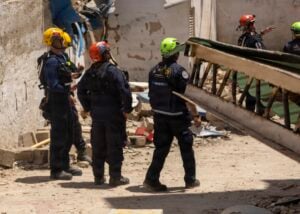
Working alongside the DART teams are Urban Search and Rescue (USAR) teams. Deployed from Fairfax County, Los Angeles County, Miami-Dade County, and the City of Miami, these teams bring together firefighters, physicians, structural engineers, and specialized canine units. After participating in the initial search-and-rescue operations, they continue to support structural assessments, emergency medical care, hazard identification, and other essential tasks throughout the humanitarian response and recovery.
“We inspect buildings and assess the presence of survivors using the tools available to us. If we identify people who are still alive, we bring in the teams responsible for the more complex operations needed to reach them and extract them from the rubble,” Los Angeles County Fire Department Captain Mike Carolan told Fox News.
The effectiveness of these teams depends on the sophisticated logistical network provided by SOUTHCOM, which links the civilian planning led by the State Department with the air, ground, and maritime capabilities deployed in the field. C-17 Globemaster III and C-130H Hercules aircraft have transported personnel and equipment, while MV-22 Osprey aircraft and CH-47 Chinook, UH-1Y Venom, and UH/MH-60 Black Hawk helicopters have supported medical evacuations, transported rescue personnel, and delivered critical supplies. Meanwhile, the U.S. Space Force has provided satellite imagery to assess damage and identify the hardest-hit areas.
To sustain that logistical bridge, SOUTHCOM also deployed a U.S. Marine Corps Logistics company equipped with transport trucks, off-road vehicles, and military ambulances, while establishing a Forward Arming and Refueling Point (FARP) at Simón Bolívar International Airport to accelerate helicopter operations supporting medical evacuations, personnel transport, and heavy-lift missions.
One notable example of this coordination was the rescue of a mother and her nine-month-old baby, who were pulled alive from the rubble four days after the earthquake during a joint operation involving U.S. and Venezuelan rescuers. The mission succeeded through the integration of information provided by local residents, canine teams, search technologies, and coordination among multiple agencies, demonstrating that the true value of the DART teams lies in their ability to combine information, resources, and expertise into a unified and effective response.
Restoring critical infrastructure
Beyond saving lives, one of the top priorities in the days immediately following the earthquake was restoring the strategic infrastructure needed to sustain the humanitarian operation. One example was Simón Bolívar International Airport in Caracas, where U.S. support helped restore operations and facilitate the arrival of international aid. Working alongside Venezuelan authorities, the U.S. Air Force deployed a Contingency Response Element (CRE) specializing in expeditionary airfield management to support air traffic control operations, coordinate humanitarian flights, and ensure the efficient reception and unloading of relief supplies.
“Venezuela faces challenges that go well beyond the earthquake itself,” Duarte said. “Damaged infrastructure, limited communications, logistical constraints, and the complexity of the operating environment made relief operations particularly difficult.”
The same approach was applied to the Port of La Guaira, a key gateway for humanitarian assistance entering the country. U.S. military personnel and technical specialists worked alongside Venezuelan authorities to assess port conditions and accelerate its reopening. At the same time, the USS Fort Lauderdale became an additional hub for communications, logistics distribution, and medical support, while the USS Billings expanded the operation’s rotary-wing capabilities to transport aid and supplies to hard-to-reach communities.
These operations highlighted several of the United States’’core disaster-response capabilities: rapid infrastructure assessment, civil-military coordination, the simultaneous management of air and maritime logistics corridors, and the use of advanced technologies to support operational planning.
From emergency response to recovery
As the response has gradually shifted from rescue operations to humanitarian assistance, attention has increasingly focused on the medium- and long-term needs of a population that was already vulnerable before the earthquake.
According to Leonardo Coutinho, director of the Washington-based Center for a Secure Free Society (SFS), international support will be essential to Venezuela’s recovery. “Had Venezuela remained isolated and closed off as it was in the past, this tragedy would likely have reached even more devastating proportions,” he told Diálogo.
Washington has mobilized more than $300 million to fund emergency medical care, food assistance, drinking water, sanitation services, temporary shelters, protection for displaced people, and logistical support. The funding is being administered through a network of international and nongovernmental organizations, including the World Food Programme (WFP), International Medical Corps, Project Hope, and the International Red Cross. A significant portion of the funding is also being channeled through the humanitarian fund managed by the United Nations Office for the Coordination of Humanitarian Affairs (OCHA).
According to the State Department, U.S. military operations in Venezuela are entirely self-sustaining and do not rely on local resources, allowing available infrastructure to remain focused on assisting the affected population.
“Several allied countries in the region are also contributing. The scale of assistance provided by El Salvador is particularly noteworthy, as is the support coming from Mexico,” Coutinho concluded.
Rebuilding will take years, but the reopening of strategic infrastructure, the steady flow of humanitarian assistance, and the cooperation between Venezuelan authorities and international partners are already helping lay the foundation for recovery and strengthening the resilience of affected communities.