

Over the past several decades, security in Latin America and the Caribbean has seen both progress and setbacks in the face of increasingly sophisticated threats. While some countries have made significant progress in reducing violence, others continue to face the expansion of illicit economies and transnational criminal organizations.
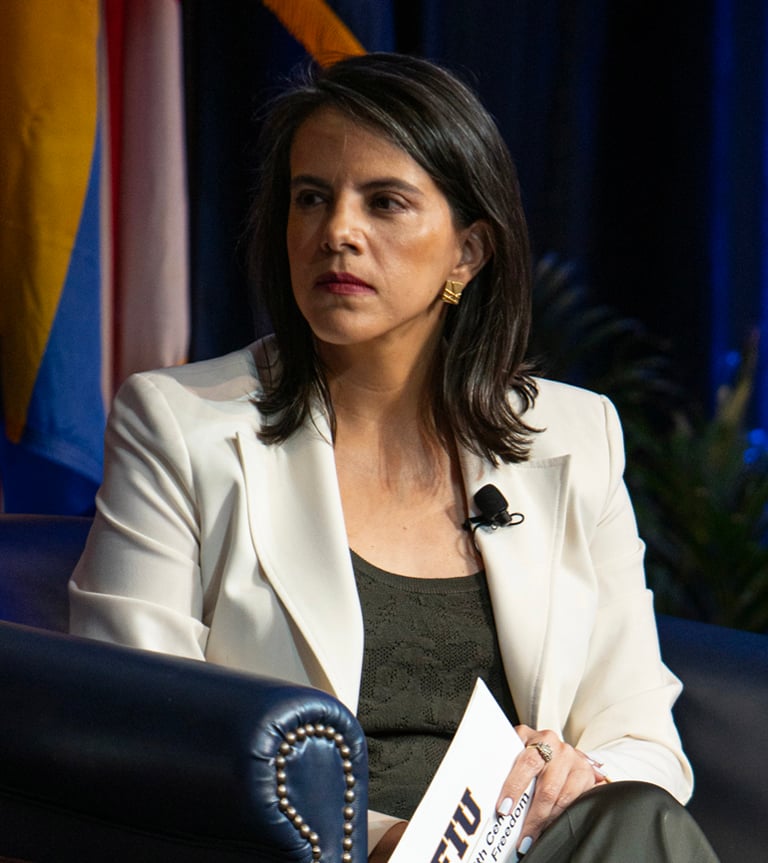
In an exclusive interview with Diálogo, former Minister of Defense of Colombia and former Ambassador to Washington Juan Carlos Pinzón argues that the challenge extends beyond the evolution of organized crime itself. The central problem, he says, is that these organizations have expanded beyond illicit markets, increasing their influence over governance, institutions, and regional security.
According to Pinzón, the diversification of illicit economies, the involvement of extra-regional actors, the growing use of new technologies, and policies that have allowed criminal organizations to expand have made security an increasingly complex challenge that transcends national borders and requires coordinated regional responses.
Diálogo: Over the past several decades, Latin America has experienced recurring cycles of progress and setbacks in security. Why has the region struggled to sustain long-term security gains, and what structural factors continue to drive instability?
Juan Carlos Pinzón, former minister of Defense of Colombia: There is one factor we cannot underestimate: Organized crime has infiltrated politics. We have seen political sectors that have either justified criminal activity or simply chosen not to confront it.
Countries that confronted organized crime and terrorism decisively — such as Colombia through programs like Plan Colombia, which was sustained across nearly four presidential administrations — made significant progress. Violence declined, security improved, and investment increased. In Colombia’s case, those were years of sustained economic and social progress.
Unfortunately, the same pattern eventually reemerged. At some point, politics took precedence, and it was decided that granting concessions to criminal organizations was a better approach. I have no doubt there was genuine hope that it would work, but the reality is that it did not.
Criminal groups took advantage of those circumstances to rebuild and strengthen themselves.
And when a country like Colombia, because of its size and geographic location, enters a period of deterioration, the consequences are severe. Ecuador is deeply affected. It also creates serious problems in relation to Venezuela, projects criminal activity into Brazil and Argentina, and undoubtedly impacts the Caribbean and Central America.
Diálogo: Fragmented gangs have evolved into sophisticated transnational criminal organizations. Groups such as the Tren de Aragua, which emerged from the prison system, have expanded across multiple countries in less than a decade. What conditions in Latin America have enabled such rapid growth and cross-border expansion?
Pinzón: The complicity and alliances between politics and, if you will, an ideological vision aimed at steering Latin America and several of its countries toward old-style neo-Marxism — now supported by criminal organizations — have facilitated this phenomenon.
But there is also no doubt that problems cannot be solved with a single tool.
In Colombia, when confronting organized crime and terrorism, we used the Armed Forces very effectively. They were successful in their mission to confront armed groups. However, the rest of the state never arrived with the same speed to provide education, infrastructure, roads, healthcare, justice, and effective governance.
That absence of the state has allowed these organizations to reestablish and maintain their control. It is no longer just territorial control by armed groups; in many cases, it has become social control over communities — the ability to dominate people’s lives and subject them to constant extortion.
Diálogo: As transnational criminal organizations continue to multiply across the region, tracking the evolution of their operations and influence has become increasingly difficult. What emerging trends or types of organizations do you believe pose the greatest long-term strategic threat to the region, and why?
Pinzón: I know I’ve touched on this before, but I want to emphasize it again. The combination of political sectors that tolerate or justify organized crime, together with criminal organizations that finance and support those political actors, represents a real threat to stability and democracy.
This is leading to governments that, in some cases, come to power under criminal influence and then work from within to dismantle institutions, weaken them, and often impose socialist models that have failed everywhere they have been tried, leaving countries even poorer.
Of course, illegal economies finance all of this. Drug trafficking remains a major problem, but more recently illegal mining has also become a significant source of revenue. I have always been especially concerned about money laundering associated with these activities because it infiltrates not only politics but also legitimate sectors of the economy, creating illicit financial networks that are extremely difficult to manage.
Diálogo: What role do extra-regional criminal organizations play in Latin America’s security environment? How do you assess the growing presence of Chinese criminal networks and their influence on the expansion of illicit economies in the region?
Pinzón: This is a very concerning issue because many countries have not confronted transnational crime with the same determination they apply to crime within their own borders.
Take China, for example. China places great importance on its domestic security and acts decisively at home. Yet internationally, it has, in a sense, turned a blind eye to money laundering — that is, the purchase of assets with proceeds from drug trafficking and other criminal activities — as well as to the sale of chemical precursors that are ultimately essential for narcotics production.
One would hope for stronger cooperation, but today that cooperation does not exist. On the contrary, this has become a destabilizing factor.
At the other end of the spectrum is Iran and its proxies, such as Hezbollah and Hamas, which in one way or another have found sources of financing in Latin America’s criminal economies.
These issues must therefore be analyzed through a broader geopolitical lens. Critical minerals, for example, are far from a minor issue. Today, geopolitical competition is shaped to a large extent by the ability to produce advanced technologies in energy, computing, and other strategic sectors, and critical minerals are essential to that effort. This also represents an opportunity for Latin America.
However, much of that extraction is often carried out illegally, benefiting extra-regional actors that are not promoting stronger institutions or more beneficial development for the region.
Diálogo: As transnational criminal organizations have expanded beyond a single illicit activity to operate simultaneously in drug trafficking, illegal mining, human trafficking, extortion, arms trafficking, and financial crimes, how does this convergence of illicit economies change the way states should understand and confront organized crime?
Pinzón: If states do not align their efforts, work together, and establish clear red lines against organized crime, criminal organizations will continue to exploit what happens on one side of a border or another. That is why strong regional policies are essential.
I believe the Americas Shield initiative has the potential to become an operational tool. I think it was a good initiative by the U.S. government, and several countries have joined it.
Diálogo: Criminal organizations are increasingly combining territorial control with cyber capabilities, encrypted communications, cryptocurrencies, fraud schemes, and transnational financial networks. To what extent has this evolution transformed the security environment in Latin America? Given these increasingly complex threats, do you believe governments and security institutions are adapting quickly enough and coordinating effectively?
Pinzón: Technology is always a tremendous opportunity. Personally, I believe that if states make the right investments in security — and, more broadly, in technological development — they can always find solutions.
In Colombia, speaking from my own experience, even during my time as minister, my greatest priority was acquiring cutting-edge technology. It made a tremendous difference in intelligence, precision strikes, the application of force, locating the enemy, and protecting the population.
Technology evolves rapidly, especially in the cyber domain. One issue that has become particularly important — and a serious challenge for Colombia — is the use of drones. Technology is now available to everyone, and if states fail to adopt it, criminal organizations will.
We are also seeing money laundering evolve through increasingly sophisticated financial markets that should be engines of social development but are instead being exploited by drug traffickers and organized crime.
Cyberspace remains a global challenge. Cybercrime and cyberattacks — including those carried out by states as instruments of warfare — have become an increasingly serious threat. We see, for example, Russia’s use of social media to influence electoral processes.
And finally, there is the issue of drones. At the tactical level in Colombia, they have given criminal organizations an advantage on the battlefield and, in some cases, a degree of air superiority over state forces. These are challenges that governments must address urgently.
Diálogo: Beyond violence itself, organized crime is increasingly undermining public trust in institutions, governance, and the rule of law. How serious is this erosion of institutional legitimacy across Latin America, and what long-term risks does it pose for democratic stability?
Pinzón: It is extremely serious. Years ago, Vanderbilt University conducted studies measuring public confidence in democracy. Looking at the results over time, you see a steady decline in citizens’ trust in democratic institutions.
Much of this is linked to the perception of corruption as a permanent feature of both traditional politics and these newer forms of collusion between organized crime and political actors. This has become a factor that increasingly calls into question the stability of democratic institutions.
Even more concerning is the growing evidence that societies and communities are becoming deeply frustrated with the current model of governance.
Diálogo: Cooperation among state institutions is often cited as essential for achieving concrete results against organized crime. Based on your experience, how critical is interagency coordination to effectively confronting these criminal organizations?
Pinzón: It is essential. In the 1990s, a theory emerged about ungoverned spaces. The idea is that whenever a territory lacks governance, someone will eventually fill that vacuum — whether it is the state or a criminal organization.
The only way to reclaim those spaces is through the presence of armed forces that stabilize the territory, provide security, eliminate threats, and protect the population. But the key question is how to ensure those ungoverned spaces become genuinely governed. That is where civilian institutions responsible for infrastructure, justice, education, healthcare, and other public services must establish a sustained presence.
Colombia illustrates this well. Its Armed Forces have historically been highly successful when properly equipped and led, defeating armed threats. But in many cases, the rest of the state never followed.
And when that happens, again using Colombia as an example, the problems not only return — they become even more deeply rooted, and public distrust of institutions grows.
Diálogo: Colombia has long been recognized both for the scale of its security challenges and for its sustained efforts to confront them, including through close bilateral cooperation with the United States. Based on your experience as Minister of Defense, how important has that partnership been to Colombia’s security gains, and what lessons from Colombia’s experience could benefit other countries facing transnational criminal threats and governance challenges?
Pinzón: Colombia’s strategic partnership with the United States was extraordinary. It operated on many levels — not only in security, justice, and intelligence, but also in economic and social development.
We signed a free trade agreement that facilitated investment and trade between our two countries. We also adopted standards that strengthened environmental protection and human rights.
Overall, the relationship has been very positive. Looking ahead, I envision an even stronger strategic partnership between Colombia and the United States — not only in security, intelligence, and justice, which must remain robust, but also in discussions about critical minerals, technology transfer, expanded trade and investment, and education, where countries like Colombia can benefit greatly from the U.S. educational system to strengthen their workforce.
There is still much to build on and many positive lessons to draw from this partnership. From a security perspective, it was extraordinary. Colombia strengthened not only its intelligence capabilities, but also its air mobility and special operations forces, opening the door to a broader global outlook.
During that period, we succeeded in making Colombia a global partner of NATO, and the country reached its highest level of engagement as a major non-NATO strategic partner, representing the strongest point in the bilateral relationship.