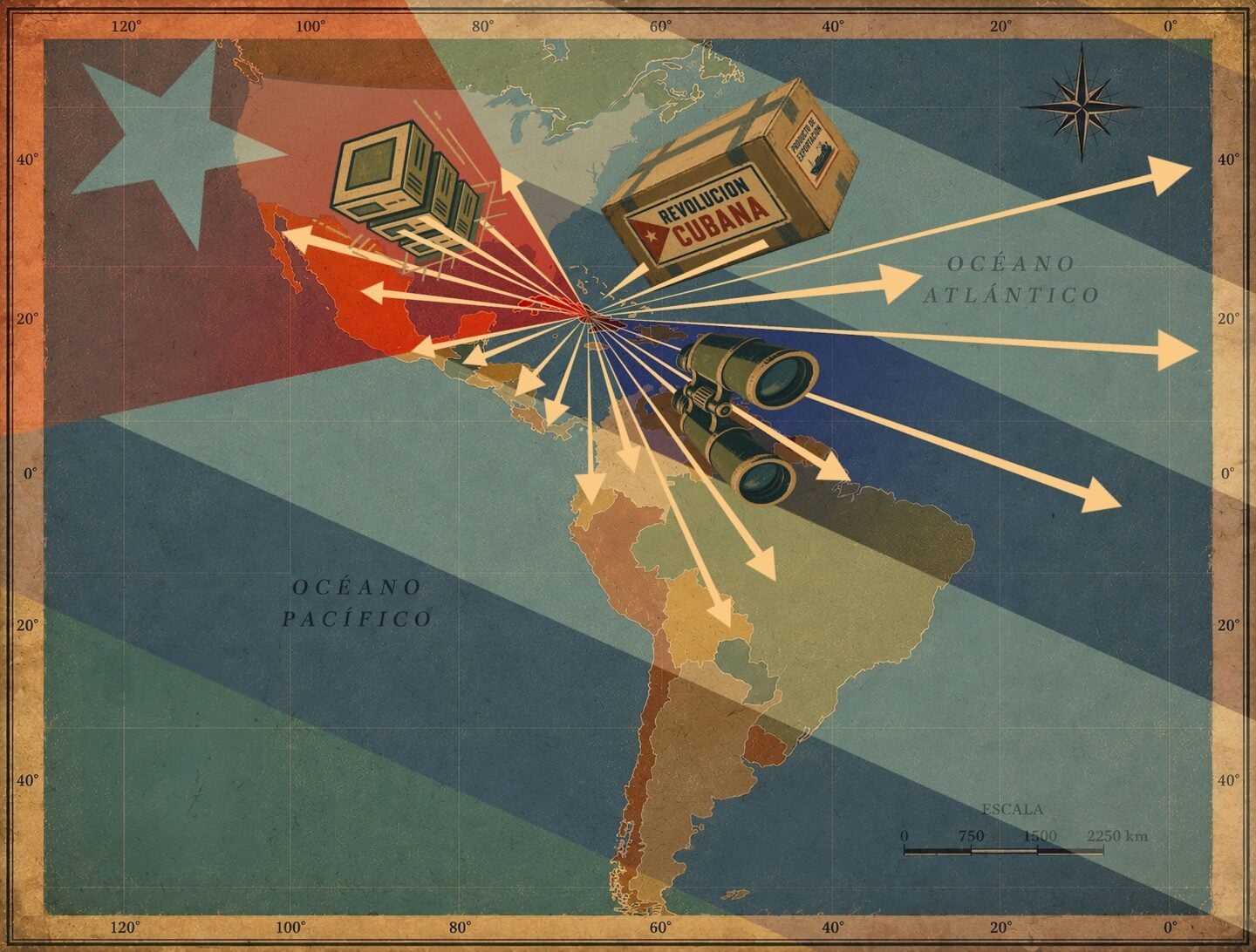

The death in June 2026 of Ramiro Valdés Menéndez, one of the principal architects of Cuba’s intelligence and internal security apparatus, marked the passing of one of the last historic figures associated with the security structures created after Fidel Castro came to power on January 1, 1959. For nearly seven decades, Cuba’s effort to export its revolution have provided the ideological foundation for a security model that spread across Latin America, based on the integration of civilian and military institutions, preventive counterintelligence, political control of the armed forces, and population surveillance.
According to Cuban political analyst José Manuel González Rubines, co-director of CubaXCuba, a U.S.-based research center focused on Cuba, in the countries that adopted this model — partly inspired by the Soviet KGB and East Germany’s Stasi — “the intelligence service stops gathering intelligence to protect the state from external or internal threats and instead begins spying on its own cadres, protecting the ruling elite and turning the state into a kind of private property of those who govern it.”
Havana’s objective has been twofold: to help ensure the survival of allied governments while building a network of politically aligned states and actors capable of supporting Cuba diplomatically, economically, and geopolitically.
According to a report published by the U.S. Department of State in July, “Cubans trained and armed tens of thousands of leftist guerrillas, supervised violent insurgencies that spread chaos across multiple continents, and backed bloody extremist attacks throughout the United States.”
However, amid the weakening of some of its traditional allies and a deep domestic economic crisis, Havana has gradually adapted its tools of influence. Today, that influence is increasingly projected through a combination of information operations, political diplomacy, transnational networks, institutional relationships, and digital influence campaigns.
Intelligence as a tool of regional influence
For a country with limited economic resources and modest conventional military capabilities, intelligence became a force multiplier. Through the General Directorate of Intelligence (DGI) — later renamed the Directorate of Intelligence (DI) — and the counterintelligence bodies of the Ministry of the Interior, Havana spent decades building relationships with political leaders, military officers, and security officials across Latin America, giving the island regional influence far beyond its economic weight.
Cuba also exported security models, counterintelligence techniques, and methods of social control that transferred elements of its domestic security system to the institutions of allied countries.
“It is a system of intervention with low costs and high returns. It doesn’t require aircraft carriers, it doesn’t require Cuba to have military bases — it simply requires trained cadres, procedures, and methods,” Rubines told Diálogo.
One of the historical pillars of this system has been the Committees for the Defense of the Revolution (CDR), a nationwide neighborhood network for political mobilization and local surveillance. As internet access and mobile communications expanded, that monitoring capability also extended into the digital sphere.
A January 2026 report by the human rights organization Prisoners Defenders, based on testimony from 200 individuals, found that 88 percent said Cuban authorities had referred to their online posts or digital communications during questioning, detentions, interrogations, or other proceedings. Nearly half reported that private messaging communications had been intercepted and later used by authorities.
“The Cuban model is not designed to repress crowds, but rather to prevent crowds from forming. It is a system focused more on the individual than on the act. The objective is not to punish behavior, but to disconnect a person from their social ties by using mechanisms such as rumors, slander, suspicions of infiltration, and the breakdown of trust within the group, ultimately pushing people into exile,” Rubines said.
The export of this model found one of its clearest examples in Nicaragua. After the Sandinista National Liberation Front came to power in 1979, Cuban advisers helped build the country’s new state security institutions.
When Daniel Ortega returned to power in 2007, cooperation with Havana once again centered on intelligence, counterintelligence, and internal security. Investigative reporting and testimony from former Nicaraguan military officers have pointed to the presence of Cuban advisers within institutions such as the National Police, immigration, customs, and the prison system. According to those sources, that role expanded after the 2018 protests, whose repression left hundreds dead.
Venezuela also served for more than two decades as one of the principal pillars of Cuba’s regional security projection. Reports by international organizations and testimony from former officials documented the involvement of Cuban advisers in intelligence and counterintelligence. Following the arrest of Nicolás Maduro in early 2026, that presence began to evolve, along with the longstanding security relationship between Caracas and Havana.
According to Rubines, this strategy has undermined democracy across the region by contributing to institutional erosion, restricting civil liberties, and entrenching authoritarian practices. “Beyond authoritarianism, this Cuban model creates locks that shut down institutional avenues, forcing pressure toward violence or exile,” he said.
Ironically, Cubans themselves have paid the highest price. For nearly seven decades, the regime devoted enormous resources to maintaining an extensive security and social control apparatus at the expense of economic development and improving living conditions for the population.
Hybrid warfare
Over the past 25 years, Havana has adapted the way it projects influence across the region. Support for armed movements, which characterized earlier periods, has gradually given way to a broader mix of political influence, diplomacy, professional missions, academic and cultural networks, state media, and digital campaigns.
“There has been a shift from the armed cadre to the legal political node. In other words, the guerrilla fighter has been replaced by the legislator, the labor union leader, the professor, and the solidarity organization,” Rubines explained.
Despite its economic and energy crisis, Havana continues to rely on an extensive transnational infrastructure to project influence throughout the region.
The Cuban Institute of Friendship with the Peoples (ICAP) is widely regarded as one of Cuba’s principal instruments of international influence. Founded by Fidel Castro in 1960, it officially promotes networks of “friendship” and “solidarity” with the island. Former Cuban intelligence officers have maintained that, although ICAP is not formally part of the Directorate of Intelligence, its international activities and relationships have historically been subject to close influence from Cuban intelligence services.
ICAP is currently headed by Fernando González Llort, one of the members of the Cuban spy network known as the Wasp Network, who was convicted in the United States for espionage-related activities.
A monitoring study by the Mexican think tank Government and Political Analysis (GAPAC), covering 71 events held across Latin America between March 1 and April 27, 2026, highlighted the Cuban regime’s ability to rapidly mobilize its international support networks during periods of pressure.
Mexico emerged as the network’s primary hub, while Colombia and Brazil stood out for the activity of political, professional, and solidarity networks linked to the island. Together, these networks combine advocacy campaigns, political initiatives, cultural exchanges, and educational programs to sustain international support for Havana while cultivating long-term ties with political leaders, professionals, organizations, and foreign officials.
The significance of this infrastructure lies not necessarily in any individual activity, but in its cumulative ability to amplify narratives, mobilize supporters, and generate political or material backing when Havana faces international pressure.
At the same time, Cuba uses a range of political and diplomatic forums to advance its interests. These include party networks such as the São Paulo Forum, political platforms such as the Puebla Group, and intergovernmental organizations such as the Bolivarian Alliance for the Peoples of Our America (ALBA). In broader regional forums, including the Community of Latin American and Caribbean States (CELAC), Havana seeks to promote favorable positions and counter its diplomatic isolation.
Information dominance also represents a key pillar of Cuba’s strategy. State media, digital platforms, and activist networks promote narratives favorable to Havana and its allies, including Russia, China, and Iran. At the same time, restrictions on independent journalism have forced much of the island’s critical reporting into exile.
“Cuba is the gateway for anti-Western actors,” Rubines said. According to the analyst, the island’s strategic value for countries such as Russia, China, and Iran lies in the influence networks, political relationships, and intelligence capabilities Havana has developed over decades, allowing them to expand their regional presence “without having to build their own structures from scratch.”
China’s expanding technological and infrastructure footprint in Cuba has also raised concerns about the potential use of facilities on the island to collect signals intelligence. Satellite imagery analysis and assessments by U.S. officials have identified expansions at sites with the potential to monitor communications and military activity across the region.
However, Rubines argues that the most enduring legacy of the Cuban system lies not only within Cuba itself, but in the security institutions, political networks, and methods of control that Havana helped build across Latin America over decades.
Ramiro Valdés’s death marks the end of the generation that designed that model. Yet the institutions, relationships, and mechanisms of influence built over nearly seven decades continue to shape events far beyond the island’s borders.