
Created in 2004 to promote Chinese language instruction and cultural exchange, Confucius Institutes have become one of the most visible instruments of China’s soft power. In 2009, Li Changchun, then a member of the Chinese Communist Party (CCP) Politburo, described them as “an important part of China’s overseas propaganda apparatus.”
In just over two decades, Confucius Institutes have expanded to hundreds of universities and schools in more than 160 countries. In Latin America, where the first Confucius Institute opened in Mexico in 2006, more than 40 are now operating. In recent years, however, growing concerns over Chinese influence, the limited transparency of these institutes, and potential national security risks have prompted numerous countries with strong academic traditions and well-established democratic institutions across North America, Europe, and Australia to progressively close these centers.
“A university is an institution rooted in a liberal tradition, founded on critical thinking and academic freedom. When an organization based on campus attempts to shape or constrain these principles, a structural conflict emerges,” Parsifal D’Sola Alvarado, director of the Colombia-based Andrés Bello Foundation, told Diálogo.
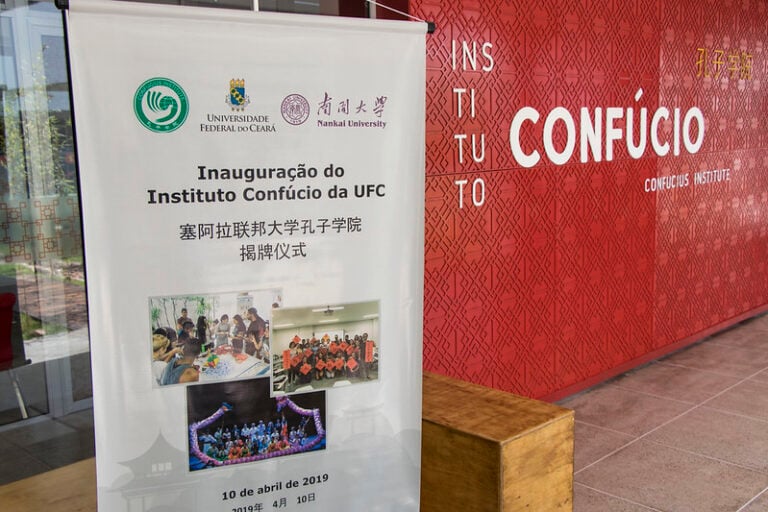
The gradual closure of Confucius Institutes across many countries is also prompting Latin America to reassess the role these centers play. The concerns stem not only from developments in other countries, but also from the way Confucius Institutes expanded throughout the region, closely linked to China’s growing strategic outreach and the advance of the Belt and Road Initiative. In countries such as Panama, El Salvador, and the Dominican Republic, the expansion of these cultural diplomacy initiatives took place during the same period that their governments switched diplomatic recognition from Taiwan to Beijing, reinforcing the role of these initiatives in building support for China and shaping public debate.
China’s influence apparatus
The overlap between cultural diplomacy and Beijing’s strategic interests has intensified debate over the risks these institutes may pose to university autonomy and the security of host countries. Unlike major Western cultural organizations, Confucius Institutes are overseen by entities directly linked to the Chinese state, which selects instructors and defines the curriculum.
Numerous experts have also pointed to links between the Confucius system and the United Front, the Chinese Communist Party body responsible for building consensus, gathering information, monitoring overseas Chinese communities, and identifying influential individuals to cultivate over the long term. “The goal is to advance the United Front agenda by making foreigners serve China,” wrote University of Canterbury sinologist Anne-Marie Brady.
According to experts, Confucius Institutes contribute to what is known as “elite capture.” Through funding, scholarships, exchange programs, and cooperation opportunities, they help build long-term networks of influence designed to discourage criticism of Beijing.
In Latin America, their expansion has found fertile ground in the limited financial resources of many public universities. According to D’Sola, however, the financial support offered by Beijing can become a source of dependency that facilitates control over academic programs and the censorship of topics considered sensitive by the Chinese government.
“There is solid evidence that Confucius Institutes have interfered with academic freedom at universities in several countries, particularly on issues that are sensitive to the Chinese Communist Party, such as Taiwan, Tiananmen, and human rights, among others,” D’Sola said.
The expert also warns about the close relationship between these institutes and Chinese embassies. Confucius Institutes do not operate in isolation, but rather form part of a broader Chinese influence strategy that combines diplomacy, media, academic cooperation, think tanks, exchange programs, and economic relations.
A significant example occurred in May, when the Chinese Embassy in Argentina, according to Infobae, pressured the University of Belgrano to cancel the presentation of a book critical of the Beijing government. “The logic of pressuring a university to cancel a panel is another step toward narrative control, and it also represents clear interference in another country aimed at restricting freedom of expression,” said the book’s author, Roberto Iglesias.
The withdrawal of Confucius Institutes
In light of these concerns, numerous countries that host some of the world’s most prestigious universities have concluded that the benefits offered by Confucius Institutes do not outweigh the risks to the autonomy of their host institutions. Eleven countries — the United States, Canada, Australia, France, Germany, Sweden, the Netherlands, Belgium, Denmark, Spain, and Switzerland — have closed some or all of their Confucius Institutes.
The United States represents the most significant case: Between 2010 and 2022, nearly all 118 Confucius Institutes operating in the country ceased operations. Sweden became the first European nation to eliminate both Confucius Institutes and Confucius Classrooms from primary and secondary schools. Australia also experienced a significant wave of closures; by 2025, six universities had either closed their Confucius Institutes or allowed their agreements to expire amid heightened scrutiny of foreign interference and the protection of academic freedom.
A particularly important point is that most of the universities involved did not discontinue Chinese language or cultural studies. Instead, they transferred these activities to structures under their direct control, replacing programs funded or supervised by Beijing with courses independently managed by the universities themselves to ensure greater academic autonomy, transparency, and freedom of inquiry.
For Latin America, this evolution offers an important lesson. If universities with greater resources, stronger oversight mechanisms, and a long tradition of academic independence identified significant problems with Confucius Institutes, countries across the region should also carefully examine the strategic implications of their presence. “The Chinese government exercises strong narrative control over its history and political reality, creating friction in environments where critical analysis is valued,” D’Sola said.
At a time when international competition increasingly revolves around influence, technology, information, and the development of future leaders, Confucius Institutes can shape public debate and gradually erode Latin American countries’ ability to make decisions free from external influence. If left unaddressed, this trend could enable China to expand its influence over institutions and the formation of future leadership elites, with potentially serious consequences for the region’s sovereignty and strategic autonomy.