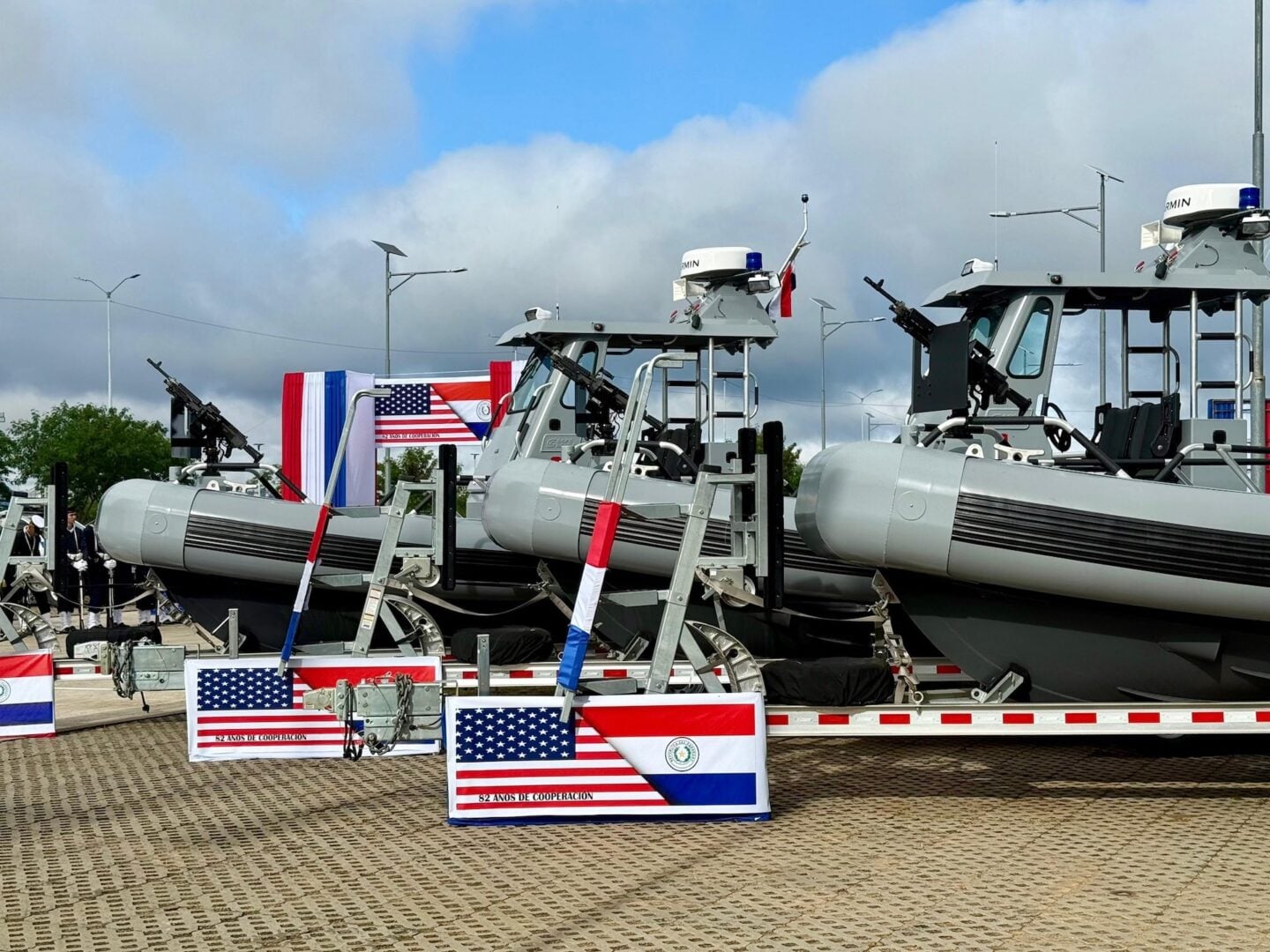

Paraguay and the United States strengthened their riverine security cooperation in April 2026 with the addition of eight new interceptor boats to the Paraguayan Navy, as part of a broader program designed to enhance surveillance, interdiction, and control along the Paraguay-Paraná Waterway. At the same time, Paraguay inaugurated a Command and Control Center to improve operational coordination along one of South America’s most important logistics corridors and a route increasingly exploited by transnational criminal organizations (TCOs).
The initiative responds to the growing use of the waterway by TCOs for drug trafficking, smuggling, arms trafficking, and other illicit activities, increasing the need to strengthen surveillance and the state’s response capabilities. The program also includes specialized training, technical assistance, and logistical support to ensure the operational sustainability of these new capabilities.
During the handover ceremony, Robert Alter, chargé d’affaires at the U.S. Embassy in Paraguay, said the program seeks to develop lasting capabilities to confront increasingly complex threats in riverine spaces.
Paraguay’s Minister of the Interior Enrique Riera Escudero underscored the strategic dimension of this cooperation. “Paraguay and the United States share a vision on regional security and the fight against organized crime, something as simple as understanding that security is the priority of any state. Strengthening capabilities to protect strategic infrastructure such as the waterway is a shared responsibility that contributes to hemispheric security,” he told Diálogo.
A strategic route under pressure
Paraguay has the third-largest commercial river fleet in the world, behind the United States and China. This position makes its rivers critical infrastructure for the national economy and regional integration.
Approximately 80 percent of Paraguay’s foreign trade moves through the Paraguay-Paraná Waterway, a network of more than 3,400 kilometers that connects Brazil, Bolivia, Paraguay, Argentina, and Uruguay and constitutes one of South America’s main logistics arteries.
“Paraguay’s river routes are the country’s gateway to and from the world. We are not talking only about strategic infrastructure, but about a system that is critical for development, competitiveness, and regional integration,” Lea Giménez, former chief of staff of the Presidency of Paraguay and an advisor on security and governance at the Development Bank of Latin America and the Caribbean (CAF), told Diálogo.
However, the growth of trade has also increased pressure on these corridors. Authorities have identified the use of river routes for drug trafficking, goods smuggling, the illegal transport of fuel and weapons, and other activities linked to transnational organized crime.
In 2024, Paraguay recorded record cocaine seizures, including the largest in its history: 4,013 kilograms hidden in a shipment of sugar bound for Belgium, in the so-called Operation Dulzura. The case exposed the use of river routes linked to the waterway within drug trafficking logistics chains bound for Europe.
“The main challenge is to consolidate the state’s presence and strengthen institutional capabilities without affecting the flow of legitimate trade,” Giménez said.
More capabilities to patrol and interdict
The new interceptor boats will expand surveillance coverage in strategic sectors of the waterway and improve response capabilities against illicit activities in hard-to-reach areas.
The initial investment exceeds $4 million and includes vessels, weapons, and specialized equipment. The full program, which includes new capabilities and logistical support, exceeds $12 million.
Together with the vessels, Paraguay put into operation a Command and Control Center that will consolidate information from river patrols, surveillance systems, drones, and ground units deployed along the main navigable corridors.
The goal is to reduce response times, improve coordination among units, and strengthen interdiction capabilities against criminal organizations operating on a transnational scale.
“The Naval Prefecture did not have the necessary capabilities to exercise effective control of the riverine space. The incorporation of these vessels, with more expected, the training of personnel, and the exchange of real-time information significantly strengthen surveillance and control operations,” Riera said.
The security impact also extends to the broader development of the national economy. “With greater control, smuggling becomes more difficult, and that encourages formalization. In an environment of low tax burden and high competitiveness, it is more convenient to operate through legal channels, and that has translated into increased revenue from formal trade,” Riera added.
Aerial surveillance and real-time monitoring
One of the program’s most relevant components is the incorporation of drone systems for aerial surveillance.
“Control of the riverine space was carried out with practically no aerial surveillance capabilities. The incorporation of drones allows us to monitor remote and hard-to-reach areas that were previously outside the reach of control systems,” Riera said.
Integrated with the interceptor boats and ground systems, the drones provide a more complete view of the operational environment and help reduce the spaces used by TCOs to move illicit cargo.
The combination of aerial surveillance, riverine patrols, and real-time information sharing strengthens the state’s ability to detect suspicious movements and coordinate faster responses.
Cooperation to strengthen capabilities
The cooperation program also includes training, maintenance, spare parts, and joint exercises between Paraguayan and U.S. forces.
These components seek to ensure the sustainability of the incorporated capabilities, considering that riverine operations require continuous logistical support and ongoing training.
The joint exercises focus on interdiction scenarios, coordinated patrols, and command procedures under simulated operational conditions, as well as the integration of new technologies into existing protocols.
This approach aims to institutionalize best practices and strengthen interoperability between forces, with the goal of consolidating a more efficient and professional riverine security system.
“Cooperation with the United States is key to consolidating sustainable capabilities over time and strengthening operational interoperability between both forces,” Riera said.
A shared regional challenge
The expansion of Paraguay’s riverine capabilities is part of a broader transformation in Latin America and the Caribbean, where logistics corridors and waterways are gaining strategic relevance and becoming more exposed to transnational organized crime.
“The region is changing its logistics map, and that requires new security architectures to protect infrastructure that is increasingly strategic, but also more vulnerable,” Giménez said.
The challenge exceeds the capacity of states acting alone. Experts warn that, while criminal networks operate transnationally, state responses in security, intelligence, and border control remain fragmented within national frameworks.
“Criminal networks operate without borders, but our institutions still think and act within them. We have to update that approach and understand logistics infrastructure as an interconnected system,” Giménez said.
Paraguay today reflects a regional trend in which security no longer depends solely on individual capabilities, but on cooperation, information sharing, and coordinated action.
“The region needs more agile cooperation mechanisms, with common standards and integrated capabilities — not to weaken sovereignty, but to strengthen joint action,” Giménez added.
As logistics chains become more complex and interdependent, coordination among states is emerging as a decisive factor for regional security.