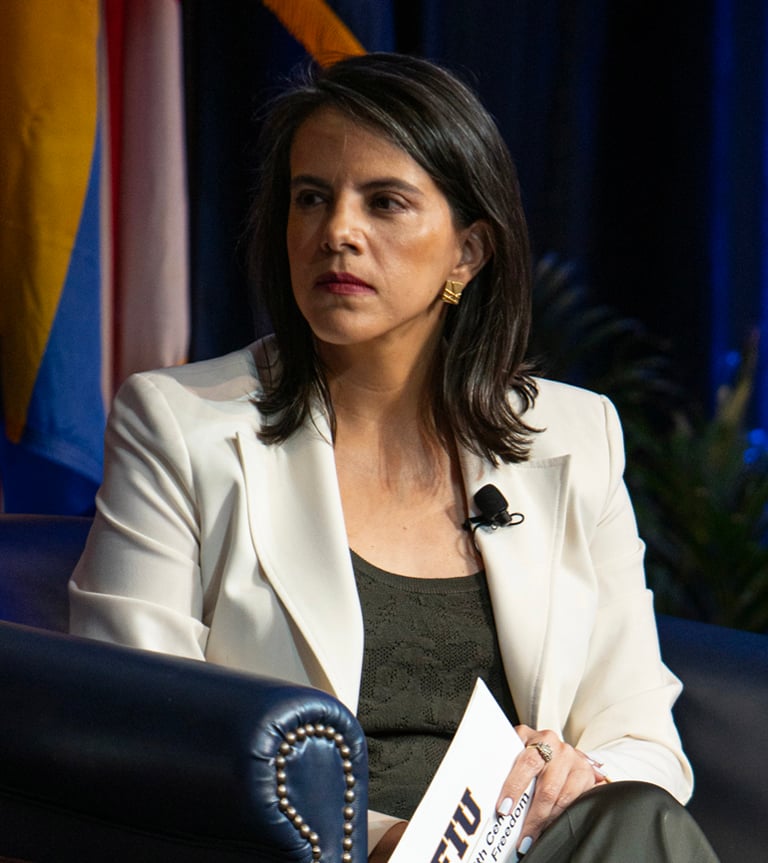


Panama’s National Border Service (SENAFRONT) Deputy Commissioner Maritza Censión is a trailblazer in her field. As the longest-serving female officer in SENAFRONT and the executive officer of the Panama East Third Brigade, she brings decades of experience to her role. This year, Deputy Commissioner Censión achieves another historic first, serving as chief of exercise PANAMAX Alpha — the first woman to hold this prestigious position.
Diálogo had the opportunity to speak with her about this significant achievement, the evolving nature of exercise PANAMAX Alpha, and the crucial role of international cooperation in protecting the Panama Canal.
Diálogo: What does it mean to be the first woman to lead an exercise such as PANAMAX Alpha?
Panama’s National Border Service Deputy Commissioner Maritza Censión, chief of PANAMAX Alpha 25: Being the first woman to lead such an important exercise in our country as PANAMAX Alpha is an honor that I accept with great pride. It’s a responsibility that I take on with the commitment, knowledge, and skills that I have acquired throughout my career, for which SENAFRONT has prepared us.
It’s important to emphasize that this is a step forward for the integration of women into the security forces and the public security forces of our country, where we women have the ability to hold strategic positions and perform strategic functions. This exercise is no exception, so I am proud to be here.
Diálogo: What are some of the new features of this iteration of PANAMAX Alpha?
Deputy Commissioner Censión: Exercise PANAMAX Alpha focuses on cooperation and interoperability between forces. The exercise carried out by our units with those of United States and the different forces with which we interact is important because it demonstrates their capabilities and skills. This interaction allows us to practice designs and prepare for a possible threat to our Panama Canal infrastructure.
Diálogo: The first PANAMAX Alpha was conducted in 2007. How has this exercise evolved over the years, and why does it remain critical to Panama’s security apparatus?
Deputy Commissioner Censión: This year, PANAMAX Alpha 25 has a more comprehensive approach in which, in addition to the simulations carried out with the different work teams and the Joint Task Force of Panama and the United States, we are conducting several training activities that include cyber defense, which is important for the security of the canal, as well as other training in the fight against common threats such as drug trafficking, common crime, and other exercises that we included. It is crucial to maintain this interaction, based above all on collaboration and coordination, which leads us to understand each other and put our procedures and processes into practice to be more effective in the face of a threat that affects the security of our canal.
Diálogo: How has your experience with SENAFRONT helped you prepare for this role?
Deputy Commissioner Censión: This exercise represents a series of qualities and characteristics that we must possess. However, in my 24 years of service, SENAFRONT has prepared me in different scenarios to be able to take on this responsibility.
Since I started, I have worked in operations in the border areas of Panama with Colombia and Panama with Costa Rica, where our leadership is put to the test as we command units, work with them, and live with them. This has given me the ability and confidence to get to know them and cooperate with each other to carry out different tasks in different places.
I have trained in different areas such as logistics and other types of master’s programs that help us strengthen that knowledge, backed by the experience we have gained in the administrative area, where our character is tested under the pressure of decision-making, facing problems, and solving them in a timely manner.
All these experiences have served to prepare me over the years and to await our commander’s assignment so that I can carry out this responsibility in PANAMAX Alpha 25.
We hope that this exercise will be one of the best and that it will open many doors for our women. This is yet another example for them to see the possibility of being able to achieve and command this type of exercise in their own time.
Diálogo: How, in your opinion, does an exercise like PANAMAX Alpha provide a sense of security to Panamanian citizens and an understanding of the importance of cooperation with the United States to protect the Panama Canal and respond to threats?
Deputy Commissioner Censión: The Panama Canal is a vital route for global trade and our country’s economy. Therefore, in the Panamanian forces, we prepare every day to face all challenges and threats to our infrastructure. That is why Panamanians must be aware that there is already a group of people preparing to defend our canal.
Diálogo: PANAMAX Alpha is held annually with the support of U.S. States Southern Command. How does this exercise contribute to strengthening cooperation and friendly ties between Panama’s security forces and their U.S. counterparts?
Deputy Commissioner Censión: Interaction with other international forces is very important. It allows us to maintain camaraderie, respect, and mutual trust, where communication is vital. Maintaining coordination with different countries is vital. Above all, it is a tool that helps us defend our canal and also prepares us to face any crisis that may affect our canal’s infrastructure.
Diálogo: Is there anything else you would like to add?
Deputy Commissioner Censión: It’s important to highlight that this entire initiative is aligned with the United Nations Security Council Resolution on Women, Peace, and Security, which promotes, above all, the participation of women in strategic decision-making positions. We are a fundamental pillar for organizations and, in this case, the fact that exercise PANAMAX Alpha is being commanded by a woman for the first time is of great importance for Panamanian women.