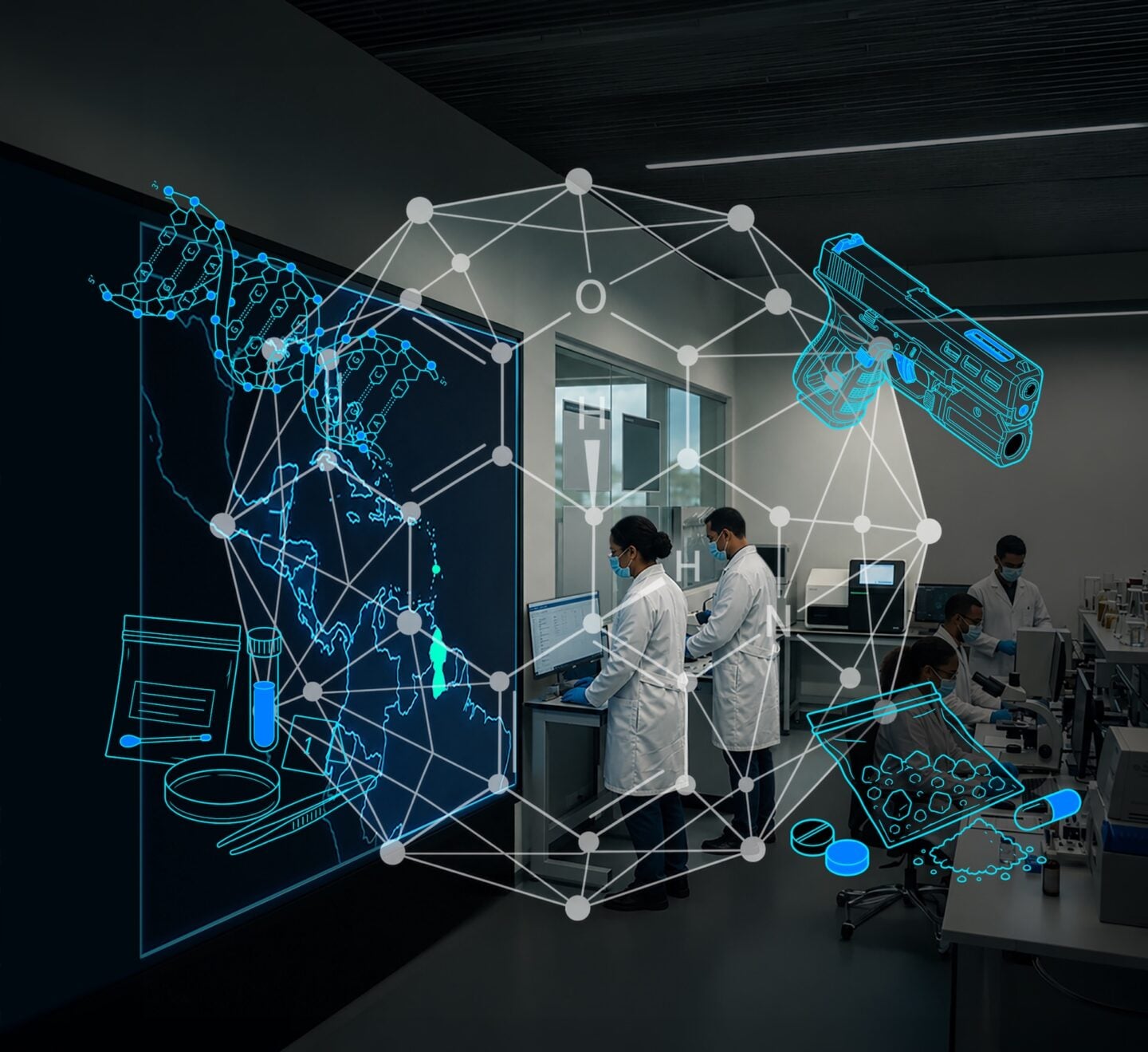

Seizing drugs or arresting suspects can disrupt criminal operations, but dismantling transnational criminal networks requires something more enduring: evidence that connects crimes, weapons, drugs, and suspects across jurisdictions. Increasingly, forensic science is providing those connections, turning isolated investigations into intelligence that supports coordinated operations and stronger prosecutions.
“Forensic science has become a strategic priority because it is a way to bring about drastic change,” Ghaleb Krame, a researcher and law enforcement expert at Anáhuac University in Mexico, told Diálogo.
Investing beyond technology
That shift was reflected during the Second Caribbean Regional Forensic Leadership Summit, held May 20-22 in Saint Lucia, where the United States announced more than $8 million to strengthen forensic laboratories across the Caribbean. This initiative will provide advanced equipment to improve detection of synthetic drugs, including fentanyl, expand technical training, reduce laboratory backlogs, strengthen collaboration with the DEA, and improve the production of court-admissible forensic evidence used in transnational organized crime prosecutions.
The summit brought together forensic, prosecution, and security officials from 13 Caribbean countries, along with representatives of the Regional Security System (RSS) and the Caribbean Community Implementation Agency for Crime and Security (CARICOM IMPACS). It also launched the Caribbean Forensic Scientific Working Group, the region’s first formal platform linking Caribbean forensic professionals with U.S. experts to improve standards, strengthen cooperation, and expand information sharing.
The initiative also builds on the Caribbean Basin Security Initiative (CBSI), through which the United States has partnered with Caribbean nations since 2010 to strengthen regional security, combat illicit trafficking, and build law enforcement and justice-sector capabilities. As part of that effort, Saint Lucia and Guyana became the first countries in the Caribbean to implement the DEA’s Global Uniform Analysis and Reporting of Drug-related Substances (GUARDS) program, strengthening regional capacity to identify and report emerging synthetic drugs using standardized analytical methods.
“The support isn’t just about equipment; it also includes training,” Krame said. “Investments like this $8 million aim to build capacity to collect and analyze evidence. Technologies such as those used for DNA analysis are costly, so pooling capabilities can have regional significance.”
Connecting evidence across borders
The value of forensic evidence extends well beyond solving individual crimes. Standardized forensic data can reveal links between cases investigated in different countries, helping authorities identify trafficking routes, shared weapons, and criminal networks operating across borders.
In June, the Royal Saint Vincent and the Grenadines Police Force formally accepted an IBIS BRASSTRAX ballistic imaging system and Bullet Catcher system from CARICOM IMPACS and the U.S. Department of State’s Bureau of International Narcotics and Law Enforcement Affairs (INL). The technology produces high-resolution three-dimensional images of cartridge cases and other ballistic evidence, enabling investigators to compare firearms evidence across jurisdictions more efficiently and identify potential links between violent crimes.
“Standardizing how we collect and share data on firearms empowers each participating territory. A breakthrough on one island can immediately help another resolve a case or prevent a violent crime,” said Barbados Defense Force Lieutenant Colonel Michael Jones, executive director of CARICOM IMPACS.
Krame said similar principles apply across multiple forensic disciplines.
“There are forensic signatures. If the same signatures appear in Mexico, Argentina, Haiti, or the Bahamas, there is a strong hypothesis that they may be the same organization, cartel, or even individual,” Krame said.
Such cooperation is particularly important as the Caribbean and the United States continue to prioritize disrupting illicit firearms trafficking, recognizing that criminal networks move weapons across borders faster than individual countries can investigate them independently.
From DNA to digital evidence
Ballistics is only one component of modern forensic investigations.
The Saint Lucia Forensic Science Laboratory, which received international accreditation in 2022 with support from the U.S Department of State, conducts DNA analysis, controlled-substance testing, crime scene investigations, firearms examinations, and evidence management. In 2023, it was designated a regional Center of Excellence for Forensic Science, reinforcing its role in supporting forensic capacity across the Caribbean.
“When information from drug analysis, DNA, ballistics, and digital evidence is integrated into an intelligence-led investigation, the difference is exponential. For the DEA, the CIA, and other agencies, decision-making is based on facts. And those facts come from the laboratories,” Krame said.
The digital domain has become equally important.
In Jamaica, the Major Organised Crime and Anti-Corruption Agency (MOCA) conducts forensic examinations of digital devices, recovers deleted or encrypted data, analyzes cyber evidence, and prepares expert testimony for court proceedings.
“International fraud leaves evidence that can be traced back to a single signature. The way a system’s vulnerability was exploited can link events that occurred, for example, in Argentina and Mexico,” Krame added.
Regional cooperation strengthens investigations
Forensic evidence becomes even more valuable when it is collected according to common standards and shared across borders.
In January, the United Nations Office on Drugs and Crime (UNODC) brought together Caribbean authorities in the Bahamas for training on firearms tracing, forensic ballistics, border detection, and the strategic use of information to combat illicit firearms trafficking.
In early June, CARICOM IMPACS, Trinidad and Tobago’s Ministry of Defence, and the INL convened a regional workshop to strengthen cross-border firearms investigations, improve intelligence sharing, and enhance prosecutors’ ability to build stronger criminal cases.
Emerging technologies continue to reshape those investigations.
“With the growing use of drones, investigators must determine which device was used, what explosives it may have carried, and how it was deployed. It’s a new field for forensic science,” Krame said.
He emphasized that sustaining these advances requires more than new equipment.
“Strengthening cooperation against organized crime requires the political will to act, invest, and fight it, as well as a cultural shift in law enforcement and prosecution to ensure there is no impunity. Only then can effective cooperation take place,” he concluded.
Strengthening forensic capabilities across the Caribbean is transforming how authorities confront transnational organized crime. Modern laboratories, shared standards, accredited forensic methods, and interoperable information systems enable investigators to connect evidence across jurisdictions, generate intelligence, and support stronger prosecutions. As criminal organizations continue to operate across borders and adopt new technologies, the ability to turn forensic evidence into actionable intelligence will become an increasingly important component of regional security and cooperation.