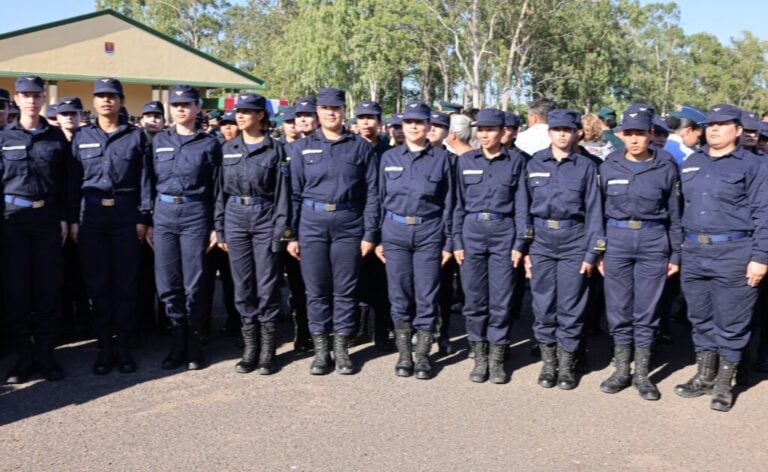

The Paraguayan Armed Forces took a huge step toward consolidating gender inclusion. For the first time, the Military Instruction Center for Students and Reserve Officers Training (CIMEFOR) admitted women to its courses. The women led the way in enrollments, with 1,045 out of a total of 1,920 applicants (54.43 percent). The official presentation of the troops took place on January 2, with relatives of applicants delivering the uniforms.
“Today we are beginning this important stage, which is a milestone for the Armed Forces; it’s something historic,” Paraguayan Army Colonel Ángel Baruja, CIMEFOR commander, said to Paraguayan radio station Universo 970 AM. “Article 46 of the National Constitution establishes that all inhabitants of the Republic of Paraguay are equal in dignity and rights. Discrimination is not allowed. So, the women will also do all training that the men receive.”
The course includes physical education, civics, first aid, weaponry, shooting, and basic combat instruction, Paraguayan daily Última Hora reported. At the end of the training, the students will graduate with the rank of second lieutenant or reserve midshipman, the Paraguayan Ministry of Defense indicated.
Greater women inclusion
“Paraguay has had women in uniform for several decades, although they have only been joining combat ranks since 2003,” Juan Belikow, defense expert and professor of International Relations at the University of Buenos Aires, told Diálogo. “The opening of CIMEFOR to women is another step along that path.”
Created in 1944, CIMEFOR has traditionally been exclusively for men. In November 2024, however, Paraguayan President Santiago Peña signed the authorization for the voluntary admission of women into the institution.
“The statistics weighed heavily, [including] the performance of women in the different military institutions such as the Academil [Francisco Solano López Military Academy],” Paraguayan Defense Minister Army General Óscar González said at a press conference. Gen. González recalled that, in the last three decades, 26 percent of women were in the top five Academil graduates. “Women can contribute a lot to the defense of the country,” Gen. González said, Paraguayan daily ABC reported.
According to Belikow, the fact that so many women have signed up as volunteers in this first CIMEFOR call was predictable. “Previous restrictions have made it so that many people who had been putting off volunteering in the past are now taking advantage of the opportunity that has opened to join. W. When the School of the Female Auxiliary Corps was created in the Argentine Army in 1981, there was also an avalanche of applicants. Over time, [the number of registrations] will tone down.”
Cyprus contingent
A woman is leading the Paraguayan military contingent that left for Cyprus in January on a peacekeeping mission. Navy Lieutenant Francisca Pérez Salinas is the commander of the contingent of 12 Paraguayan Armed Forces soldiers who will carry out their mission under the United Nations mandate, the Paraguayan Ministry of Defense indicated.
During the farewell ceremony, Gen. González said that the mission in Cyprus will be challenging, but that the military “will face every challenge with the professionalism” that characterizes his country’s Armed Forces,” Spanish news agency EFE reported.
Women, Peace, and Security
Gender inclusion in the Paraguayan Armed Forces reflects the country’s firm commitment to U.S. Southern Command’s (SOUTHCOM) Women, Peace, and Security (WPS) initiative. WPS is a policy framework that recognizes women as a critical component in efforts to achieve sustainable international peace and security.
The Inter-American Defense Board (IADB) highlighted Paraguay’s commitment to the WPS agenda during the 7th Joint Enlisted Leaders Symposium on Women, Peace, and Security 2024, which SOUTHCOM and the Peruvian Armed Forces’ Joint Command organized in Lima, Peru, August 6-9.
“Argentina, Brazil, Paraguay, and Mexico shared their knowledge, skills, and competencies acquired during the implementation and execution of their respective National Action Plans on Women, Peace, and Security, with the aim of providing useful lessons learned for countries that are still developing their National Action Plan,” the IADB said.