
Illegal, unreported, and unregulated (IUU) fishing has transcended mere environmental concerns to become a structural challenge that directly threatens the maritime security and national sovereignty of South American nations. The relentless expansion of the Chinese distant-water fishing fleet across the Pacific and South Atlantic has forced coastal states to step up their surveillance and response capabilities. This defense posture is increasingly reliant on international cooperation measures that prioritize the use of advanced technology, persistent monitoring, and regional coordination to counter what is now recognized as a strategic grey-zone threat.
According to a 2026 report from the U.S. House Select Committee on the Chinese Communist Party (CCP), China maintains the world’s largest distant-water fishing fleet, comprising approximately 16,000 vessels operating far beyond its jurisdictional waters. The report underscores a critical shift in understanding these operations: They are not merely driven by commercial interests but are aligned with broader strategic state objectives. This massive maritime presence exerts a significant impact on the exploitation of marine resources while simultaneously securing Chinese dominance over global supply chains and maritime corridors.
Furthermore, the document indicates that the CCP has integrated this fleet into a sophisticated dual-use strategy, assigning civilian vessels tasks such as oceanographic data collection and maintaining a constant presence in sensitive maritime areas. This model — sustained by state subsidies, logistical support, and global deployment — acts as a tool of maritime attrition. It makes it difficult for regional countries to exercise effective control over their own maritime spaces, as the sheer volume of the fleet overwhelms traditional naval monitoring.
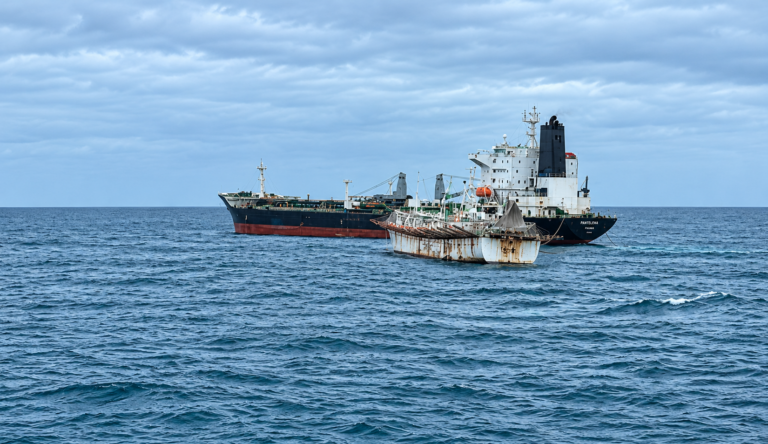
“The Chinese fleet, backed by a network of refrigerated ships, oil tankers, and support platforms, accumulates more than 110 million hours of operation annually in around 90 countries, often beyond the effective reach of maritime authorities,” Jorge Serrano, a security expert and member of the advisory team to the Peruvian Congress Intelligence Commission, noted.
Serrano stressed that the Chinese fleet strategically adjusts its operations ahead of diplomatic events and increases its activity in areas of interest such as the South China Sea and Antarctica. This suggests that the fleet serves as a vanguard for Beijing’s long-term geopolitical ambitions.
“The Chinese fishing fleet represents a direct pressure on regional maritime security and ecosystems,” Serrano added. However, he lamented that limited surveillance in vast ocean areas, and the lack of a coordinated regional legal framework have allowed IUU fishing practices to continue to proliferate, while China’s economic influence has slowed the imposition of more severe sanctions in the region.
Japanese technology: A response to predatory fishing
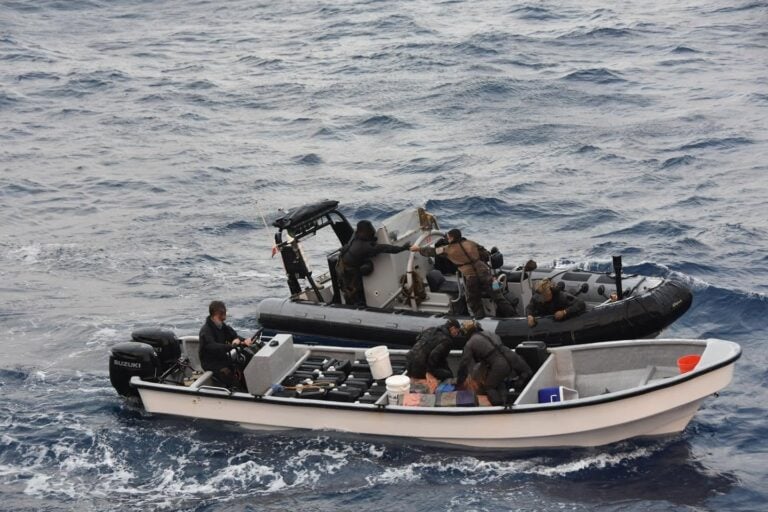
In a decisive move to counter the impact of IUU fishing and bolster regional sovereignty, Japan allocated $1.9 million in January 2026 to strengthen maritime surveillance in Argentina, Ecuador, Peru, and Uruguay. This support, channeled through the United Nations Office on Drugs and Crime (UNODC), is not merely financial but technical. It includes the provision of surveillance drones, inflatable patrol boats, and advanced image analysis systems designed to identify vessels, crews, and decode navigation patterns used to mask illicit activities.
The initiative responds to the permanent and often aggressive presence of Chinese fishing fleets in ecological and strategic hotspots, such as the waters surrounding the Galapagos Islands, the rich fishing grounds off Chile and Peru, and the maritime borders of Argentina and Uruguay. The recurrent use of dark vessels — ships that deliberately deactivate their Automatic Identification Systems (AIS) to evade detection — remains a primary obstacle. By providing tools that can see through this tactical blackout, Japan is helping South American nations in asserting their jurisdictional authority.
Milko Schvartzman, ocean policy coordinator for the Argentine environmental nongovernmental organization (NGO) Círculo de Políticas Ambientales, explained: “Maintaining a single patrol boat at sea is a significant burden, especially when hundreds of unregulated vessels operate within the boundaries of the Exclusive Economic Zone [EEZ].” Schvartzman highlighted that Japan’s contribution is critical for the region to bridge the gap in maintenance and supply resources that has traditionally hindered Latin America’s ability to effectively tackle IUU fishing.
In Argentina, the pressure from foreign fleets in the South Atlantic has reached unprecedented levels over the past decade. Statistics indicate that Argentine fishing effort in the so-called Mile 201, the EEZ limit, surged from 62,000 to 400,000 hours per 500 square kilometers between 2013 and 2023. This explosion in activity reflects a concerted effort to exhaust regional resources right at the doorstep of sovereign waters.
In response, the Argentine Naval Prefecture has stepped up its monitoring of more than 500 vessels scheduled for the squid season, recently identifying 148 vessels in transit, the vast majority flying the Chinese flag. These figures echo the 2017 incident in which Ecuador captured the Chinese vessel Fu Yuan Yu Leng 999 within the Galapagos marine reserve, discovering 6,623 sharks on board, a case that remains a symbol of the predatory nature of China’s distant-water operations.
U.S. cooperation in regional maritime control
The United States has also intensified its engagement in the fight against IUU fishing in South American waters, viewing it as a core component of regional stability. Through the U.S. Coast Guard, Washington has deployed cutting-edge cutters such as the USCGC Stone and the USCGC James to conduct joint operations with Argentina, Brazil, and Uruguay. These missions, part of the Southern Cross (Cruz del Sur) initiative, focus on coordinated patrols, real-time monitoring, and boarding exercises to build a unified front against maritime lawlessness.
Parallel to these patrols, the National Oceanic and Atmospheric Administration (NOAA) is collaborating with Colombia, Ecuador, and Peru to implement the Agreement on Port State Measures. This international treaty seeks to standardize information exchange on foreign vessels, making it harder for predatory fleets to find safe harbors for their illicit catches. This effort is critical for the management of species with high economic and environmental value, which are often the primary targets of the Chinese fleet.
U.S. Southern Command (SOUTHCOM) further supports this mission by collaborating with the NGO Global Fishing Watch. This partnership provides regional navies with real-time satellite data, allowing for the identification of illicit patterns and supporting rapid operational decisions. According to the U.S. Embassy in Peru, this intelligence-sharing has been key to improving regional interoperability in the fight against IUU fishing.
“An effective regional response requires the support of countries with advanced technological capabilities and room for maneuver in the face of Chinese economic influence,” Serrano said. He also pointed out that satellite observation systems have identified between 600 and 700 Chinese fishing vessels operating continuously off the South American coast, providing evidence of a permanent and large-scale presence that acts as a de facto occupation in international waters.
China’s global strategy for maritime dominance
The U.S. Congressional report concludes that Beijing has developed a comprehensive global strategy designed to neutralize operational and legal barriers. By utilizing an oversized fleet and requiring vessels to offload their catch at designated Chinese hubs, China channels massive volumes of catch to state-controlled processing centers, a process backed by an immense global logistics and financial network.
This model is built upon a foundation of heavy state subsidies and control of critical inputs, giving Beijing a sustained competitive advantage. This structural control allows China to influence and manipulate international prices, disrupt markets, and create dependencies within global food supply chains, effectively weaponizing the fishing industry.
Serrano warned: “Containing IUU fishing requires a sustained combination of technology, financial resources, and operational capacity.” Without these elements, he added, coastal states will continue to face difficulties in exercising maritime sovereignty against state actors with greater resources and a clear strategic intent.
In this regard, Serrano highlighted the urgent need for regional legal frameworks that mandate foreign fleets to keep their identification systems active at all times, noting that “the deliberate use of turned-off transponders limits the action of countries,” and serves as a primary tool for those seeking to operate in the shadows of international law.