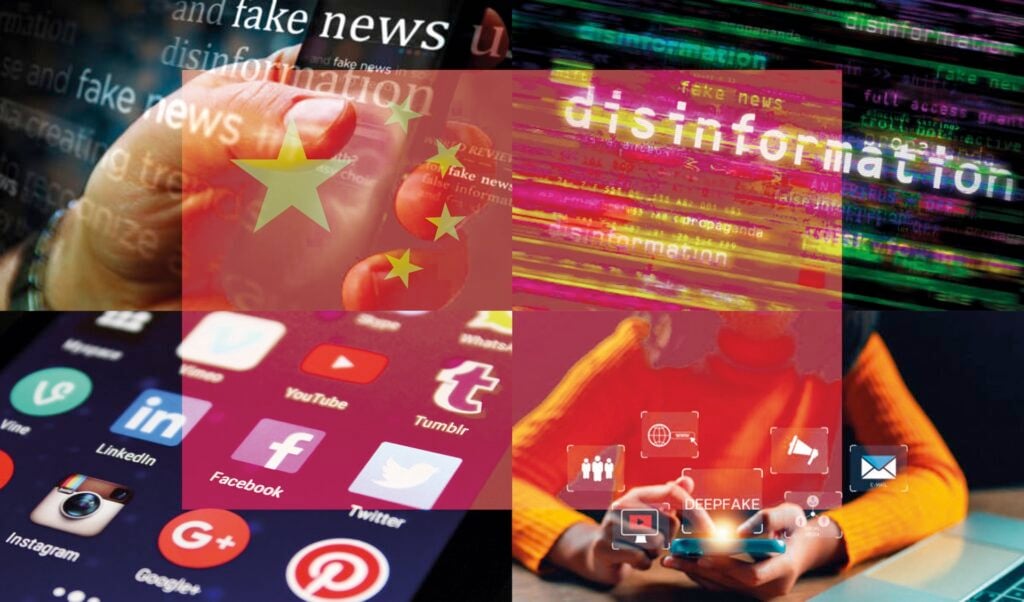

From the heart of Beijing to Latin American digital forums, China is coordinating sophisticated operations that combine advanced digital technology with strategic alliances among local elites. The objective is to shape public perceptions and political decisions across the region.
The Chinese Communist Party (CCP), through its information warfare structures, has deployed tactics such as astroturfing (the simulated display of popular support) and spamouflage (the creation of fake online profiles) to reinforce its state-aligned narratives, multiple international reports indicate.
Social division and emotional manipulation
The CCP has systematically exploited internal social and electoral divisions in countries globally. According to U.S. research corporation RAND, China exploits internal tensions to “divide and demoralize the Taiwanese population.” Similarly, the Australian Strategic Policy Institute (ASPI) identified spamouflage networks aimed at amplifying extremist voices and undermining confidence in Australian politics.
These sophisticated operations extend beyond the simple dissemination of information. They seek to alter emotions and perceptions to influence individual decisions and destabilize societies. As highlighted by the European Journal of International Law, this phenomenon goes far beyond the scope of traditional propaganda.
The scale of these operations is a significant concern for the international community. In its 2024 annual report, the U.S. Office of the Director of National Intelligence (ODNI) warned of “malign influence operations” driven by China through fake social media profiles, designed to influence presidential elections. Beijing is also actively experimenting with generative artificial intelligence (AI) tools to refine and scale these deception tactics.
According to the Atlantic Council think tank, China “considers information a strategic resource for sustaining its regime,” integrating its dissemination operations into a broader framework of economic, political, technological, and social influence. Control of information has become a key instrument for expanding Beijing’s global power and promoting international acceptance of the CCP’s vision of the world order.
Astroturfing: Manufacturing consensus on social media
Today’s astroturfing has evolved into a highly coordinated digital machine. It utilizes bots and fake accounts, often powered by AI, to mimic human interactions and simulate consensus on platforms such as X, Facebook, and Instagram. Applications such as Telegram and WeChat also serve as coordination centers for these activities.
The phenomenon is actively expanding into major markets like Brazil, where Chinese applications such as Kwai and WeChat have gained ground among media outlets, institutions, and content creators. A report by Entorno Diario in Ecuador indicated that Kwai has been used to manipulate the visibility of publications and selectively promote certain topics, posing a tangible risk of influencing public discourse.
“China uses these tactics as part of its ‘sharp power’ strategy, taking advantage of the freedoms of Latin American democracies,” Vladimir Rouvinski, an academic at the Center for Interdisciplinary Studies at Icesi University in Colombia, told Diálogo. “These operations can expand discreetly to influence public opinion and local political processes.”
Time magazine reported in 2023 that accounts such as “Hoy Chile,” “Hoy Costa Rica,” and “Hoy Paraguay” were spreading content in Spanish aligned with Beijing’s interests. This campaign used astroturfing techniques to simulate popular support through automation, thereby manufacturing the illusion of social consensus. This content strategically mixes cultural and political messages, positioning China’s model of “democracy with Chinese characteristics,” Entorno Diario reported.
The Citizen Lab at the University of Toronto warns that astroturfing “goes beyond disinformation: It fabricates false consensus and distorts public debate.” By silencing dissent and amplifying pre-approved agendas, these operations erode digital democracy and allow narratives to be imposed under the guise of citizen support.
Rouvinski acknowledges that “operations such as astroturfing and spamouflage are difficult to detect and even more difficult to neutralize. Although there are greater capabilities to identify inauthentic networks, responding effectively remains a technical and political challenge.” He adds that these tactics may intensify “in scenarios where China perceives risks to the positioning it has achieved in the region.”
Spamouflage: The engineering of digital propaganda
While Russia pioneered the use of troll farms to manipulate digital discourse, China has adapted and refined these tactics to spread state narratives and censor criticism. Both powers now employ AI to fabricate deepfake videos and posts that distort reality.
The spamouflage propaganda network, initially identified in 2019 by social network analysis company Graphika, has perfected its methods to evade detection and amplify its reach. It operates by mixing political content with cultural posts and uses fake or hijacked accounts to gain credibility. Its decentralized operation, with multiple groups replicating similar content, makes it difficult to eradicate and allows it to saturate strategic audiences, Graphika indicated.
In 2023, the Foundation for Defense of Democracies reported that Meta removed more than 7,700 accounts and 954 Facebook pages linked to spamouflage, describing it as “the largest multi-platform influence operation detected to date.” However, the network remains active and is continuously evolving. As recently as May 2025, Meta disrupted new, smaller Chinese-origin influence networks that had already integrated the use of AI-generated personas to target audiences in regions like Taiwan and Japan, confirming that Beijing is rapidly refining its deceptive tactics to evade detection and increase credibility.
Freedom House documented that countries like Ecuador, during elections and periods of polarization, have been the scene of coordinated operations involving fake accounts and bot networks, highlighting the vulnerability of the local information space. Rouvinski warns that sensitive electoral contexts, such as those in Honduras or Colombia, are particularly susceptible, and that “Beijing has closely followed the friction between the Gustavo Petro government and several countries, evaluating scenarios that could favor its interests.”
“Through disinformation campaigns, astroturfing, and other tactics, China could sway public perceptions and decisions toward narratives that support its political positioning in the region,” Rouvinski added.
The Citizen Lab also documents the use of fake websites that appear to be regional media outlets to insert messages aligned with Beijing’s interests, a tactic consistent with the practices of spamouflage.
AI: The new frontier of manipulation
Digital manipulation has entered a new era driven by AI. RAND describes the evolution of bots from simple repeaters to manipulation 3.0, where AI increases the credibility of the fake personas and dangerously blurs the lines between reality and fiction.
Rouvinski warns that “we still need to understand the magnitude and variety of tools used by China to advance its interests in Latin America.” According to him, Latin American countries lack the institutional and technological preparedness to deal with these threats, as when China decides to act, it does so quickly and effectively.
For Rouvinski, governments will need to invest resources in capabilities that enable them to detect and mitigate these types of operations. “The only way to reduce the impact is to raise public awareness of these strategies and strengthen information resilience in democracies.”